

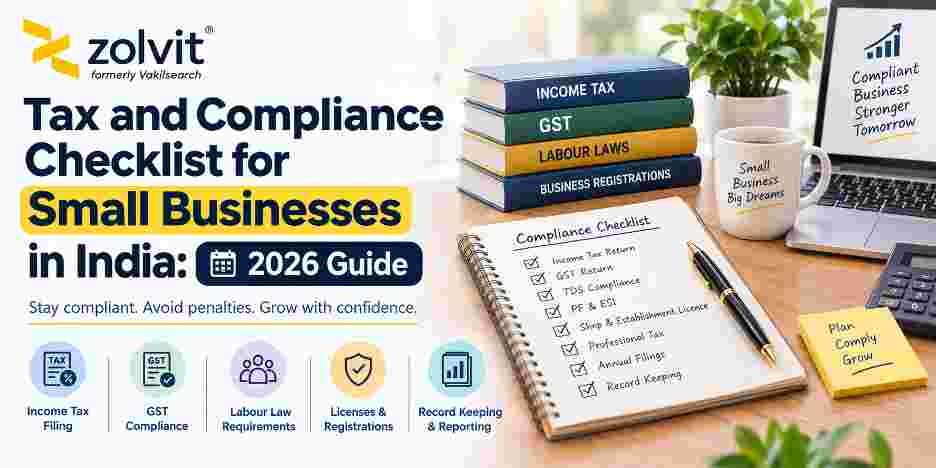

Most small business owners worry about GST notices, TDS mismatches, or missed MCA filings. A clear tax and compliance checklist helps keep registrations, filings, payments, and records on track. For businesses considering GST Registration, keeping track of requirements early can make compliance easier.
This is particularly important in 2026 as the Income Tax Act, 2025 applies from 1 April 2026, while FY 2025–26 returns continue under the earlier regime. For a new business, sole proprietorship registration online may also form part of the initial setup.
Whether you own a proprietorship, partnership firm, LLP, or private limited company, here is your checklist of registrations, filings, payments, and record-keeping, including GST Registration and sole proprietorship registration online where applicable.
Table of Contents
What Is a Tax and Compliance Checklist for Small Businesses in India?
A tax and compliance checklist is a list of all registrations, returns, taxes to be paid, and documents that a small business needs to file as per Indian tax and corporate law, including the deadlines for each.
It generally includes the following five aspects:
- Tax compliance: GST, income tax, advance tax, TDS and TCS.
- Corporate compliance: ROC and MCA filings for companies and LLPs.
- Labour compliance: PF, ESI and professional tax.
- Licences and registrations: Udyam, Shops and Establishment, FSSAI, IEC and others.
- Record keeping: books of accounts, invoices and returns, kept for the required period.
Think of it as a working dashboard for your business’s tax and compliance obligations.
Did You Know? Under the Income-tax Act, a business that misses its return due date can lose the right to carry forward certain losses. A late return can cost you more than the late fee.
Why Tax and Compliance Matter for Small Businesses
It allows you to safeguard your right to eligible input tax credits, keeps your books clean for lenders and investors, and helps you avoid unnecessary penalties, interest, and notices. Here’s what you get from compliance:
- Lower costs. Late fees and interest add up quickly, and most of them are avoidable.
- Smooth funding. Banks, NBFCs, and investors check your GST returns, ITRs, and ROC filings.
- Protected input tax credit. Your buyers can claim credit only when you file on time.
- Fewer notices. Clean, consistent filings attract less scrutiny.
- Better business decisions. Updated books show your real profit.
Compliance Requirements by Business Structure
The compliance load depends on how your business is structured. A sole proprietor has the lightest load, while a private limited company has the heaviest.
| Business Structure | Key Registrations | Main Annual Filings |
| Sole proprietorship | PAN of the owner, GST (if applicable), Udyam, local licences | ITR of the proprietor (ITR-3 or ITR-4), GST returns |
| Partnership firm | Firm PAN, partnership deed, GST (if applicable), Udyam | ITR-5, GST returns, tax audit if limits are crossed |
| LLP | LLP incorporation, PAN, TAN, GST (if applicable) | Form 11, Form 8, ITR-5, DIN KYC for designated partners |
| One Person Company | Incorporation, PAN, TAN, bank account | AOC-4, MGT-7A, ITR-6, auditor appointment |
| Private Limited Company | Incorporation, PAN, TAN, GST, Udyam | AOC-4, MGT-7 or MGT-7A, ITR-6, ADT-1, board meetings and statutory registers |
Choosing the right structure early saves compliance costs later. If you are unsure, an expert can compare options based on your turnover and growth plans.
Once the broad compliance areas are clear, the next step is to identify the registrations that apply before regular filing begins.
Registrations and Licences Checklist
Before tracking returns and payments, make sure the business has the registrations and licences that apply to it. The exact list depends on your structure, activity, location and employees.
- PAN for the business or proprietor.
- Business bank account in the business’s name.
- GST registration, mandatory once your turnover crosses the threshold (see the next section).
- Udyam (MSME) registration, free and done online.
- TAN, required if you deduct TDS or collect TCS.
- Shops and Establishment registration under your state law.
- Professional tax registration, where your state levies it.
- Trade licence from the local municipal body, where applicable.
- FSSAI licence for food businesses.
- Import Export Code (IEC) for importers and exporters.
- PF and ESI registration, once you cross the employee limits.
- Trademark registration to protect your brand name and logo.
After registration, GST is usually one of the most frequent compliance areas for a growing business, so it helps to separate registration, scheme selection, and recurring filings.
GST Compliance Checklist
GST compliance covers registration where applicable, correct tax invoices, timely GSTR-1 and GSTR-3B filing, input tax credit reconciliation, and the annual return where applicable. The exact return set depends on the scheme and filing frequency.
Do You Need GST Registration?
| Type of Supplier | Registration Threshold (Aggregate Annual Turnover) |
| Suppliers of goods | ₹40 lakh (₹20 lakh in some states) |
| Suppliers of services | ₹20 lakh (₹10 lakh in special category states) |
| Casual and non-resident taxable persons | Mandatory from day one |
The threshold depends on the nature of supply and the applicable state rules. Check the current GST provisions for your state and the type of supply before relying on a turnover threshold.
Choose the Right GST Scheme
| Scheme | Who Can Use It | What You File |
| Regular scheme | Any registered business | GSTR-1 and GSTR-3B, with input tax credit available |
| QRMP scheme | Turnover up to ₹5 crore | Quarterly returns with monthly tax payment |
| Composition scheme | Small traders and manufacturers (turnover up to ₹1.5 crore) and eligible service providers (up to ₹50 lakh) | Quarterly CMP-08 and annual GSTR-4, no input tax credit |
GST Return Due Dates
- Monthly filers: GSTR-1 is due on the 11th, GSTR-3B on the 20th, and composition taxpayers file CMP-08 by the 18th of the month after each quarter.
- QRMP filers: Quarterly GSTR-1 is due on the 13th after the quarter ends, and quarterly GSTR-3B falls on the 22nd or 24th, depending on your state’s category. Monthly tax payment goes through PMT-06 by the 25th.
- Annual return: GSTR-9 and GSTR-9C for FY 2025-26 are due on 31 December 2026.
- E-invoicing: Businesses with turnover above ₹5 crore face mandatory e-invoicing and file monthly returns.
Monthly GST Checklist
- Issue tax invoices with correct GSTIN, HSN or SAC code, and tax rate.
- Reconcile purchases with GSTR-2B before claiming input tax credit.
- File GSTR-1 and GSTR-3B on time, even for nil-turnover months.
- Pay tax liability through the electronic cash or credit ledger.
- Generate e-way bills for goods movement above the prescribed value.
- Correct errors through amendments and GSTR-1A where permitted.
Latest News: The GST Council’s 56th meeting simplified the rate structure from 22 September 2025, moving most goods and services into 5% and 18% slabs, with a 40% rate for a small set of sin and luxury items. Check the rate on every product or service you sell, because old invoice templates may still carry outdated rates.
GST is only one part of the picture. Income-tax compliance runs alongside it and depends on your business structure, income, and applicable tax provisions.
Income Tax Compliance Checklist
Income tax compliance for a small business means paying advance tax, maintaining books, getting a tax audit if limits are crossed, and filing the correct ITR before the due date.
Know Which Act Applies
Returns relating to FY 2025–26 continue under the Income-tax Act, 1961 framework, while income arising from 1 April 2026 onwards is covered by the Income Tax Act, 2025. The new law uses tax year terminology and introduces new section and form references, so avoid mixing the two frameworks when preparing filings.
Where the old tax regime is being opted for in cases where Form 10-IEA is applicable, the form must be filed within the prescribed timeline. The applicable form and procedure should be checked for the relevant tax year.
Presumptive Taxation and Tax Audit Limits
| Provision | Who It Covers | Turnover or Receipts Limit |
| Section 44AD | Small businesses (not professionals) | ₹2 crore (₹3 crore if cash receipts are 5% or less) |
| Section 44ADA | Specified professionals | ₹50 lakh (₹75 lakh if cash receipts are 5% or less) |
| Tax audit, Section 44AB (business) | Businesses | Above ₹1 crore (₹10 crore if cash transactions are 5% or less) |
| Tax audit, Section 44AB (profession) | Professionals | Above ₹50 lakh |
Advance Tax Dates
Advance tax applies when your estimated tax liability for the year crosses ₹10,000. The instalments fall on 15 June, 15 September, 15 December and 15 March, while presumptive taxpayers can pay the entire amount in one instalment by 15 March.
ITR Due Dates for FY 2025-26
| Taxpayer | Due Date |
| Salaried individuals filing ITR-1 or ITR-2 | 31 July |
| Business or professional income, no audit | 31 August 2026 |
| Business or professional income, audit required | 31 October 2026 |
| Belated return (late filing) | 31 December 2026 |
The tax audit report itself is due by 30 September, before the audited return is filed.
Income Tax Checklist
- Maintain proper books and bank reconciliations all year.
- Estimate profit and pay advance tax on schedule.
- Check whether a tax audit applies once turnover nears the limit.
- Choose between the new and old tax regimes with your CA.
- Pick the right ITR form (ITR-3 or ITR-4 for proprietors, ITR-5 for firms and LLPs, ITR-6 for companies).
- Verify the return through e-verification within the allowed time.
- Respond to notices on the Income Tax portal promptly.
Income-tax compliance also extends to payments made to employees, contractors, professionals, and other parties. This is where TDS and payroll obligations come in.
TDS, TCS and Payroll Compliance Checklist
If you pay salaries, rent, contractors, professional fees, or commission above prescribed limits, you may have to deduct TDS, deposit it on time, and file quarterly returns.
TDS Due Dates
- Deposit: TDS is deposited by the 7th of the following month, except for March deductions, which are due by 30 April.
- Quarterly returns: The returns for FY 2026-27 are due on 31 July 2026, 31 October 2026, 31 January 2027 and 31 May 2027.
- Form changes: From 1 April 2026, TDS reporting forms have been renumbered under the Income Tax Act, 2025. For example, the new Form 138 corresponds to the earlier Form 24Q, while Form 140 corresponds to the earlier Form 26Q. Check that your payroll or accounting software uses the applicable 2026 forms.
Payroll Checklist
| Requirement | Applies When | Due Date |
| Provident Fund (PF) | Establishment with 20 or more employees | 15th of the next month |
| ESI | 10 or more employees, with wages up to ₹21,000 a month | 15th of the next month |
| Professional tax | Employees in states that levy it | As per the state |
| TDS on salary | Salary above the exemption limit | 7th of the next month |
| Form 16 and Form 16A | After the TDS return | As per the TDS rules |
- Deduct TDS at the right rate and section.
- Deposit TDS before the 7th.
- File the quarterly return and issue TDS certificates.
- Match your records with Form 26AS or the Annual Information Statement.
- Keep PF and ESI contributions current, as default can invite penalties and damages.
For companies and LLPs, tax filings are only one layer of compliance. MCA and ROC filings continue alongside them.
ROC and MCA Compliance Checklist (Companies and LLPs)
Companies and LLPs have recurring MCA filing obligations, and the applicable annual filings generally continue even when there is little or no business activity.
| Form | Applies To | Due Date |
| AOC-4 (financial statements) | All companies | 30 October 2026 for FY 2025-26 |
| MGT-7 / MGT-7A (annual return) | All companies (MGT-7A for OPCs and small companies) | 29 November 2026 for FY 2025-26 |
| ADT-1 (auditor appointment) | Companies | Within 15 days of the AGM |
| LLP Form 11 | LLPs | 30 May 2026 for FY 2025-26 |
| LLP Form 8 | LLPs | 30 October 2026 for FY 2025-26 |
| DIR-3 KYC / DIR-3 KYC Web | Directors holding DIN, as applicable | Generally due by 30 September of the following financial year; check the MCA filing requirement for the relevant year |
Penalty alert: Delayed MCA filings can attract additional fees, including the prescribed additional fee for specified annual filing forms. Because MCA filing rules, forms and relief measures can change, confirm the applicable fee and due date on the MCA portal before filing.
ROC Checklist
- Hold at least four board meetings in a year with proper gaps between them.
- Conduct the AGM within the permitted timeline.
- Get your accounts audited and appoint or reappoint the auditor.
- File AOC-4 and MGT-7 or MGT-7A.
- Update statutory registers and director KYC.
- File event-based forms promptly (change of directors, address, share capital).
Businesses registered as, or dealing with, MSMEs also need to keep supplier-payment and reporting obligations in view.
MSME Compliance Checklist
MSME compliance covers Udyam registration where applicable, timely payment to micro and small enterprise suppliers, and half-yearly reporting of specified outstanding payments by covered companies.
- Register on Udyam. Udyam Registration is free, paperless, and online. It provides a permanent Udyam Registration Number and certificate, subject to the applicable MSME classification rules.
- Pay micro and small suppliers on time. The law sets a limit of 45 days, or 15 days where there is no written agreement.
- Watch Section 43B(h) of the Income-tax Act. Payments to micro and small enterprise suppliers are deductible only when actually paid within the legal time limit.
- File Form MSME-1 if you are a company with dues. It is filed half-yearly, and the report for April to September 2026 is due on 31 October 2026.
- Update your Udyam details when turnover or investment changes.
Many small businesses miss Section 43B(h) because they treat supplier payments as a cash-flow matter. It is also a tax issue.
With the individual requirements mapped out, the easiest way to manage them is to bring the recurring dates into one calendar.
Annual Tax and Compliance Calendar
A compliance calendar turns a long list of laws into a simple routine. Here is a quick view of what to track.
| Frequency | Compliance | Typical Due Date |
| Monthly | TDS deposit | 7th |
| Monthly | GSTR-1 (monthly filers) | 11th |
| Monthly | PF and ESI | 15th |
| Monthly | GSTR-3B (monthly filers) | 20th |
| Quarterly | GSTR-1 (QRMP) | 13th after quarter-end |
| Quarterly | CMP-08 (composition) | 18th after quarter-end |
| Quarterly | GSTR-3B (QRMP) | 22nd or 24th after quarter-end |
| Quarterly | TDS returns | 31 July, 31 October, 31 January, 31 May |
| Quarterly | Advance tax | 15 June, 15 September, 15 December, 15 March |
| Half-yearly | MSME-1 | 31 October and 30 April |
| Annual | GSTR-4 (composition) | 30 April |
| Annual | Tax audit report | 30 September |
| Annual | ITR (non-audit / audit) | 31 August / 31 October |
| Annual | GSTR-9 and GSTR-9C | 31 December |
| Annual | AOC-4 and MGT-7 | Around 30 October and 29 November (AGM-linked) |
Dates can be extended by notification for a given period, so always check the official portal before the due date.
A calendar matters because missed deadlines can create more than administrative work. The financial consequences vary by the type of default.
Penalties for Non-Compliance
Penalties for missed compliance can be small per day but large over time. Interest also keeps running until you pay.
| Default | Typical Consequence |
| Late GST return | Late fee of ₹50 a day (₹20 for nil returns), subject to a cap, plus 18% annual interest on unpaid tax |
| Late ITR | Late fee under Section 234F of ₹5,000 (₹1,000 if income is up to ₹5 lakh) |
| Advance tax shortfall | Interest of 1% per month on the shortfall |
| Late TDS deposit | Interest at 1.5% per month, plus possible disallowance of the expense |
| Late TDS return | Late fee of ₹200 a day, up to the TDS amount |
| Late ROC filing | ₹100 per day with no cap |
| DIR-3 KYC default | DIN is deactivated and reactivation costs ₹5,000 |
The new Income Tax Act, 2025 renumbers many of these provisions for tax years from 2026-27. Your CA can confirm the exact section.
Beyond filing on time, keeping the supporting records in order makes it easier to reconcile figures and respond if a department asks for clarification.
Records and Documents to Maintain
Good records are your best defence in any notice, audit or loan review.
- Books of accounts: cash book, ledger, journal, and stock register where relevant.
- Sales and purchase invoices, with credit and debit notes.
- Bank statements and reconciliation reports.
- GST returns, challans, e-way bills and e-invoice records.
- Income tax returns, advance tax challans and TDS certificates.
- Payroll records: salary registers, PF and ESI challans, appointment letters.
- ROC filings, board minutes and statutory registers for companies and LLPs.
- Contracts and agreements with customers, vendors and landlords.
- Licences and registration certificates, with renewal dates noted.
Keep books and supporting records for the period required under the applicable tax, GST, company law and other record-retention rules. Where a notice, assessment, audit or litigation is pending, retain the relevant records until the matter is resolved. Your CA can confirm the exact retention period for your situation.
Even businesses that know their deadlines can slip up during busy periods. These are some of the mistakes worth checking for before each filing cycle.
Common Mistakes to Avoid
- Treating nil returns as optional. GST and ROC returns are due even without sales.
- Claiming input tax credit without reconciliation. Mismatches with GSTR-2B invite notices.
- Mixing personal and business expenses. It muddies your books and weakens deductions.
- Missing advance tax, then paying interest at the year-end.
- Ignoring the tax audit limit when turnover grows near the threshold.
- Paying MSME suppliers late and losing the tax deduction under Section 43B(h).
- Using old GST rates or forms after rate and law changes.
- Skipping MCA filings for an inactive company.
- Relying on a single person or spreadsheet, with no backup or review.
Conclusion
Compliance feels like a burden when deadlines for each task are spread across many places. Bring order to the process with monthly GST, TDS, and payroll compliance, advance-tax and return checking, and annual income-tax and ROC filings.
Get your registration done correctly, maintain clean books, reconcile prior to filing, and follow all deadlines. For businesses starting out, sole proprietorship registration online can also make the initial registration process easier to manage.
If you prefer attending to customers rather than dates, consult Zolvit’s legal and compliance experts for a clear plan for your business.
Why Choose Zolvit?
- Expert lawyers for notices, contracts and regulatory matters.
- CA support for GST, income tax, TDS and bookkeeping.
- Company Secretaries for ROC, MCA and secretarial compliance.
- Fast processing of registrations, returns, and filings.
- Affordable pricing with clear quotes before you begin.
- End-to-end compliance from registration to annual filings.
- Dedicated support from people who know your business.
CTA
Ready to put your compliance on autopilot?
Talk to Zolvit’s CAs, Company Secretaries and lawyers today.
Get a personalised compliance checklist, expert filing support and reminders before every deadline.
Frequently Asked Questions (FAQs)
What is a tax and compliance checklist for small businesses?
A tax and compliance checklist is a structured list of every registration, return, payment, and record a small business must handle under tax and corporate laws. It covers GST, income tax, TDS, ROC filings, licences and payroll laws, along with due dates, so owners avoid penalties and notices.
Is GST registration mandatory for every small business?
No. GST registration is mandatory only when aggregate turnover crosses ₹40 lakh for goods or ₹20 lakh for services, with lower limits in some states. Certain categories, such as casual and non-resident taxable persons, must register regardless of turnover. Always check your state’s limit first.
Can a small business skip filing GST returns if there were no sales?
A registered business must file GST returns even for a nil-turnover period. Nil returns can be filed quickly, often through SMS or the portal, and avoid late fees. Skipping them leads to penalties, blocked e-way bills, and possible cancellation of registration after continued non-filing.
Should a small business file an income tax return even if profits are low?
YES. Filing is mandatory if income exceeds the basic exemption limit, or if you cross specified thresholds, such as business turnover above ₹60 lakh or professional receipts above ₹10 lakh. Even when it is optional, filing helps with loans, visas, refunds, and carrying forward business losses.
What are the ITR due dates for small businesses?
For FY 2025-26, non-audit business and professional income returns are due on 31 August 2026, while tax audit cases are due on 31 October 2026. Individuals with salary or simple income file by 31 July. Missing the date invites a late fee and interest and may restrict loss carry-forward.