

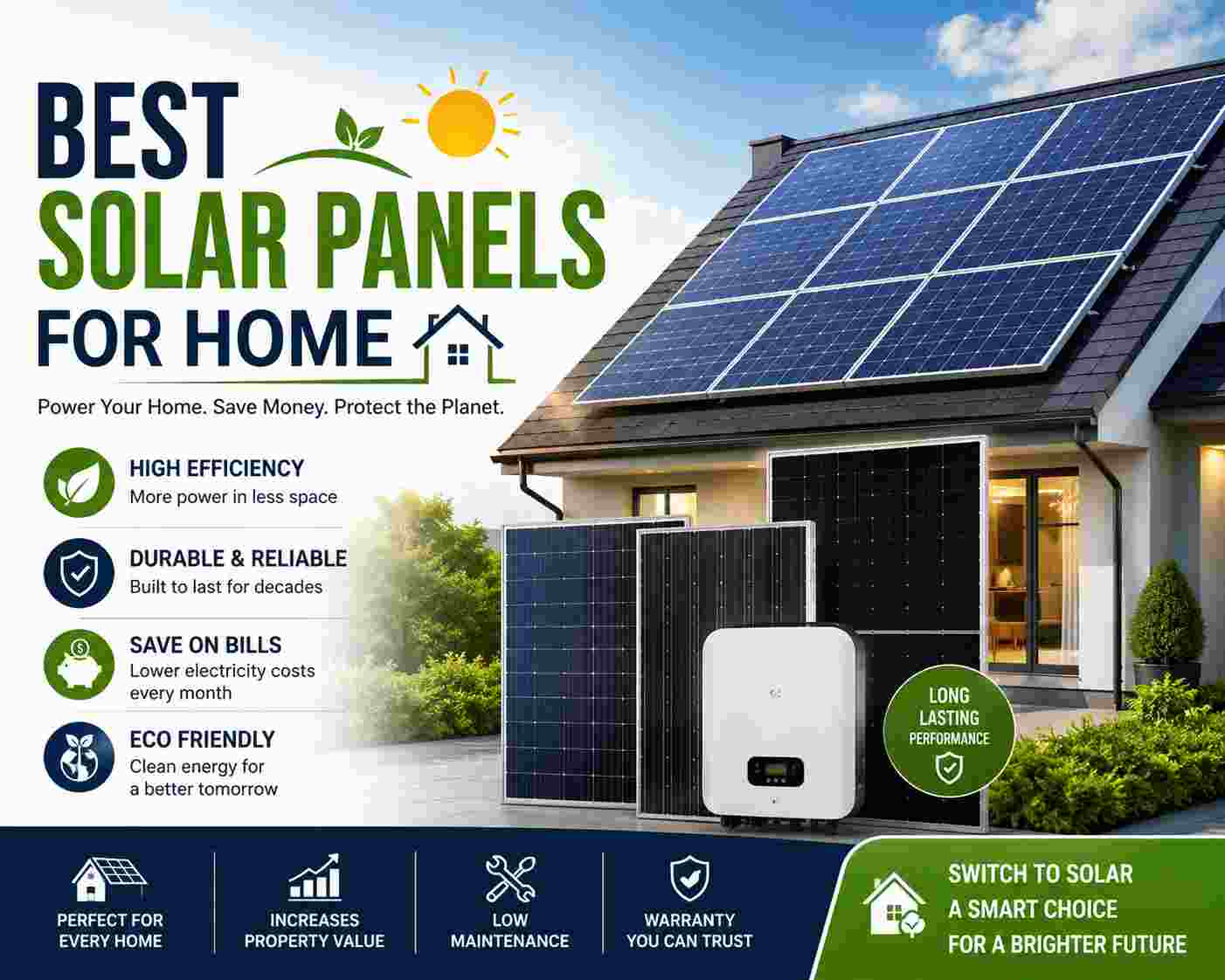
Best Solar Panels for Home
If your electricity bill made you wince this month, you’re not alone. Families across India are watching power costs go up year after year, and more of them are quietly doing the math on solar. Not because it sounds cool. Because it actually makes financial sense now in a way it didn’t five years ago.
But most people don’t know where to start. Which solar panels should they buy? How big a system do they need? Is the subsidy real or just paperwork? This piece answers all of that without the sales talk.
Table of Contents
Why Right Now Is Actually a Good Time to Go Solar
Solar panel prices have fallen sharply over the last decade — drops of over 80% in some categories. That alone changes the whole conversation.
The PM Surya Ghar Muft Bijli Yojana scheme offers direct subsidies to residential customers. For a 2 kW rooftop solar system, you could get up to ₹78,000 back. That’s real money off the total cost, not a promise buried in fine print.
Net metering is another thing working in homeowners’ favour. Most states now let you push extra solar energy back into the grid during the day and pull from it in the evening. Your meter essentially runs backwards when you’re producing more than you use. Your home solar system doesn’t just save money — it earns credits against your bill.
And India gets serious sunlight. A rooftop solar setup in Rajasthan, Gujarat, or Maharashtra produces significantly more energy per panel than the same system in Germany or the UK, where solar has been mainstream for years.
The Three Types of Solar Panels — And Which One Fits Your Home
Walk into any solar showroom and they’ll throw these names at you. Here’s what they actually mean:
Monocrystalline Solar Panels
Cut from a single silicon crystal, these are the most efficient of the three. They convert between 18% and 23% of sunlight into usable electricity — more power from less roof space.
If your terrace is limited, monocrystalline solar panels are worth the extra cost. They also hold up better on cloudy days and during cooler winter months when sunlight is weaker.
Polycrystalline Solar Panels
Made by melting multiple silicon pieces together. Less efficient at 15% to 17%, but cheaper. If solar panel price is your main concern and you have plenty of roof space, polycrystalline panels get the job done without stretching the budget.
These are the blue-tinted panels you’ll spot on rooftops across Indian cities. Widely installed, well-supported, and dependable.
Thin-Film Solar Panels
Lightweight and bendable, but the least efficient of the three. You’ll see it more on commercial buildings or industrial sheds where roof load is a concern. For a typical home, skip it.
How Big a System Does Your Home Actually Need?
This is where people either get it right or end up with a system too small to matter — or too big to ever pay off.
Pull out your last six electricity bills. Add the units consumed and divide by six. That gives you your average monthly usage. Now use this as a rough guide:
- A 1 kW home solar system produces around 4 to 5 units per day under Indian conditions
- If you use 200 to 300 units a month, a 2 to 3 kW system is usually the right fit
- If you’re at 400 to 600 units a month, you’re looking at a 4 to 6 kW system
South-facing roofs get the most sun exposure. If you’re planning to add an AC or buy an electric vehicle in the next year or two, size the system for that now. Expanding later costs more than getting it right the first time.
Solar Panel Price in India: Real Numbers, Not Estimates
A lot of websites give vague ranges. Here’s what a fully installed rooftop solar system actually costs right now, including the inverter, mounting structure, wiring, and labour:
- 1 kW system: ₹60,000 to ₹80,000
- 2 kW system: ₹1.2 lakh to ₹1.6 lakh
- 3 kW system: ₹1.7 lakh to ₹2.2 lakh
- 5 kW system: ₹2.8 lakh to ₹3.5 lakh
- 10 kW system: ₹5 lakh to ₹6.5 lakh
After government subsidies, the solar panel price you actually pay can drop quite a bit. For most households, the payback period sits between 4 and 7 years. After that, the solar energy your system generates costs you nothing for the next 18 to 20 years.
That’s the number worth focusing on — not the upfront cost, but the decade and a half of near-zero electricity bills on the other side of it.
Which Brands Are Worth Trusting?
The Indian solar market has matured enough that there are solid domestic options alongside imported panels. Here’s an honest look at the ones that come up most in real installations:
Waaree Energies is one of the largest manufacturers in India. Their panels have a consistent track record across both monocrystalline and polycrystalline variants at reasonable price points. Adani Solar has pushed hard into the residential segment. Wide availability and decent warranty terms make them a practical choice for most homeowners.
Vikram Solar is worth looking at if efficiency matters to you. Their monocrystalline solar panels perform well and they have enough of an installation history in India to judge on actual results. Tata Power Solar carries brand trust built over decades. Their after-sales network is strong, which matters when something needs fixing three years in.
Luminous works well for smaller home solar system setups, especially for first-time buyers who want panels, inverter, and wiring from one company. For imported options, Longi Solar and Canadian Solar offer higher efficiency but come at a higher solar panel price.
What to Look for in an Installer — This Part Matters More Than Most People Think
You can buy excellent solar panels and still end up with a bad system if the installation is rushed or careless. Wrong mounting angle, skipped earthing, messy wiring — it happens more than it should.
Before committing to any installer, check these things:
- MNRE empanelment — only empanelled vendors can process the government subsidy; always confirm this before signing
- Workmanship warranty — separate from the panel warranty, this covers the installation itself and should last at least a year
- Inverter type — string, microinverter, or hybrid; a hybrid inverter lets you add battery storage later without replacing the whole system
- Net metering support — applying with your DISCOM is a process; confirm the installer handles it, not you
- Past customer references — ask for phone numbers, not just photos; one five-minute call with an existing customer tells you more than any brochure
What Changes After You Switch to Solar Energy
The first electricity bill after installation is usually the moment it all clicks. Daytime consumption — the fridge, fans, lights, washing machine — runs on solar energy from morning to late afternoon. For families at home during the day, bills drop by 70% to 90%.
Even if the house is empty during the day, the rooftop solar system keeps working. Every unit exported earns a credit against what you pull from the grid after sunset.
Over a 25-year panel life, most Indian homeowners save between ₹5 lakh and ₹15 lakh, depending on system size and local tariff rates.
Frequently Asked Questions
-
How many solar panels does a typical Indian home need?
A standard 3 BHK home using around 300 to 400 units a month usually needs a 3 to 4 kW system. That works out to roughly 8 to 12 panels, depending on each panel’s wattage.
-
Will a home solar system work during a power cut?
A standard grid-tied system shuts down during an outage — it’s a safety requirement to protect lineworkers. If you want power during cuts, you need a hybrid system with a battery. Worth planning for if outages are common in your area.
-
How long do solar panels last?
Most quality panels come with a 25-year performance warranty, guaranteeing at least 80% of the original output at the end of that period. Many panels keep producing electricity well past the 25-year mark.
-
Is the solar panel price in India likely to drop more?
It’s possible, but the big drops have already happened. Prices are expected to move slowly from here. Sitting on the fence while paying full electricity tariffs every month rarely works out better than just getting the system installed.
-
Can a battery be added to an existing rooftop solar system later?
Yes, but it depends on the inverter. A standard grid-tied inverter doesn’t support battery storage — you’d need to swap it for a hybrid inverter. If battery backup sounds useful to you, it’s smarter to plan for it from day one.