

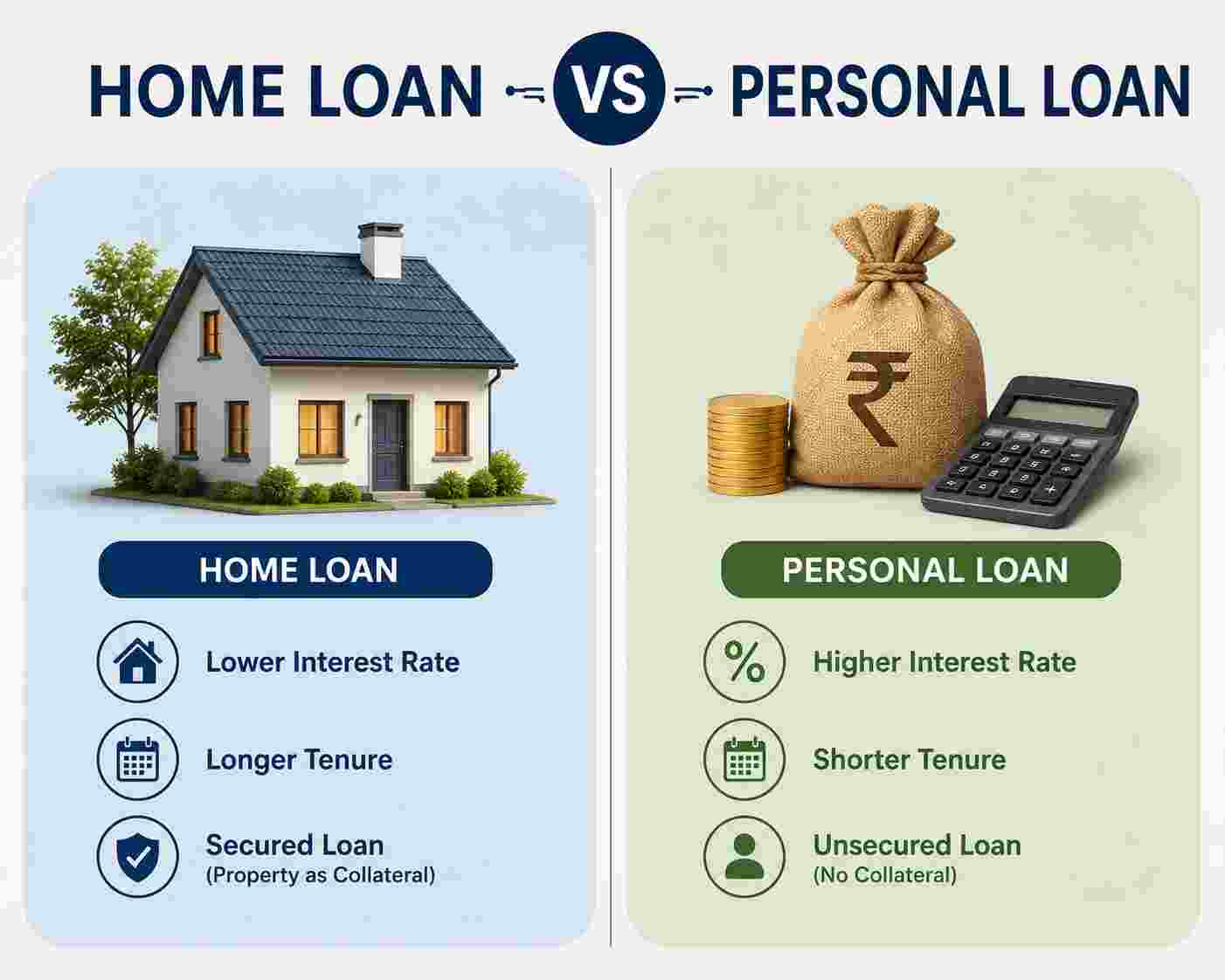
Home Loan or Personal Loan? Compare Features, Costs & Benefits
Whenever someone needs money in India, two options come up almost immediately — a home loan or a personal loan. Both solve the same basic problem. But that is about where the similarity ends. The interest rates are different. The tax treatment is different. The timelines are different. And picking the wrong one can cost you a significant amount over the years.
This article walks you through the real differences so you can make a clear, informed choice — rather than simply going with whatever the bank suggests first.
Table of Contents
What Is a Home Loan?
A home loan — also called a housing loan — is money borrowed specifically to buy, construct, or renovate a residential property. The property is pledged as collateral, and the lender holds the title documents until you fully repay the loan.
Because the lender has physical security, they carry far less risk. That lower risk shows up directly in the interest rate. Home loan rates in India typically sit between 8.5 and 11 percent per annum. Tenures run from 15 to 30 years, which keeps monthly EMIs manageable even on large amounts.
What Is a Personal Loan?
A personal loan is unsecured. You do not pledge any asset. The bank approves it based on your income, employment record, and credit score alone.
No collateral means more risk for the lender, and they price that into the rate. Personal loan rates in India typically run from 10.5 to 24 percent per annum. Tenures are shorter — usually one to five years — which pushes the EMI higher. The upside is speed. Many lenders disburse personal loans within 24 to 48 hours, something a home loan simply cannot match.
A Clear Loan Comparison Between the Two
Here is a straightforward loan comparison side by side:
- Purpose — Housing loan is for property purchase, construction, or renovation. Personal loan can be used for anything
- Collateral — Home loan requires the property as security. Personal loan requires nothing
- Interest rate — Home loan rates run from 8.5 to 11 percent. Personal loan rates run from 10.5 to 24 percent
- Tenure — Home loan runs from 15 to 30 years. Personal loan runs from 1 to 5 years
- Loan amount — Home loans can go into the crores. Personal loans are usually capped around 40 to 50 lakh
- Processing time — Home loans take longer due to property and legal checks. Personal loans are fast
- Tax benefit — Home loan offers deductions under Section 80C and Section 24. Personal loan offers none
The Tax Benefit That Changes the Whole Calculation
This is the part most people undervalue until someone runs the numbers for them.
Under Section 80C, you can claim up to Rs 1.5 lakh per year on the principal repayment of your housing loan. Under Section 24(b), you can claim up to Rs 2 lakh per year on the interest paid on a self-occupied property. Together, that is a potential deduction of Rs 3.5 lakh from your taxable income every single year.
Over a 20-year tenure, this becomes a very large saving — especially for anyone in the 30 percent tax bracket. A personal loan offers none of this. If tax efficiency matters to you, the home loan wins before you even look at the rate difference.
When a Home Loan Makes More Sense
A home loan is the right call when you are buying, building, or doing real renovation on a property you own or plan to own. The rate is lower, the EMI is more manageable, and the tax benefits reduce the effective cost further.
If you can wait for the longer approval process and are comfortable pledging the property, a housing loan will cost you significantly less than a personal loan for the same purpose. For amounts above Rs 20 to 25 lakh, it is also the only realistic option — personal loans rarely go that high.
When a Personal Loan Makes More Sense
A personal loan earns its place when you need money quickly and cannot wait weeks for paperwork and property verification. Medical emergencies, urgent travel, a wedding with a fixed date — these situations need speed, and the personal loan delivers it.
It also makes sense when you do not own property to pledge, or when the money is not going toward property at all. Education fees, debt consolidation, home furnishing, or any personal expense that a housing loan will not cover — a personal loan handles all of these cleanly.
For people who dislike carrying debt for 20 years, the shorter repayment cycle of a personal loan is genuinely appealing. You borrow, you pay it off, you move on.
The Top-Up Home Loan Most People Miss
If you already have a home loan, ask your bank about a top-up loan before you even think about a personal loan. A top-up home loan lets you borrow an additional amount on your existing housing loan — at home loan interest rates, not personal loan rates.
Documentation is minimal since the bank already holds your property and knows your repayment record. The extra amount simply gets added to your existing EMI. If you qualify, it is almost always the best loan option for meeting a personal financial need without paying a steep rate.
What Lenders Check Before Saying Yes
Whether you apply for a home loan or a personal loan, banks look at broadly the same things:
- Credit score — Aim for 750 or above. Below 650, approval becomes difficult regardless of income
- EMI to income ratio — Your total EMIs should not exceed 40 to 50 percent of your monthly take-home pay
- Employment stability — Salaried applicants from established employers get better rates and easier approvals
- Existing debts — High existing obligations reduce how much new credit a lender will extend
- Age — Younger applicants get longer tenures. Older applicants face a shorter repayment window
Sorting these out before you apply — building your credit score, reducing existing debt, keeping your documents ready — improves both your chances of approval and the rate you walk away with.
Frequently Asked Questions
-
What is the main difference between a home loan and a personal loan
The core difference is collateral and purpose. A housing loan is secured against your property and is meant for property-related needs. A personal loan is unsecured and can be used for anything. Because the home loan carries less risk for the lender, the interest rate is noticeably lower. In any genuine loan comparison, this rate difference shapes most of the decision.
-
Which loan carries the lower interest rate?
A home loan almost always carries the lower rate. Housing loan rates typically fall between 8.5 and 11 percent. Personal loan rates run between 10.5 and 24 percent. Applied to a large amount over 15 or 20 years, that gap translates into lakhs of rupees in additional interest.
-
Can I use a personal loan to buy a house?
You can, but it is rarely wise. Personal loans are usually capped around 40 to 50 lakh, which falls short of most urban property prices. The rate is higher, the tenure is shorter, there are no tax benefits, and the EMI pressure is real. A housing loan is almost always the smarter choice for buying property.
-
What tax benefits come with a home loan that a personal loan does not offer?
A housing loan gives you deductions under Section 80C — up to Rs 1.5 lakh per year on principal repayment — and Section 24(b) — up to Rs 2 lakh per year on interest for a self-occupied property. A personal loan gives you nothing comparable. For anyone in a higher tax bracket, this advantage alone often makes the home loan the best loan over its full tenure.
-
How do I decide which is the best loan for my situation?
Start with what the money is actually for. Property purchase or construction — home loan. Urgent need for something else — personal loan. Large amounts — only a housing loan is realistic. Already have a home loan — explore a top-up before anything else.