

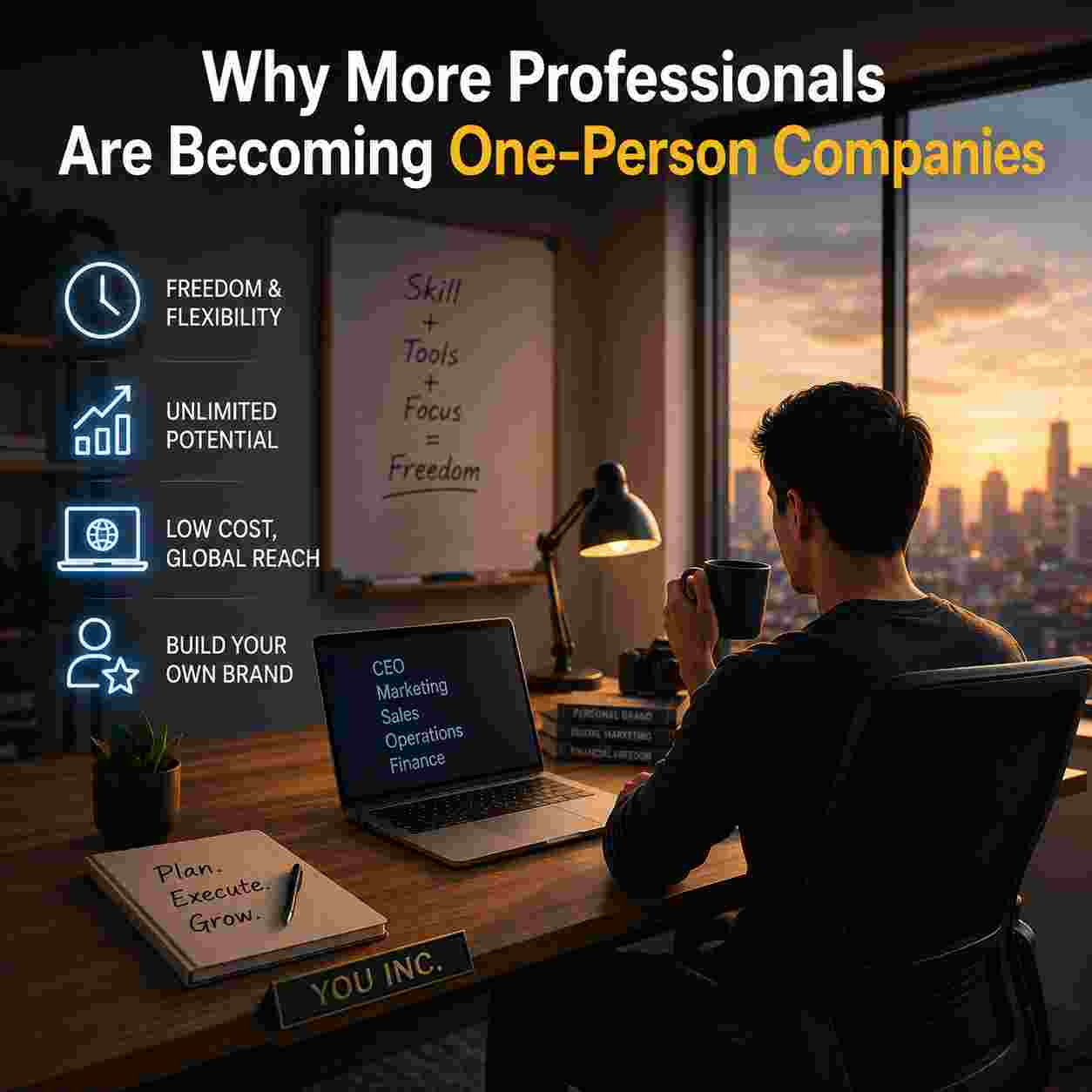
Why More Professionals Are Becoming One-Person Companies
A few years back, telling your family you’re quitting your job to “work alone” would’ve made them worry. Now, it barely raises an eyebrow. Skilled people across India, and honestly everywhere else too, are closing their laptops in someone else’s office and opening them the next morning as their own boss. This isn’t a short-lived trend. It’s a genuine shift in how people want to earn, grow, and build something with their own name on it.
Bharat Stories has been watching this shift closely, mostly because it touches almost everyone working today — designers, writers, consultants, coders, marketers, you name it. They’re all circling the same question: why work for one company when you could work with several, on terms you actually set yourself?
Table of Contents
What Does “One-Person Company” Actually Mean?
Put simply, a one-person company is a business run by exactly one person. No team to manage, no office politics to wade through, no boss looking over your shoulder. That one person handles the work, the clients, the money, and every decision in between.
This idea sits right next to what’s known as a solopreneur business. A solopreneur builds and runs a company alone, often staying small on purpose instead of scaling up with a bunch of employees. They might bring in help for one-off tasks, but the core of the business never leaves their hands.
That’s quite different from a startup founder chasing a big company with investors and a growing team. A solopreneur usually just wants control, some breathing room, and a direct line between the work they put in and the money they take home.
The Real Reasons Behind This Shift
Nobody wakes up on a random Tuesday and quits their job for no reason. There are a handful of real, practical reasons pushing people toward solo work.
Freelancing Has Become a Normal Career Path
Ten years ago, freelancing was something you did between proper jobs, almost as a stopgap. Now it’s a legitimate career on its own. Platforms that connect skilled people with clients across the world have made starting out — and sticking with it — a lot easier than before.
A graphic designer sitting in Pune can take on a client in Berlin without ever shaking hands. A writer in Jaipur might juggle five clients from five different industries in one month. That kind of freedom simply didn’t exist before remote work became the norm.
There’s another upside too — freelancing lets people dip into different industries without being boxed into one company’s way of doing things, so they end up learning faster.
The Creator Economy Opened New Doors
The creator economy has quietly rewritten what “having a business” even means. Someone with a phone, a half-decent idea, and the discipline to show up regularly can build an audience and turn that into real income. Think YouTubers, newsletter writers, course creators, the educators you follow on Instagram.
What sets the creator economy apart from older business models is that the product, more often than not, is the person themselves — their knowledge, their personality, their way of explaining things. No factory, no office lease, nothing fancy required. Just a laptop, a phone, and something worth saying.
This has nudged plenty of professionals out of their old roles. A former HR manager might be running a career-coaching newsletter today. A former bank employee could be teaching personal finance online now, using the same skills they always had, just dressed up differently.
Personal Branding Makes Solo Work Possible
None of this really works without personal branding. In a regular job, the company’s name does all the heavy lifting. When you’re working solo, your own name and reputation become the thing people judge you by.
Personal branding, at its core, is just how someone presents their skills, values, and personality to the people they’d like to work with. In practice, that usually looks like:
- A message about what they do that stays consistent and doesn’t keep changing
- Showing up on the platforms where their audience or clients are already spending time
- Actual proof of work — portfolios, case studies, results clients can verify
- A voice and tone that feels the same whether it’s a post, an email, or a quick call
- Owning up honestly when something doesn’t go as planned
Without personal branding, even a genuinely talented professional can find it hard to land clients. With it, sometimes people who aren’t even the most skilled in the room still get more work, simply because others trust them and already know who they are.
Online Entrepreneurship Lowered the Cost of Starting
Starting a business used to mean renting an office, hiring a few people, and spending a fair bit before earning a single rupee back. Online entrepreneurship has quietly chipped most of that away.
These days, someone can start a service-based business with nothing more than a laptop and a decent internet connection — taking payments online, hopping on video calls with clients, sending finished work over email or a shared drive.
What Professionals Gain From Going Solo
People don’t choose this path for money alone. Ask around, and you’ll hear the same handful of benefits come up again and again:
- Control over time — deciding when to work and when to switch off, instead of clocking in on someone else’s schedule
- A direct link between effort and income — better work tends to mean better pay, without office politics getting in the way
- Freedom to pick clients and projects — and the ability to actually say no to work that doesn’t feel right
- Faster learning — bouncing between different clients sharpens skills quicker than sitting in one role for years
- Location freedom — working from home, a co-working space, or wherever a laptop happens to be open
Challenges People Don’t Always Talk About
Going solo isn’t all freedom and flexible mornings. There’s a quieter, harder side to it that doesn’t get talked about nearly enough.
Income can swing wildly, especially in that first year. Some months bring in solid money, others bring in almost nothing at all. That’s exactly why most seasoned solopreneurs keep a savings buffer set aside before they ever leave a steady paycheck behind.
There’s also no team to lean on when things pile up. The same one person ends up doing the actual work, chasing clients, and sending out invoices — and that gets exhausting fast for anyone who’s used to having coworkers around.
How Professionals Are Preparing for This Shift
A pretty common move is starting freelancing on the side while still holding down a regular job. That way, they can build up a client base and figure out their pricing without putting their main income at risk. Once that side income starts feeling reliable, they make the full switch.
Others go the opposite way — building their personal branding first, writing posts, sharing their work in public, long before they ever chase a paying client. By the time they actually go solo, there’s already an audience out there who trusts them.
A Quiet but Lasting Shift in Work Culture
This whole movement toward solo work isn’t really just about escaping a 9-to-5. It points to something deeper — a change in how people think about their careers. Less about climbing someone else’s ladder, more about building something that’s actually theirs.
As the tools behind online entrepreneurship keep getting simpler, and more platforms make freelancing easier to break into, this way of working is only going to keep growing.
Frequently Asked Questions
-
Is a solopreneur business different from a small startup?
Yes, quite a bit actually. A startup usually wants to grow into something bigger, with a team and outside investors backing it. A solopreneur business stays small on purpose, run by just one person, with no real team to speak of.
-
Do I need a large following to succeed in the creator economy?
Not really. Plenty of people do well with a small, focused audience that genuinely trusts them. What matters more is how relevant the content feels to that particular group of people, not how big the number is.
-
How long does it usually take to replace a full-time salary through freelancing?
That depends a lot on the skill, the demand for it, and how much effort goes into finding clients. Some people get there in six months. Others take a year, sometimes longer. It’s rarely an overnight thing, no matter what anyone tells you.
-
Is personal branding only useful for creators and influencers?
Not at all. It helps consultants, freelancers, coaches, and even fairly traditional professionals like accountants or lawyers who’d rather attract clients directly instead of waiting around for referrals.
-
What’s the biggest mistake people make when starting online entrepreneurship?
A lot of people jump in without any savings or a real plan for finding clients. It’s safer to build a bit of income on the side first, get a feel for the market, and then move into it fully once there’s something steady to fall back on.