

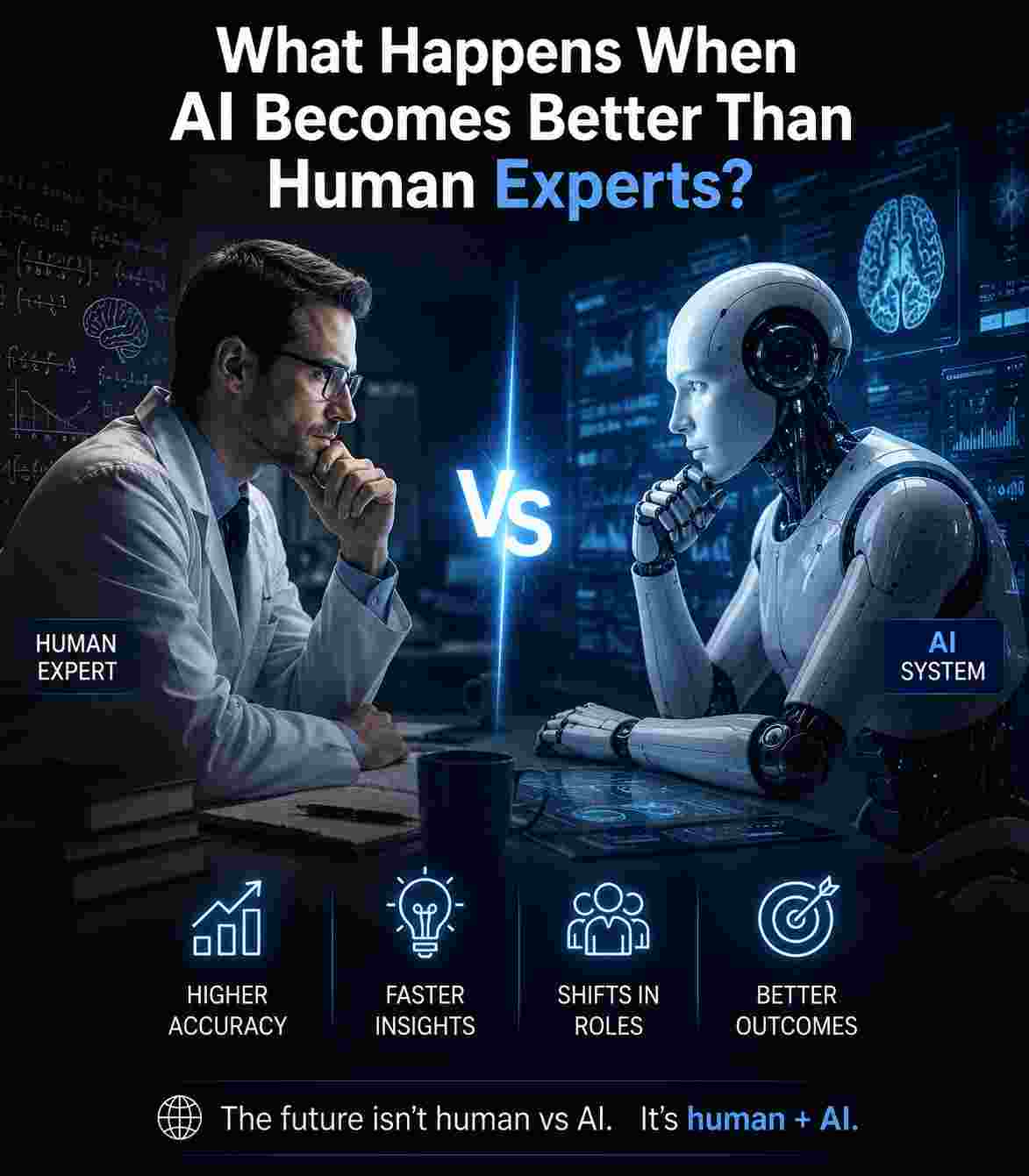
What Happens When AI Becomes Better Than Human Experts?
For a long time, the word “expert” carried real weight. It meant someone who had put in years of work, made plenty of mistakes, and built knowledge most people simply didn’t have. That idea is now being seriously challenged. AI systems are already doing things trained professionals used to do — and in some cases, doing them better. The honest question worth asking is: what does that actually mean for the rest of us?
Table of Contents
AI Is Already Ahead in Some Areas
Most people still picture AI as a helpful tool — something that saves time rather than something that replaces skill. In many situations, that is still accurate. But in certain fields, the line between tool and replacement is quietly disappearing.
AI has matched or outperformed experienced radiologists in reading certain medical scans. Legal AI tools review contracts faster than junior lawyers and catch errors that human reviewers miss. Financial algorithms execute decisions at a pace no human team can compete with. These are not predictions about the future. They are things happening right now, in real workplaces, affecting real professionals.
What Artificial General Intelligence Actually Means
The AI being used today is called narrow AI. It does one specific job well and nothing outside of it. A translation tool translates. A fraud detection system detects fraud. Artificial general intelligence — AGI — is an entirely different concept. It describes an AI that can learn, reason, and apply judgment across any subject or situation, the way a human mind works.
AGI does not exist yet. But the pace of progress has genuinely surprised many of the researchers building these systems. Most serious AI experts now treat AGI as a question of when, not if. When it arrives, the effects will not stay contained to one industry. It will reshape how nearly every knowledge-based profession operates. Taking artificial general intelligence seriously now — before it arrives — is simply smarter than reacting after the fact.
Where the AI Impact Is Already Showing Up
The AI impact is visible in industries that have nothing to do with robotics or manufacturing. White-collar professionals everywhere are watching automation reshape what their daily work actually involves.
The clearest examples right now:
- Healthcare — AI reads imaging results, flags high-risk patients, and supports diagnosis at a speed human teams alone cannot replicate
- Legal work — contract review, due diligence, and case research are being handled faster and more cheaply by AI than by human associates
- Financial services — credit scoring, fraud detection, and investment decisions are areas where AI regularly matches or outperforms trained analysts
- Education — adaptive tools track individual students and spot knowledge gaps that a single teacher managing a full classroom will often miss
- Creative fields — writing, design, and music composition are areas where AI output has reached a quality that genuinely surprises working professionals
What This Means for Human Jobs
This is the part that makes people uncomfortable, and that reaction is fair. If automation can do what a trained expert does, what actually happens to the expert?
Work built around processing information, following fixed rules, and repeating tasks under predictable conditions is under the most pressure. Work that involves reading people, making ethical calls, handling creative decisions, and working through genuinely unpredictable situations is far harder to replace.
History shows that technology tends to change jobs more than it simply removes them. New roles appear. Existing ones shift in what they require. But that process is not painless, and it does not work out automatically for everyone.
The Risks That Don’t Get Talked About Enough
Future technology is usually discussed in terms of what it makes possible. What gets far less attention is what can go wrong — and those conversations deserve equal space.
When an AI system makes a serious error — a wrong diagnosis, a biased hiring recommendation, a harmful financial decision — accountability becomes difficult to assign. Who is responsible? The company that built the system? The professional who used its output without questioning it? The person who faced the consequences?
These are not imaginary questions. They are being argued in courts and regulatory offices right now. When the logic behind decisions that affect people’s lives is buried inside a machine, people lose the ability to understand or challenge those decisions.
What Leading AI Experts Are Actually Saying
It is worth paying attention to what AI experts — not online commentators, but the people actually building these systems — are saying publicly.
Many prominent researchers have called for more careful development, better safety testing, and honest public discussion about where artificial general intelligence is heading. Several well-known figures in the field have supported regulation — not to slow progress for its own sake, but because they understand what is at stake if these systems are built without proper care.
Practical Steps Anyone Can Take Right Now
Engaging with this topic does not require a technical background. There are practical things anyone can do:
- Learn how AI works at a basic level — understanding what these systems can and cannot do, and where they tend to fail, is useful for anyone affected by them
- Build skills that machines genuinely struggle with — human judgment, ethical reasoning, honest communication, and managing uncertain situations
- Follow what serious AI experts are actually saying — the real conversation among researchers is far more grounded and useful than most news coverage
- Stay adaptable — people who approach change with genuine curiosity tend to navigate it better than those who treat every shift as a threat
The Human Question Technology Cannot Answer
When AI becomes better than human experts across a wide range of tasks, the most important question is not an economic one. It is a human one.
What do people actually value about expertise beyond the output it produces? A doctor who takes time to explain a difficult diagnosis with real care. A teacher who notices a child has gone quiet and wants to understand why. A lawyer who listens patiently to a client who is scared. These are not inefficiencies waiting to be automated away. They are the part of expertise that has always mattered most to the people on the receiving end of it.
The AI impact on society is not fixed in advance. It will be shaped by the choices people make about what to hand over to machines, what to hold onto, and what kind of future is actually worth building. Future technology creates new possibilities. Humans still decide which ones to pursue.
Frequently Asked Questions
-
What is artificial general intelligence and how does it differ from today’s AI?
Current AI is narrow — it performs specific tasks it was built for and nothing outside that scope. Artificial general intelligence describes an AI that can reason and apply knowledge across any subject or situation, the way a human mind can. It does not yet exist. Most serious AI experts believe it will eventually be developed, though estimates on timing vary widely.
-
Which types of jobs face the most pressure from automation?
Jobs built around structured, rule-following work — routine data processing, standard document handling, predictable interactions — face the most direct pressure from automation. Roles involving genuine human connection, ethical complexity, creative decision-making, and unpredictable environments are considerably harder to replace with current technology.
-
Are AI experts genuinely concerned about where this is heading?
Many are, and they say so openly. Well-known researchers have called for more careful development and proper oversight of artificial general intelligence. Their concern is practical — systems making decisions that affect real people’s lives must be transparent and accountable, not simply efficient.
-
How can someone stay relevant as AI gets more capable?
Focus on what AI genuinely struggles with — empathy, nuanced communication, ethical judgment, and managing complex human situations without a clear rulebook. Staying genuinely informed about future technology, beyond surface-level headlines, helps people make smarter decisions about where to direct their energy.
-
How significant is the AI impact for ordinary people?
It is already significant for many, and it will grow. The AI impact touches healthcare, legal services, education, and finance — all areas that affect how people receive services and find work. Staying engaged with these changes, rather than ignoring them or feeling overwhelmed by them, is the most practical response anyone can have.