

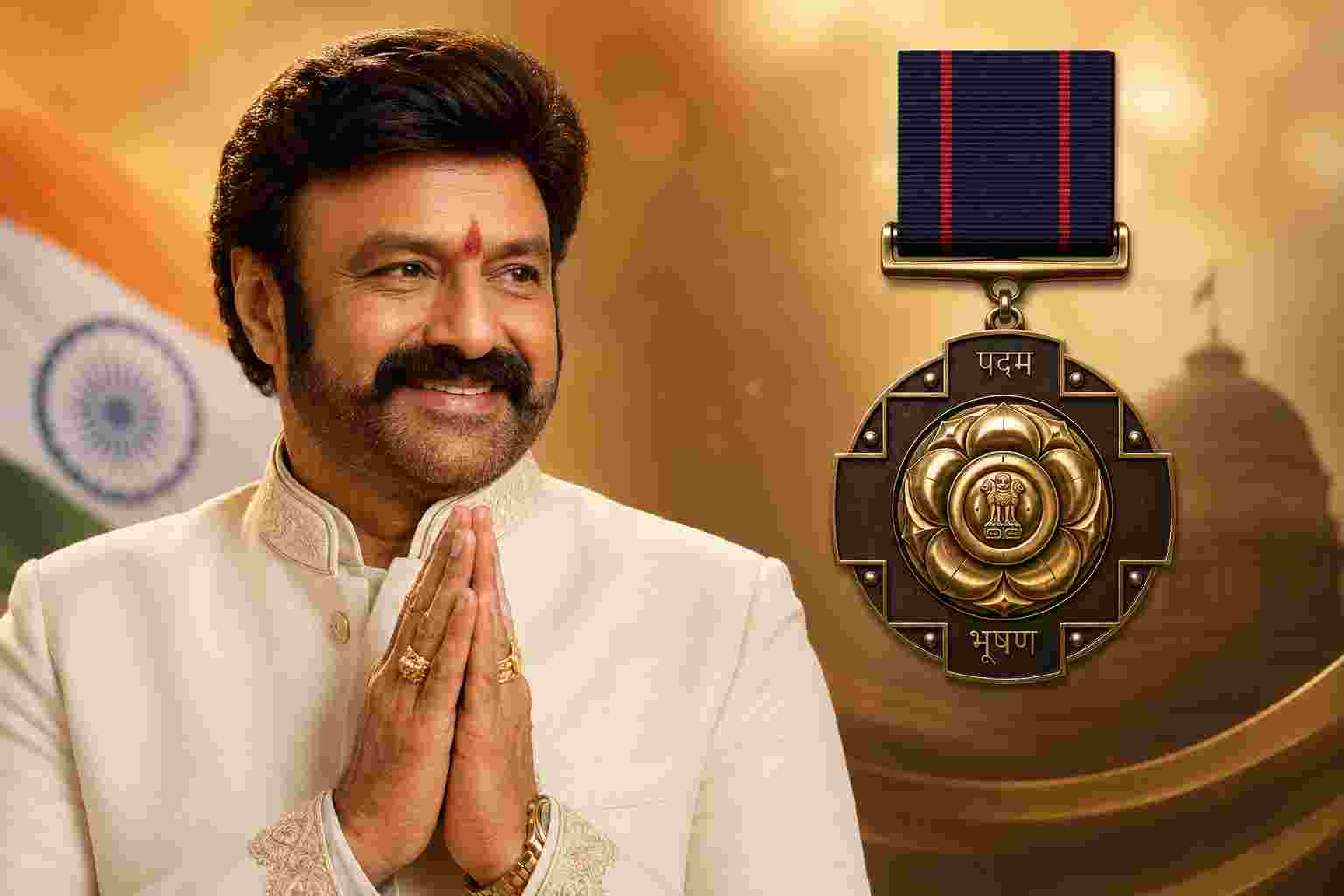
Nandamuri Balakrishna Receives Padma Bhushan
Table of Contents
Nandamuri Balakrishna Overview
In January 2025, the Government of India announced the year’s Padma awards, and among the names on that list was a Telugu actor whose career has run alongside the entire modern history of his industry. The Balakrishna Padma Bhushan honour wasn’t a surprise to anyone who’s followed Telugu cinema closely, but it still landed as a moment worth pausing on — because Nandamuri Balakrishna spent decades stepping out from a famous shadow and building something that was unmistakably his own.
It puts this together for anyone who wants to understand who he is, what he’s built across a career spanning fifty years, and why this recognition matters.
Born Into Cinema, But Not Coasting on It
Nandamuri Balakrishna was born on 10 June 1960 in Madras, now Chennai, to N. T. Rama Rao — a towering figure in Telugu cinema and a three-time Chief Minister of Andhra Pradesh — and his wife Basavatarakam. Telugu cinema was based in Madras at the time, so his earliest years were spent there before the industry’s gradual move to Hyderabad, where his family relocated during his adolescence.
He earned a bachelor’s degree in commerce from Nizam College, Hyderabad, and married Vasundhara Devi in 1982 at the age of twenty-two. They have three children. None of this reads particularly unusual for someone of his background — what makes his story interesting is what came after.
He made his acting debut as a child artist at just fourteen, in Tatamma Kala (1974), directed by his father. Several of his early films were directed by N. T. Rama Rao himself, including Daana Veera Soora Karna (1977) and Sri Tirupati Venkateswara Kalyanam (1979). Being cast by your own father in major productions could easily have become a crutch. For Balakrishna, it became a starting point instead.
Building a Career That Outgrew the Surname
By 1984, at the age of twenty-four, Balakrishna had moved into adult lead roles with Sahasame Jeevitham. That same year saw him in Mangammagari Manavadu, Janani Janmabhoomi, and the biographical film Shrimad Virat Veerabrahmendra Swami Charitra — a remarkably busy stretch that signalled he intended to work, not coast.
The decades that followed produced a body of work running past a hundred feature films, spanning genres in a way that’s genuinely uncommon for a single actor’s career. His commercially successful titles include:
- Muvva Gopaludu (1987) and Aditya 369 (1991), both considered landmark films of their respective decades
- Samarasimha Reddy (1999) and Narasimha Naidu (2001), action films that cemented his mass-hero status in Telugu cinema
- Legend (2014) and Akhanda (2021), the latter a major box office success featuring him in a dual role as an Aghori and a farmer
- Veera Simha Reddy and Bhagavanth Kesari, both released in 2023, proving his commercial pull remained strong well into his sixties
- Daaku Maharaaj (2025), continuing an output that shows no real sign of slowing
What stands out across this list isn’t just longevity — plenty of actors stay in the industry for decades without staying relevant. Balakrishna kept finding roles, kept experimenting with biographical, historical, and hagiographical subjects, and kept drawing audiences across generational lines.
What the Padma awards Recognised
The Padma awards are India’s highest civilian honours after the Bharat Ratna, given across three tiers — Padma Vibhushan, Padma Bhushan, and Padma Shri. Balakrishna received the Padma Bhushan, the third-highest tier, recognising his exceptional contributions to the field of arts.
It’s worth being precise about what this recognises and what it doesn’t. The award acknowledges his work as a Telugu actor and producer across a career spanning five decades — not his political career, which runs on a separate track entirely. He has represented the Hindupur constituency in the Andhra Pradesh Legislative Assembly since 2014, currently serving his third consecutive term, but the Padma Bhushan was awarded specifically for his cinematic contributions.
That distinction matters because it places him properly within the lineage of great performers honoured through the Padma awards over the decades — recognised purely on the basis of what he built on screen.
An Actor Biography Filled With Recognition
Any actor biography of Balakrishna’s career has to account for the sheer volume of recognition he’s accumulated, much of it well before the Padma Bhushan arrived.
He has won the Best Actor award at the Nandi Awards three times, the Santosham Film Awards three times in the same category, and the TSR National Awards three times as well. He has also received seven Filmfare Awards South nominations for Best Actor in the Telugu category — a number that reflects sustained, recognised quality across decades rather than a single career peak.
This pattern of consistent recognition, spread across so many different award bodies and so many different decades, is genuinely rare. Plenty of actors have a defining era. Balakrishna has had several, each acknowledged independently by the industry as it happened.
Carrying a Legacy Without Being Defined By It
There’s a particular kind of pressure that comes with being the son of someone as significant as N. T. Rama Rao — an actor whose influence on Telugu cinema and Andhra Pradesh politics is difficult to overstate. Balakrishna inherited that name, but the body of work he built is genuinely his own.
His 2019 biopic project on his father — released in two parts, NTR: Kathanayakudu and NTR: Mahanayakudu — showed a son honouring his father’s legacy while still working within his own creative voice as both actor and the driving force behind the project. It wasn’t a tribute coasting on sentiment. It was a substantial production that required the same commitment he’d brought to his commercial hits.
The Nandamuri family name carries enormous weight in Andhra Pradesh, both in cinema and in politics. Balakrishna has spent fifty years proving that weight didn’t define his career — his choices, his range, and his willingness to keep working did.
Why This Recognition Landed the Way It Did
When the Padma Bhushan was announced, the response across Telugu cinema reflected something genuine rather than ceremonial. This wasn’t recognition for a single great film or a brief golden period. It was an acknowledgement of fifty continuous years of work, from a child artist’s debut to leading roles well into his sixties, across action, drama, biographical cinema, and everything in between.
The Balakrishna Padma Bhushan honour sits alongside his political role, his decades of box office success, and his standing as one of Telugu cinema’s most enduring names. For an industry that has produced no shortage of major stars, that kind of staying power says something real about the work itself.
Frequently Asked Questions
-
When did Nandamuri Balakrishna receive the Padma Bhushan?
He was conferred the Padma Bhushan in 2025, recognised among that year’s Padma awards recipients for his exceptional contributions to the arts, specifically his decades-long career in Telugu cinema as both actor and producer.
-
Who is Nandamuri Balakrishna’s father?
He is the son of N. T. Rama Rao, a legendary Telugu actor who also served three terms as Chief Minister of Andhra Pradesh. Balakrishna made his acting debut as a child artist in a film directed by his father in 1974.
-
What are some of Nandamuri Balakrishna’s most successful films?
Among his many successful films are Aditya 369, Samarasimha Reddy, Narasimha Naidu, Legend, Akhanda, Veera Simha Reddy, and Bhagavanth Kesari. His career spans action, drama, biographical, and historical cinema across more than a hundred films.
-
Is Nandamuri Balakrishna involved in politics as well as acting?
Yes. He has represented the Hindupur constituency in the Andhra Pradesh Legislative Assembly since 2014 and is currently serving his third consecutive term. His political career runs separately from his cinema work, though both reflect his standing in Andhra Pradesh.
-
What other awards has Nandamuri Balakrishna won throughout his career?
Beyond the Padma Bhushan, he has won the Nandi Award for Best Actor three times, the Santosham Film Award three times, and the TSR National Award three times. He has also received seven Filmfare Awards South nominations for Best Actor in the Telugu category