

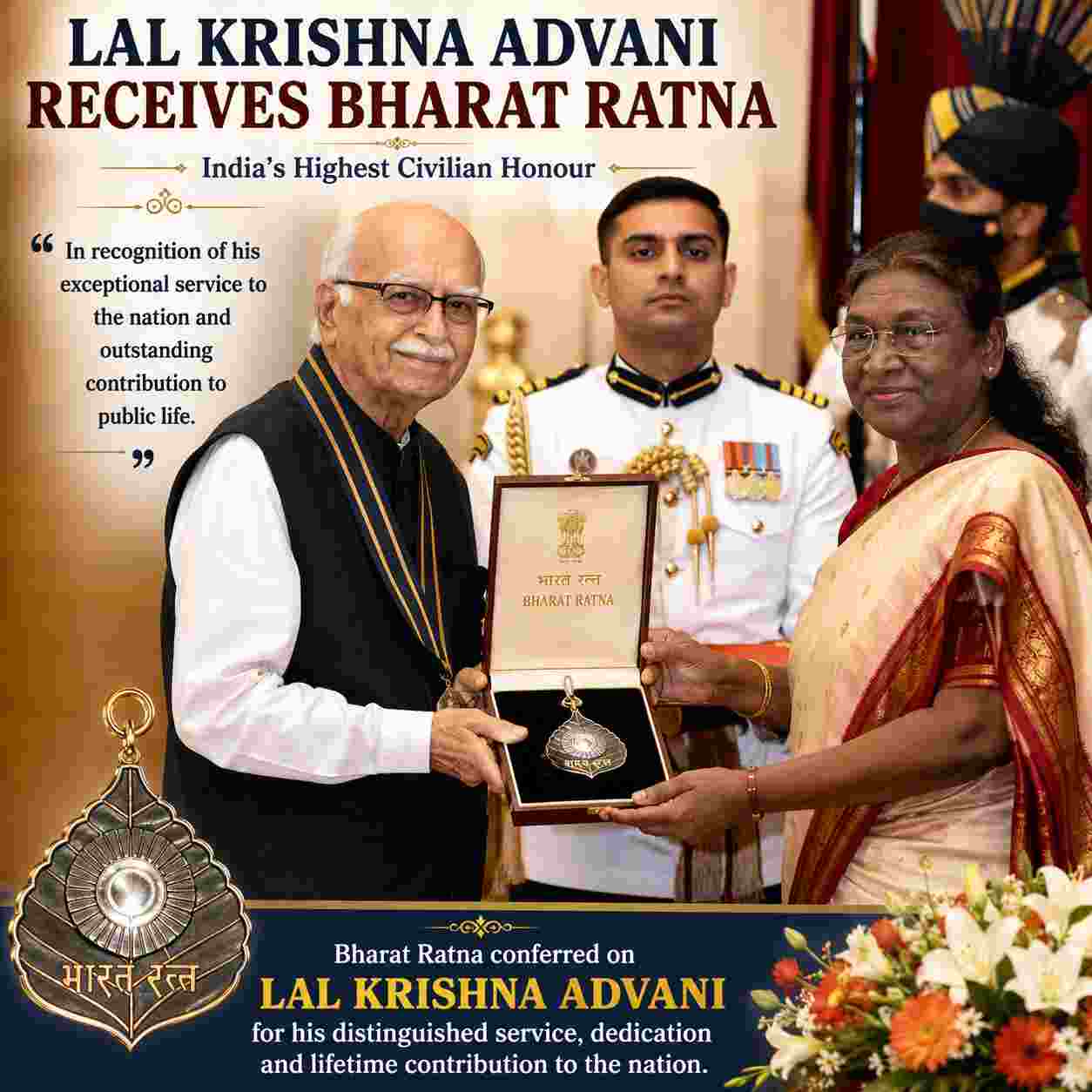
Lal Krishna Advani Receives Bharat Ratna
When India announced that Lal Krishna Advani would receive the Bharat Ratna 2024, it felt like a moment the country had been building toward. On March 31, 2024, President Droupadi Murmu went to Advani’s home in New Delhi to personally hand over the award. That choice alone — going to him rather than holding a formal ceremony — said something about how the occasion was being treated. For a man who gave more than seven decades to public life and helped build the BJP from its very first days, the recognition was one many felt should have come sooner.
Table of Contents
Where It All Started
Lal Krishna Advani was born on November 8, 1927, in Karachi, then part of British India. His family were Sindhi Hindus, and the Partition of 1947 changed everything for them. Like millions of others, they had to leave. Advani eventually settled in Bombay, finished his education, and stepped into a political career that would span more than half a century.
He joined the Rashtriya Swayamsevak Sangh in 1941 at age fourteen. That early grounding in nationalist thought stayed with him through every phase of his career and shaped the political choices he made right until the end.
Building the BJP: The Heart of the Advani Biography
No honest reading of the Advani biography skips over his role in founding the Bharatiya Janata Party. When the BJP was set up in 1980, Advani stood alongside Atal Bihari Vajpayee as one of its founding members. In 1984, the party won just two seats in Parliament. What came next — a steady climb to national power over fifteen years — is one of the more striking stories in modern Indian politics.
Advani served as BJP president three times. He had a clear ability to reach voters across different states, to hold the party together through difficult periods, and to build its presence state by state. By the late 1990s, the BJP was in a position to lead the national government. Advani was one of the main reasons that happened.
The 1990 Rath Yatra
The event that most people in Indian politics connect to Advani’s name is the 1990 Rath Yatra. He travelled across India — thousands of kilometres — drawing attention to the Ram Janmabhoomi movement in Ayodhya. At every stop, crowds turned out in large numbers. The journey put the BJP at the centre of one of the most debated questions in Indian politics at the time.
The yatra was stopped when Advani was arrested in Bihar. But the political effect lasted well beyond that. Many observers of Indian politics point to it as the moment the BJP’s support expanded substantially across northern and western India. It remains one of the most discussed chapters in the Advani biography.
Home Minister and Deputy Prime Minister
When the NDA-led government came to power in 1998, Advani took charge of the Home Ministry. He held the role for six years and sixty-four days — which makes him the longest-serving Home Minister in India’s history. He handled national security situations, border management, and some of the most serious domestic challenges the government faced during that period.
From 2002 to 2004, he also served as Deputy Prime Minister under Vajpayee. He was at the top of the Indian government during a demanding stretch, and he carried those responsibilities through events that tested the administration on multiple fronts.
Key Facts from the Advani Biography
For anyone trying to understand the full picture of the Advani biography and his place in Indian politics, these facts tell a clear story:
- Co-founded the BJP in 1980 alongside Vajpayee, growing it from two seats to a ruling national party
- Longest-serving Home Minister in India’s history, from 1998 to 2004
- Served as Deputy Prime Minister from 2002 to 2004
- Longest-serving Leader of the Opposition in the Lok Sabha
- BJP’s prime ministerial candidate in three general elections — 1989, 1991, and 2009
- Received the Padma Vibhushan in 2015 before the Bharat Ratna 2024
The Day He Received the Bharat Ratna 2024
That year, five people received the Bharat Ratna 2024 — the highest number in a single year since 1999. The others were former Prime Ministers Chaudhary Charan Singh and P.V. Narasimha Rao, former Bihar Chief Minister Karpoori Thakur, and agricultural scientist M.S. Swaminathan. All four received it posthumously.
Advani was the only living recipient. President Murmu went to his residence in New Delhi, with the Vice President and Cabinet ministers present. Prime Minister Modi, who had announced Advani’s name for the award, said the day was emotionally significant for him. The ceremony at home, rather than at Rashtrapati Bhavan, reflected both Advani’s age — he was 96 — and the regard in which the occasion was held.
What Political Leaders Said
Modi said Advani had given his entire life to India and helped ground Indian democracy in a clear nationalist vision. Defence Minister Rajnath Singh said he stood for something increasingly rare in politics — genuine probity and conviction.
Advani himself responded in writing. He said the honour was not just for him personally, but for the values he had tried to live by throughout his public life. It was a quiet, measured response from someone who had spent decades at the centre of Indian politics without ever appearing to perform for an audience.
His Legacy in Indian Politics
People will remember Advani differently depending on which part of his career they focus on. His supporters point to the BJP he helped build, his record as Home Minister, and the decades he spent in Parliament serving in various roles. His critics raise the controversies of 1992 and his role in the Ayodhya dispute.
What is hard to dispute is simply how long he was at it. He was in Parliament until 2019. He was part of the RSS from 1941, the Jana Sangh from 1951, and the BJP from its founding in 1980. In the full history of Indian politics, very few people have stayed active and relevant across a period that long.
What the Award Actually Means
Awards like the Bharat Ratna carry a meaning that goes beyond the individual. They reflect what a country chooses to formally acknowledge — which contributions it decides belong in that category of the highest national recognition.
For a BJP leader who spent significant stretches of his career in opposition, who stepped aside more than once when the party’s interest required it, and who was still engaged with public life well into his nineties, the Bharat Ratna 2024 marks the end of a journey covering nearly eight decades. Lal Krishna Advani’s place in Indian politics — whatever view one takes of individual moments along the way — earned him a record that the country’s highest civilian honour now formally reflects.
Frequently Asked Questions
When did Lal Krishna Advani receive the Bharat Ratna 2024?
He received the Bharat Ratna 2024 on March 31, 2024, when President Droupadi Murmu visited his home in New Delhi. At 96, Advani was the only living recipient among five people honoured with the award that year.
What was Advani’s connection to the BJP?
As a BJP leader since the party’s founding in 1980, Advani was one of its co-founders. He served as BJP president three times and was the party’s prime ministerial candidate in 1989, 1991, and 2009. He is widely seen as one of the two people most responsible for building the party into a national force.
What positions did Advani hold in government?
He was Home Minister from 1998 to 2004 — the longest tenure in that role in India’s history. He also served as Deputy Prime Minister from 2002 to 2004 and was the longest-serving Leader of the Opposition in the Lok Sabha. He remained a member of Parliament until 2019.
Why is the Rath Yatra central to the Advani biography?
The 1990 Rath Yatra is one of the most discussed events in the Advani biography. He covered thousands of kilometres across India, drawing attention to the Ram Janmabhoomi issue. He was arrested before finishing the journey, but it is widely credited with significantly expanding the BJP’s support base across northern and western India.
What other major award did Advani receive before the Bharat Ratna 2024?
Advani received the Padma Vibhushan in 2015, India’s second highest civilian honour. That same year, his fellow BJP founder Atal Bihari Vajpayee received the Bharat Ratna. Together, they are remembered as the two figures who built the modern BJP.