

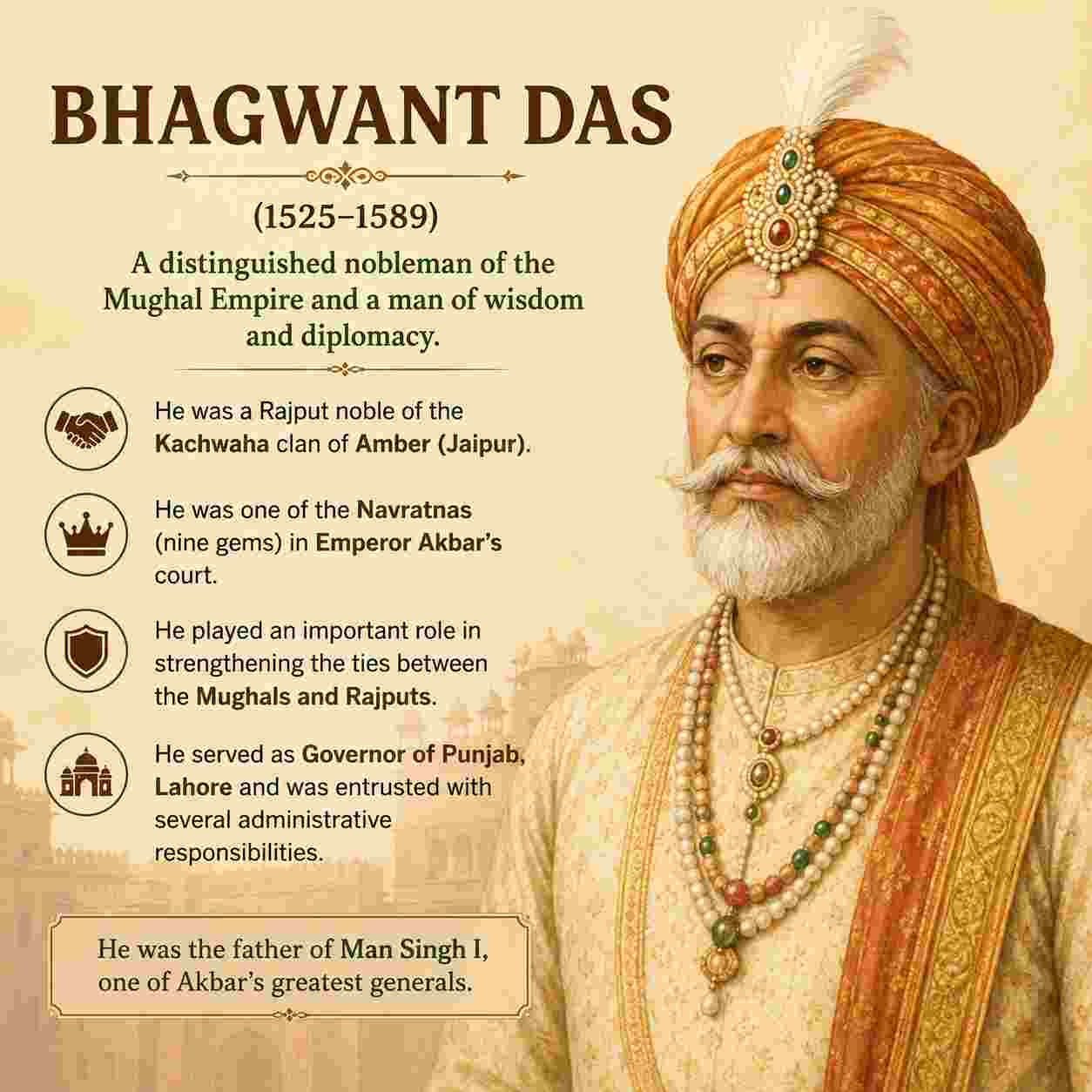
Raja Bhagwant Das History
If you look back at the Mughal period, the first names that will immediately pop into your mind are those of the Mughal emperors – Akbar, Jahangir and Shah Jahan. But there were politicians, kings, and generals to make things work behind every great empire. Raja Bhagwant Das was such a man. He was the king of Amber, a man of the sword on the battlefield, and an astute politician, well-versed in the dynamics of peace as well as war. His story needs more attention than is generally given to the discussion of mainstream Indian historical figures.
An Raja Bhagwant Das biography is more than just a collection of battles and titles. It’s a story of a man who maintained a delicate balance between the Rajput clans and the Mughal court, saved his kingdom and ensured the prosperity of its people, and provided Akbar’s son Man Singh I with a chance to become one of the most loyal generals of the Mughals. When it comes to learning the history of Rajasthan and the Mughal era generals that influenced it, the names of Bhagwant Das cannot be ignored.
Table of Contents
Rise to Power: Becoming the King of Amber
After the death of Raja Bharmal, in 1574, Bhagwant Das became the King of Amber. By that time he was 47, old enough to rule wisely, but young enough to be able to lead armies. Under him, Amber experienced a period of real calm for his fifteen year reign (1589-1594). He was not the kind of king who sat behind palace walls. He accompanied his forces, led them on the battlefield and was admired by his countrymen and the court of the Mughals.
Amber was a great ally of Akbar and was given as much protection and prestige as few other Rajput kingdoms in those days. Bhagwant Das didn’t miss that opportunity. During his reign, he allowed the kingdom to expand, trade flourished, administration was stable, and Amber was a truly prosperous kingdom. The military service and the domestic governance in the context of Rajput warriors history makes Bhagwant Das different from many.
Bhagwant Das as a General Under Emperor Akbar
One of the most significant chapters in the life of Raja Bhagwant Das was his role as a military general in the Mughal forces. Emperor Akbar placed great trust in him, and that trust was earned through performance. Bhagwant Das took part in several major military campaigns across different parts of the subcontinent — Punjab, Kashmir, and even Afghanistan. Each campaign added to his reputation as a reliable and capable commander.
The Battle of Punjab
Raja Bhagwant Das fought and won the Battle of Punjab for the Mughal forces. This victory was recognized in Akbar’s court, and Bhagwant Das received formal commendation for his role in securing the region. Punjab was strategically vital to the Mughal Empire’s northern security, and holding it was not a simple task given the various forces at play at the time.
Defeating Yousuf Shah Chak in Kashmir
Perhaps the most talked-about military achievement of Bhagwant Das in Mughal era generals history is the Battle of Kashmir. He faced Yousuf Shah Chak, the King of Kashmir, who was considered a fierce and determined opponent. Bhagwant Das defeated him and his forces, pushing them off the battlefield. This victory brought Kashmir under Mughal control and was a major milestone in Akbar’s ambition to rule a united India. The skill and determination that Bhagwant Das showed in this battle cemented his place as one of the most dependable generals in Akbar’s inner circle.
The Afghanistan Campaign and the Post of Governor of Kabul
The Afghanistan campaign was another chapter that showed the range of Bhagwant Das as a military leader. After he played a decisive role in this campaign, Emperor Akbar rewarded him with one of the most prestigious administrative posts available — Governor of Kabul. This appointment tells you a great deal about how much Akbar trusted him. Kabul was not just a city; it was the gateway to Central Asia and a crucial part of the Mughal Empire’s northwestern frontier. Putting Bhagwant Das in charge of it was a statement of deep confidence.
Title, Honour and Recognition at the Mughal Court
In 1585, Emperor Akbar gave Raja Bhagwant Das the rank of Mansab of 5000 which was one of the highest ranks in the Mughal army. This was not given out easily. The Mansab system was Akbar’s way of managing the command of his soldiers and administrative officers; a rank of 5000 put Bhagwant Das in the upper echelons of the entire Mughal establishment. He was also awarded Amir-ul-Umra—a title that means something like chief of the nobles.These honours made him not just a Rajput king with a regional influence, but a figure with empire-wide standing.
Throughout this period, Bhagwant Das remained loyal to the Mughal throne. He never acted against the Emperor’s wishes, never switched sides, and never allowed personal ambition to override his commitments. That kind of steady loyalty was rare in an era when court politics were unpredictable and alliances shifted often. In the context of Rajput warriors history, this loyalty was a conscious, calculated choice — not blind submission. He knew that Amber thrived within the Mughal system, and he protected that arrangement at every turn.
The Rajput-Mughal Alliance and Its Deeper Meaning
The Rajput-Mughal relationship that his father Bharmal began was one that Bhagwant Das worked hard to maintain and expand. His younger sister Jodha Bai, who married Emperor Akbar and later came to be known as Mariam-uz-Zamani, became one of the most respected figures in the Mughal court. Emperor Akbar never forced her to abandon her Hindu faith — she continued to practice her religion freely inside the palace, and there are even accounts of Akbar participating in her festivals. This was remarkable for its time.
Bhagwant Das, rather than simply benefiting from this arrangement, actively deepened it. He gave his own daughter Manbhawati Bai in marriage to Prince Salim — the son of Akbar who would later become Emperor Jahangir. This was a deliberate move to tie the Amber royal family even more firmly to the Mughal imperial line. It was smart politics, yes, but it also reflected a genuine belief in the value of this cross-cultural alliance in the broader context of Rajasthan history.
Legacy and What He Left Behind
Raja Bhagwant Das died on 4 December 1589. He was succeeded by his son Raja Man Singh I, who went on to become one of the most celebrated Mughal era generals in Indian history — a man who commanded vast armies and played a key role in shaping Akbar’s empire. But Man Singh’s rise was only possible because Bhagwant Das had laid the foundation. He built the relationships, earned the trust, and demonstrated the loyalty that gave the Amber royal family its position of influence within the Mughal establishment.
When you look at his story through the lens of Indian historical figures, Bhagwant Das stands out for something that does not always get enough credit — the ability to serve two roles at once. He was a warrior who could win battles in Punjab, Kashmir, and Afghanistan, and at the same time a statesman who kept his own kingdom peaceful and prosperous. That dual ability, rare in any era, is what makes the Raja Bhagwant Das biography worth studying closely. He showed that real strength is not just about fighting — it is about knowing when to fight, when to negotiate, and when to build something lasting.
Frequently Asked Questions
Who was Raja Bhagwant Das?
Raja Bhagwant Das was the King of Amber from 1574 to 1589. He belonged to the Kachwaha Rajput clan and served as a senior general in the forces of Mughal Emperor Akbar. He is remembered as one of the most capable Rajput warriors history has produced from the Mughal era.
Who succeeded Raja Bhagwant Das as King of Amber?
After his death on 4 December 1589, he was succeeded by his son Raja Man Singh I, who became one of the most powerful Mughal era generals and expanded the Mughal Empire through numerous military campaigns.
What is the significance of Bhagwant Das in Rajasthan history?
In the larger story of Rajasthan history, Bhagwant Das represents a pivotal moment when the Kachwaha Rajputs chose alliance over conflict with the Mughals. This decision brought stability and prosperity to Amber and gave the kingdom a position of real influence within the most powerful empire of that era.