

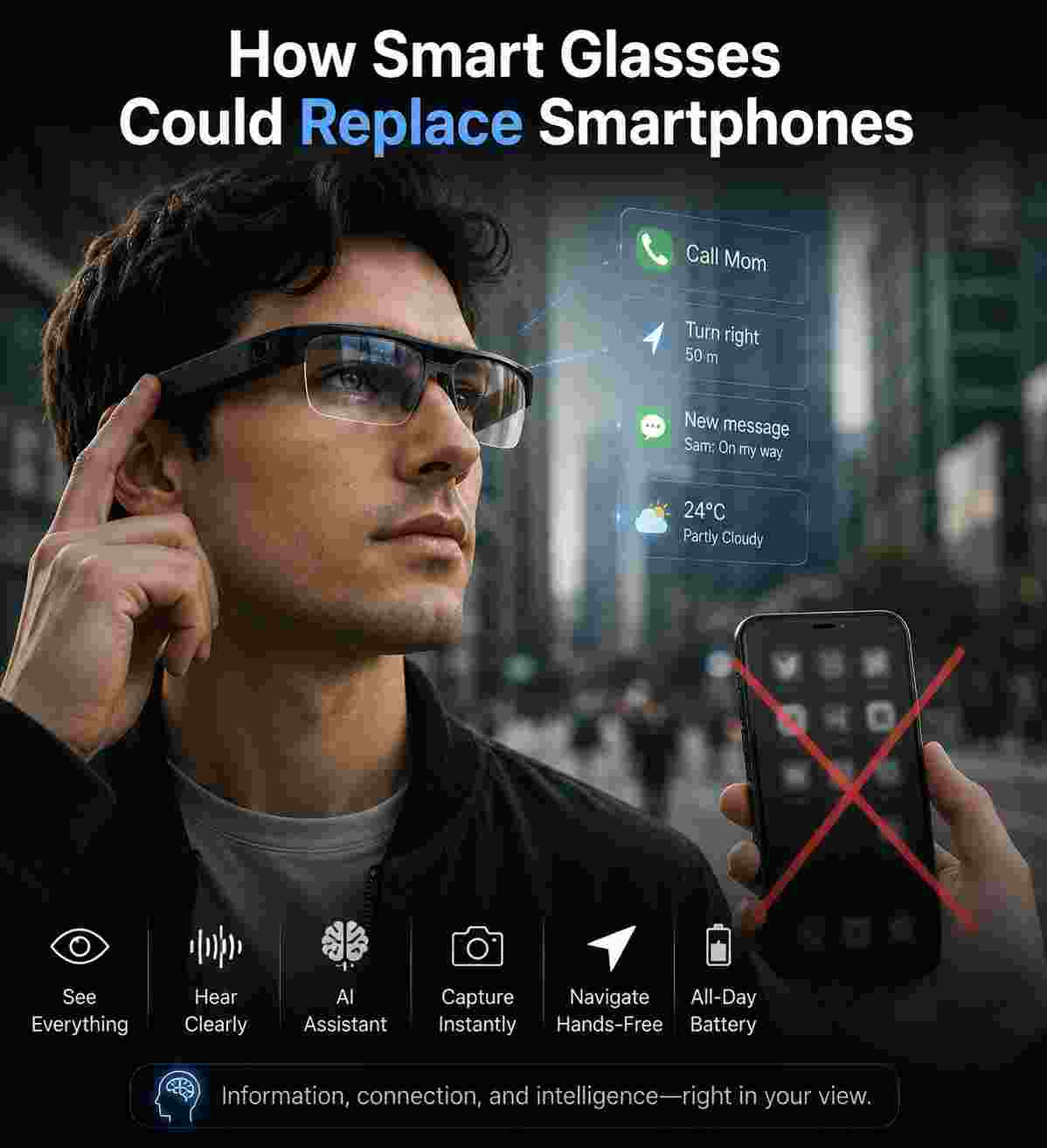
How Smart Glasses Could Replace Smartphones
Most people check their phone somewhere between 90 and 150 times a day. That number sounds absurd until you start actually counting — the quick glance at a notification, the map check at a junction, the message reply typed while half-listening to someone across the table. The phone has become the default device for almost everything, and yet it remains a fundamentally awkward one.
You pull it out of a pocket, look down at a screen, lose eye contact with whoever you’re talking to, and then put it away again. Smart glasses promise to cut out most of that friction. Instead of pulling attention down to a screen, information comes to the eyes directly, sitting in the line of sight without needing a separate device at all.
Whether that promise actually delivers — and whether smart glasses can genuinely replace smartphones — is a more complicated question. BharatStories breaks it down honestly.
Table of Contents
What Smart Glasses Actually Do Right Now
The phrase “smart glasses” covers a surprisingly wide range of products. At one end, there are audio-focused frames that look like ordinary glasses but have speakers built into the arms — good for calls and music, not much else. At the other end sit full augmented reality headsets that project interactive visuals into the wearer’s field of view.
The products that get the most attention sit somewhere in between. Meta’s Ray-Ban smart glasses handle calls, play audio, and take photos through a built-in camera, while looking like ordinary sunglasses. Google, Apple, and several other companies are working on more capable versions that layer digital information directly onto the physical world.
Wearable technology in this category is moving faster than it has in years. The hardware challenges that made earlier attempts clunky — bulk, battery life, heat, visual quality — are genuinely being addressed, even if not fully solved yet.
The Case for Smart Glasses Over a Smartphone
The argument for smart glasses replacing the smartphone starts with attention. Every time someone pulls out a phone, they’re making a choice to look away from the world in front of them. Smart glasses don’t ask for that trade-off. A notification, a navigation arrow, a translation of a foreign sign — all of this can appear without the wearer ever lowering their eyes.
For people who use their phone heavily for navigation, communication, and quick information lookups, smart glasses could handle all three without interrupting whatever else is happening. Hands stay free. Eye contact stays intact.
This is where augmented reality makes the biggest argument for itself. Rather than replacing reality with a screen, augmented reality adds to it — showing relevant information layered onto what the person is already looking at. Street directions appear on the road ahead. A restaurant menu gets translated in real time. A contact’s name appears near their face in a meeting.
What Would Actually Need to Change
The smartphone replaced the camera, the music player, the alarm clock, and the map in one device. For smart glasses to do the same to the smartphone, the list of requirements is substantial:
- Battery life lasting a full working day without a charge
- Display quality sharp and comfortable enough for reading and working
- A form factor that looks like ordinary glasses, not a tech experiment
- Privacy controls addressing legitimate concerns around a wearable camera on the face
- Voice and gesture input that works reliably in real-world environments
- Connectivity handling video calls, apps, and data at the speed people expect
None of these are impossible. Several are already partly solved. Getting all of them right at the same time, in a product that costs what a premium smartphone costs, is the engineering challenge still being worked through.
Tech Trends Pointing Toward This Shift
Looking at current tech trends, the direction of travel seems clear even if the timeline doesn’t. Processing power is moving off the device and into the cloud, which makes the hardware sitting on someone’s face lighter and less demanding. AI is making voice interaction reliable enough to replace touch input for a growing share of tasks.
Tech trends in wearable technology more broadly also point this way. Smartwatches moved from curiosity to mainstream in about a decade. Wireless earbuds did the same in half that time. Smart glasses are a harder problem — they need to do more and be more socially acceptable — but the trajectory of the category is consistent.
Several major technology companies are spending heavily in this direction. When Apple, Meta, Google, and Samsung are all working toward similar endpoints, the question shifts from whether it will happen to when it will feel ready.
The Privacy Problem That Can’t Be Ignored
Smart glasses with cameras raise a concern that’s harder to dismiss than most tech objections. A phone camera is obvious — people can see when someone is pointing it at them. A camera built into glasses is not obvious at all.
This creates a real social and ethical tension. The same capability that makes smart glasses useful is exactly what makes some people uncomfortable being near someone wearing them. Early attempts, most notably Google Glass, ran into exactly this problem and it contributed significantly to why that product never reached mainstream adoption.
Companies working on current products are trying to address this through indicator lights, limited recording times, and privacy settings. Whether that’s enough to shift social norms around camera-equipped eyewear is something the market will decide.
Future Gadgets and the Question of Replacement
Smart glasses as future gadgets that fully replace smartphones is probably still several years away, and possibly longer for mass adoption. The more likely near-term scenario is coexistence — smart glasses handling the tasks they do better while the phone stays for longer reading, video, and anything that benefits from a large screen.
The replacement question might not be the most useful frame anyway. The phone replaced the camera not by being better for every purpose, but by being good enough for most purposes while already being in someone’s pocket.
What This Means for You Right Now
If you’re someone who finds constant phone checking interfering with how you work and connect with people, the current generation of smart glasses is worth watching closely. The products available now are not yet the replacement — they’re the preview.
For early adopters, audio-first smart glasses that handle calls and music without looking out of the ordinary are genuinely useful today. For people waiting for the full augmented reality experience, the wait is real but getting shorter.
Wearable technology in the eyewear category has had a lot of false starts. The current moment feels different — more grounded, more focused on actually solving the friction of phone use rather than adding features for their own sake.
Frequently Asked Questions
-
Can smart glasses actually replace smartphones for everyday use right now?
Not entirely, not yet. Current smart glasses handle specific tasks well — calls, audio, quick notifications, photos — but they can’t match a smartphone for reading, video, detailed app use, or anything requiring a large screen. They’re a supplement to the phone today, with replacement potential still a few years out.
-
What is augmented reality and how does it work in smart glasses?
Augmented reality means digital information layered onto the real world rather than shown on a separate screen. In smart glasses, this could mean navigation arrows appearing on the street ahead, translations overlaid on foreign-language signs, or contact details appearing near a person’s face. The information lives in the line of sight without replacing what the wearer sees.
-
What are the biggest obstacles stopping smart glasses from going mainstream?
Battery life, display quality, social acceptance of built-in cameras, and price are the main barriers. Getting all of these to a point that works for ordinary daily use — not just for tech enthusiasts — is the challenge that’s still being worked through across the industry.
-
How do current tech trends support the growth of smart glasses?
Tech trends around AI, cloud processing, and miniaturisation are all moving in directions that benefit smart glasses. AI makes voice input reliable enough to replace touch. Cloud computing reduces how much processing needs to happen on the device itself. Miniaturisation makes lenses thinner and hardware lighter.
-
Are there privacy concerns with wearable technology like smart glasses?
Yes, and they’re legitimate ones. A built-in camera that isn’t visually obvious raises real concerns about recording without consent. Most current products address this with indicator lights or limited recording features, but public comfort with the idea is still developing. It’s one of the bigger non-technical challenges the category needs to work through.