

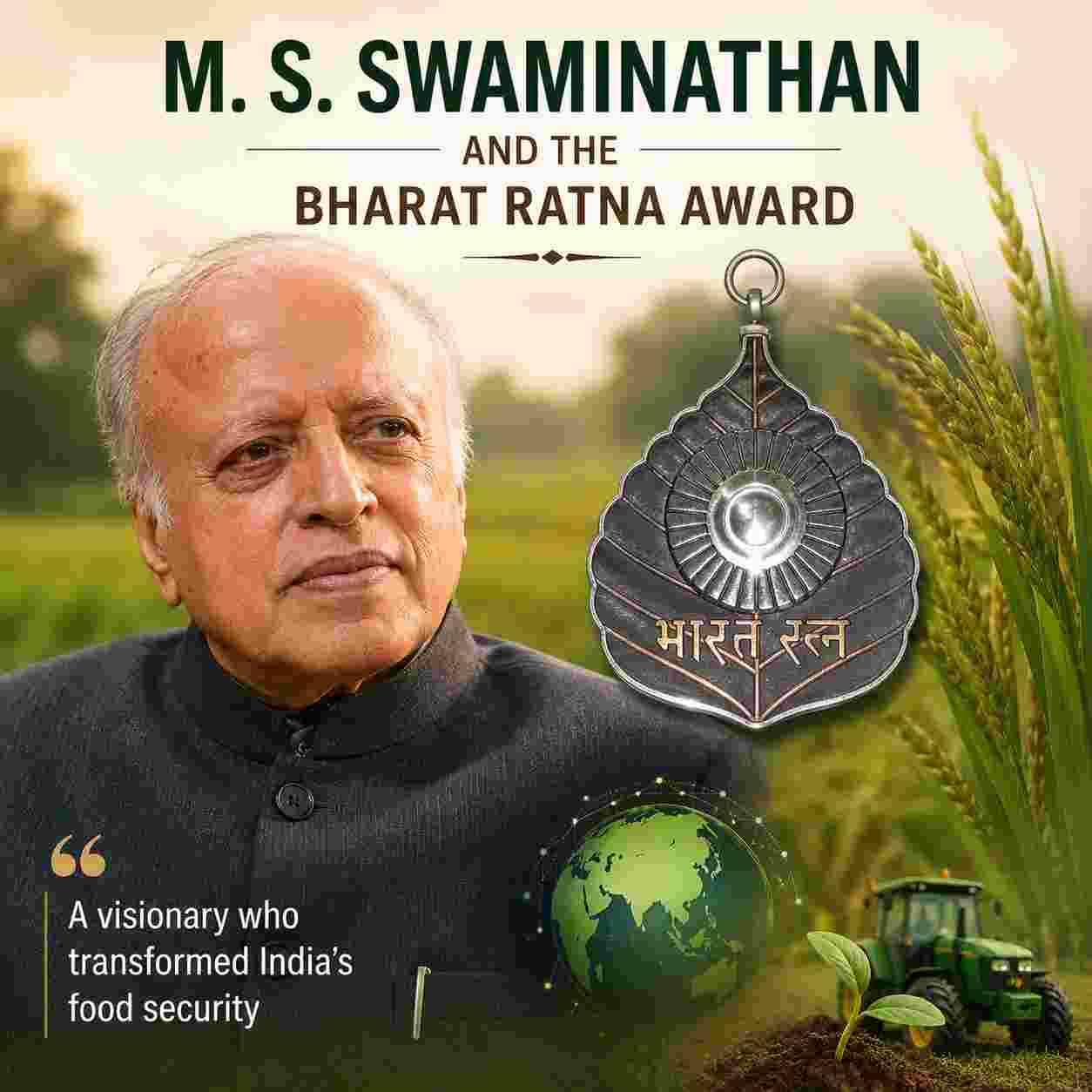
M. S. Swaminathan and the Bharat Ratna Award
On 9 February 2024, Prime Minister Narendra Modi announced that M. S. Swaminathan would be posthumously awarded the Bharat Ratna, India’s highest civilian honour. The man had passed away just months earlier, on 28 September 2023, at the age of 98. But the recognition felt long overdue to anyone who understood what he had done — and what India might have looked like without him.
Bharat Stories put this piece together for anyone who wants to understand who Swaminathan really was, what made his work so significant, and why the Bharat Ratna felt like the right tribute for a life like his.
Table of Contents
A Biography Rooted in a Famine
Mankombu Sambasivan Swaminathan was born on 7 August 1925 in Kumbakonam, in the Madras Presidency. His father was a general surgeon, and the family had originally come from Mankombu in Kerala — which is how the ‘M’ at the start of his name came to be.
His biography takes an unexpected turn early on. His parents wanted him to become a doctor, and he began studying zoology with that path in mind. But in 1943, the Bengal Famine hit. Swaminathan was 18 years old. The famine killed somewhere between two and three million people, and it left a permanent mark on how he thought about science, about farming, and about what his life should be for.
He changed direction. He shifted to agricultural science and never looked back. He cleared the civil services exam, was selected for the Indian Police Service, and walked away from that too — choosing a UNESCO fellowship in genetics in the Netherlands instead. Every time a more comfortable or prestigious path appeared, he chose the one that led back to food and farming.
That kind of clarity about purpose, in a young person in post-Partition India, is genuinely striking.
The Making of an Agriculture Scientist
After his fellowship in the Netherlands, Swaminathan returned to India and joined the Indian Agricultural Research Institute in New Delhi in 1954 as an assistant cytogeneticist. His early research focused on the genetics of rice, wheat, and potato — understanding how plants worked at a cellular level so that they could be made to work better in the field.
As an agriculture scientist, he was building toward something larger than he may even have known at the time. In the early 1960s, he began collaborating with the American scientist Norman Borlaug, who had been developing high-yielding, disease-resistant wheat varieties in Mexico. Borlaug’s seeds were promising. Getting them to actually work in Indian conditions was Swaminathan’s contribution.
He crossbred Mexican dwarf wheat varieties with Japanese strains to create something that would thrive in India’s climate and soil. Then came the harder work — persuading farmers to try it, persuading the government to procure it, pushing through scepticism at every level. In 1966, the Indian government agreed to import 18,000 tonnes of the new high-yielding wheat seeds.
The Green Revolution: What It Was and What It Cost
The Green Revolution is the term that follows MS Swaminathan everywhere, and with good reason. As the driving scientific force behind it, he took India from the edge of famine to food self-sufficiency within roughly a decade.
Here is what that actually involved:
- Introduction of high-yielding varieties of wheat and rice suited to Indian growing conditions
- Widespread use of fertilisers, pesticides, and improved irrigation methods
- Working directly with farmers in Punjab and Haryana to demonstrate and build confidence in the new varieties
- Collaboration between scientists, policymakers, and farming communities at a scale India had never attempted before
- A shift from subsistence-level grain production to genuine surplus, which changed rural economies across northern India
But Swaminathan was clear-eyed about what this kind of farming cost. Intensive fertiliser use, heavy irrigation, and monocultures damaged soil health, depleted groundwater, and created long-term environmental problems in the states that had adopted the Green Revolution most heavily.
This is where his thinking evolved in a way that set him apart from many scientists of his era. He didn’t simply defend what he had helped create. Instead, he proposed what he called an “evergreen revolution” — a longer-term approach to food security that balanced productivity with ecological health.
What the Bharat Ratna Recognises
Swaminathan received the Bharat Ratna posthumously, with President Draupadi Murmu formally conferring the award at Rashtrapati Bhavan on 30 March 2024. It came after a career that had already accumulated a remarkable number of recognitions — all three tiers of the Padma Awards, the first World Food Prize in 1987, the Ramon Magsaysay Award, and the Albert Einstein World Science Award, among dozens of others.
TIME magazine listed him as one of the twenty most influential Asians of the 20th century — alongside Mahatma Gandhi and Rabindranath Tagore. The United Nations Environment Programme called him the “Father of Economic Ecology.” The Bharat Ratna is India’s highest civilian honour. It is awarded for exceptional service to the nation.
His Later Work and Lasting Influence
After stepping back from institutional roles, Swaminathan set up the M. S. Swaminathan Research Foundation in Chennai in 1988. The foundation focused on sustainable agriculture, rural development, and technology access for small farmers and fishing communities — groups that the Green Revolution had not always reached.
His later contributions included:
- Advocating strongly for the rights and welfare of farmers at the policy level
- Heading the National Commission on Farmers, which submitted five reports between 2004 and 2006 recommending that the Minimum Support Price for crops be set at least 50 percent above the cost of production — a recommendation that remains politically significant today
- Developing rice varieties with improved photosynthesis and water-use efficiency
- Promoting gender equity in agriculture and rural development at a time when this was rarely discussed in scientific circles
- Serving as a Member of Parliament in the Rajya Sabha from 2007 to 2013, using that platform to push for farmer-friendly policy
What His Life Actually Means
MS Swaminathan once said that he wanted to be remembered as someone who helped farmers. That’s a modest way to describe a life that changed the food security of a nation with over a billion people. But it also captures something true about how he thought and worked — always with the farmer at the centre, not the science, not the awards, not the international recognition.
He turned down easier paths repeatedly. He chose genetics over the police service. He chose India over better-funded opportunities abroad. He chose sustainable thinking over defending the status quo of the Green Revolution when he saw its flaws. For someone whose biography is full of achievements, what stands out is the consistency of his choices.
Frequently Asked Questions
-
When did MS Swaminathan receive the Bharat Ratna?
The Bharat Ratna was announced on 9 February 2024 by Prime Minister Narendra Modi and formally conferred on 30 March 2024 by President Draupadi Murmu at Rashtrapati Bhavan.
-
Why is MS Swaminathan called the Father of the Green Revolution in India?
He was the principal scientific force behind India’s agricultural shift in the 1960s. His collaboration with Norman Borlaug to develop and adapt high-yielding wheat varieties for Indian conditions, combined with his work in persuading farmers and the government to adopt them, directly led to India becoming self-sufficient in grain production by the early 1970s.
-
What is the Green Revolution and what were its effects on India?
The Green Revolution refers to the period in the 1960s and 1970s when India adopted high-yielding crop varieties, improved irrigation, and modern farming practices that dramatically increased food grain production. Wheat production almost doubled within six years. India moved from food aid dependence to self-sufficiency.
-
What other awards did MS Swaminathan receive besides the Bharat Ratna?
His recognition was extensive — Padma Shri in 1967, Padma Bhushan in 1972, and Padma Vibhushan in 1989. He won the first World Food Prize in 1987, the Ramon Magsaysay Award for Community Leadership in 1971, and the Albert Einstein World Science Award in 1986.
-
What was the MS Swaminathan National Commission on Farmers?
Swaminathan chaired the National Commission on Farmers, which submitted five reports to the Indian government between 2004 and 2006. The most discussed recommendation was that the Minimum Support Price — the price the government pays farmers for their crops — should be set at a minimum of 50 percent above the weighted average cost of production.