

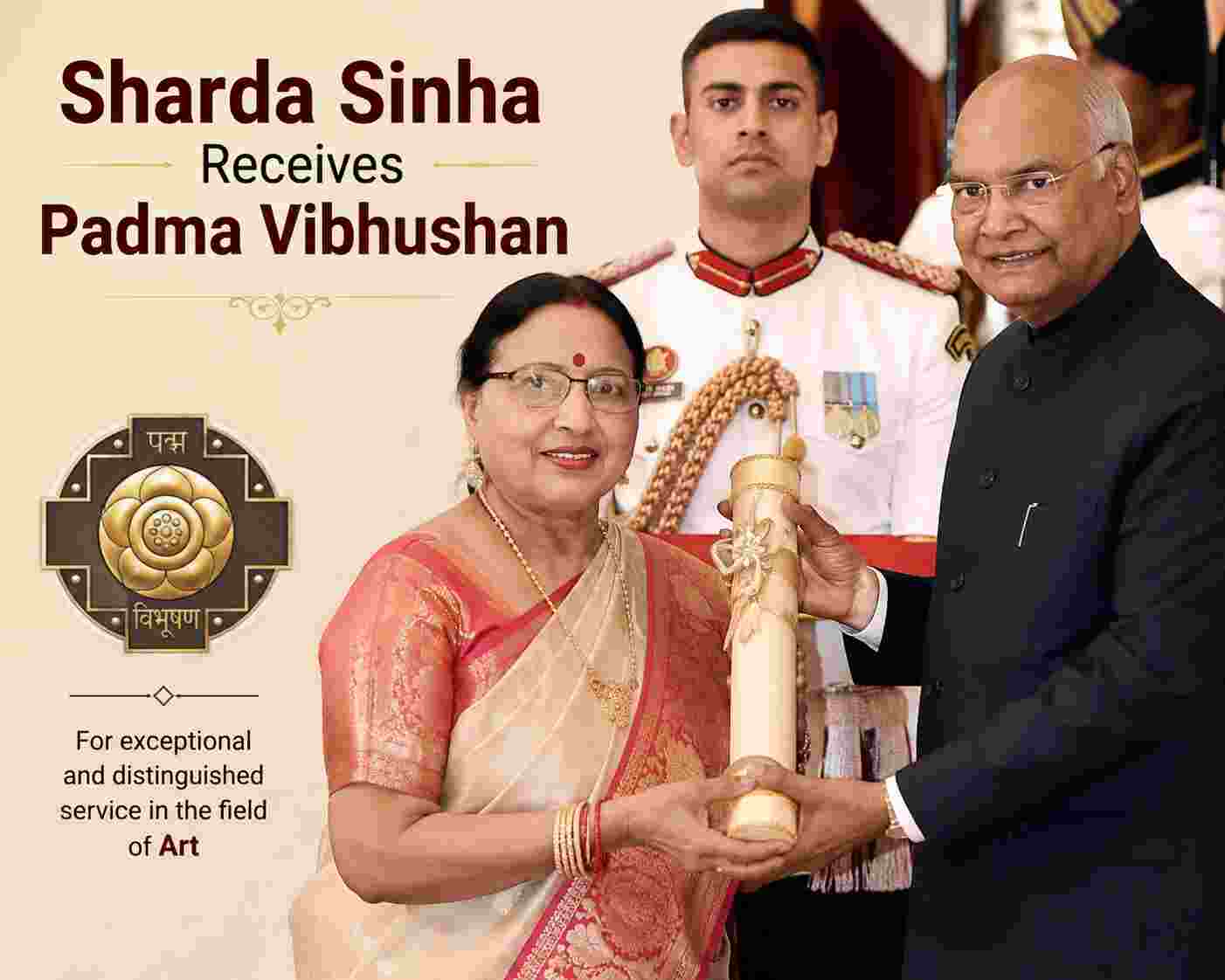
Sharda Sinha Receives Padma Vibhushan
On 25 January 2025, the Government of India announced its Padma awards for the year. Among the names was one that meant something deeply personal to people across Bihar, eastern Uttar Pradesh, and the Indian diaspora wherever Chhath Puja is observed. Sharda Sinha was awarded the Padma Vibhushan posthumously — India’s second-highest civilian honour — just weeks after she passed away on 5 November 2024 at the age of 72.
The Sharda Sinha Padma Vibhushan recognition arrived too late for her to receive in person, but her son Anshuman had specifically requested the government consider her for the honour after her death. When the announcement came, the feeling across Bihar was less celebration and more quiet, grateful acknowledgement — that the country had finally confirmed what the state had known for decades.
It puts this together to honour her life, her music, and what this recognition means.
Table of Contents
A Biography Rooted in Bihar’s Villages
Sharda Sinha was born on 1 October 1952 in Hulas village, Supaul district, Bihar, into a Bhumihar family. She was the only daughter among nine children of Sukhdev Thakur. Growing up in rural Bihar, surrounded by the folk songs of Maithili, Bhojpuri, and Magahi traditions, she absorbed what would become the defining material of her life’s work.
Her biography follows an unusual path for someone of her era. She didn’t simply fall into singing — she pursued it academically. She earned a master’s degree from Patna University and later completed a doctorate in music from Lalit Narayan Mithila University in Darbhanga, one of the few folk singers of her generation to combine formal training with deep roots in oral tradition. That combination gave her music a quality that was simultaneously learned and completely natural.
She married Brajkishore Sinha in 1970. They had two children — a son, Anshuman, and a daughter, Vandana. Her husband passed away in September 2024. She followed just six weeks later, having battled multiple myeloma since 2017. The closeness of their deaths struck people as profoundly sad, and for many who knew her work, it felt like one chapter ending completely.
The Sound of Chhath Puja
If you ask someone from Bihar what Chhath Puja sounds like, there’s a reasonable chance the first voice they hear in their head is Sharda Sinha’s. She recorded 62 Chhath songs across nine albums through major labels including T-Series and His Master’s Voice — a body of devotional work so embedded in the festival that many people assumed the songs had simply always existed.
As a folk singer, she wasn’t just performing existing material. She was recording and preserving songs that might otherwise have faded with the communities that originally sang them. And she did it without losing what made those songs alive — their sincerity, their regional character, their connection to real moments in people’s lives.
Bhojpuri Music and Beyond
Sharda Sinha is most associated with Bhojpuri music and Maithili folk, but her reach went further. She made her mark in Bollywood too — in Maine Pyar Kiya (1989), Hum Aapke Hain Koun (1994), and Gangs of Wasseypur 2 (2012). The song she sang in Hum Aapke Hain Koun is particularly remembered as one of the film’s most emotionally affecting moments, carrying the weight of its subject with a simplicity that elaborate production couldn’t have achieved.
This crossing between folk and film, between Bhojpuri music and Hindi cinema, was part of what made her unusual. She never abandoned her roots to pursue mainstream appeal. She brought her roots with her.
What the Padma Vibhushan Recognises
Sharda Sinha’s relationship with the Padma awards was a progression across three decades. She received the Padma Shri in 1991, the Padma Bhushan in 2018, and the Padma Vibhushan posthumously in 2025. That trajectory — from acknowledgement to the highest tier below the Bharat Ratna — mirrors how her stature grew over time, even as she remained personally committed to the same kind of music she had always made.
The Padma Vibhushan is awarded for distinguished service of a high order to the nation. In her case, it recognised not just the songs she sang but what those songs did — for Bhojpuri music as a legitimate art form, for the folk traditions of Bihar, for the millions of people who found in her voice something that connected them to home regardless of where they were.
She also received the Sangeet Natak Akademi Award in 2000, considered one of the most significant honours in Indian performing arts. Her collection of recognition spans government awards, academic bodies, and the kind of informal, sustained affection from ordinary people that no committee can confer.
Why She Was Called Bihar Kokila
Bihar Kokila — the cuckoo of Bihar — is the title that defines her public identity, and it captures something real about how she was perceived. The kokila in Indian tradition is the bird whose song arrives with the seasons, whose voice signals something about the time of year and the feeling of a place. Sharda Sinha’s voice functioned something like that for Bihar’s Chhath season.
People talk about hearing her songs at the ghat and feeling immediately that the festival had begun in the way it was supposed to. Her voice was a cue — not just musical, but emotional. It told people where they were in the year and what they were supposed to feel. That kind of embeddedness in a community’s seasonal life is almost impossible to manufacture. It builds across decades of consistent, sincere presence.
Her last rites were performed in Patna with full state honours — a recognition that her passing was felt as a public loss, not just a personal one.
A Legacy That Doesn’t Require Upkeep
One of the quieter truths about Sharda Sinha’s legacy is that it doesn’t need anyone to maintain it. Every Chhath Puja, without any institutional effort, her songs are played at rivers and ghats across Bihar and wherever the Bihar diaspora observes the festival. The music is already part of the ritual. The Sharda Sinha Padma Vibhushan confirmed what the people already knew.
Her biography is ultimately the story of a woman who chose a difficult thing — preserving folk music rather than chasing mainstream success — and did it so well that the mainstream eventually came to her anyway.
Frequently Asked Questions
-
When was Sharda Sinha awarded the Padma Vibhushan?
The Sharda Sinha Padma Vibhushan was announced on 25 January 2025 as part of the Republic Day honours list. President Droupadi Murmu formally conferred the award on 27 May 2025. The honour was given posthumously — Sharda Sinha had passed away on 5 November 2024 at the age of 72.
-
Why is Sharda Sinha called Bihar Kokila?
Bihar Kokila means the cuckoo of Bihar. The title reflects how deeply her voice became associated with the seasonal rhythms of the state, particularly Chhath Puja. It was given by the people of Bihar over decades and stuck because it captured something true — her singing felt like a natural part of Bihar’s cultural calendar.
-
What are Sharda Sinha’s most well-known songs?
Among her most recognised works are the Chhath songs Kelwa Ke Paat Par Ugalan Suraj Mal, Bahangi Lachakat Jaaye, and Pahile Pahil Chhathi Maiya. She also sang Babul in Hum Aapke Hain Koun and Taar Bijli in Gangs of Wasseypur 2 — both remembered warmly by Bollywood audiences.
-
What languages did Sharda Sinha sing in?
She sang primarily in Maithili and Bhojpuri, with work also in Magahi and Hindi. Her Bhojpuri music and Maithili folk songs formed the core of her catalogue, but she crossed into Hindi film playback when the right material came.
-
What other awards did Sharda Sinha receive during her career?
Beyond the Padma Vibhushan, she received the Padma Shri in 1991 and the Padma Bhushan in 2018 — giving her all three tiers of the Padma awards across her career. She also received the Sangeet Natak Akademi Award in 2000, one of the most significant recognitions in Indian performing arts.