

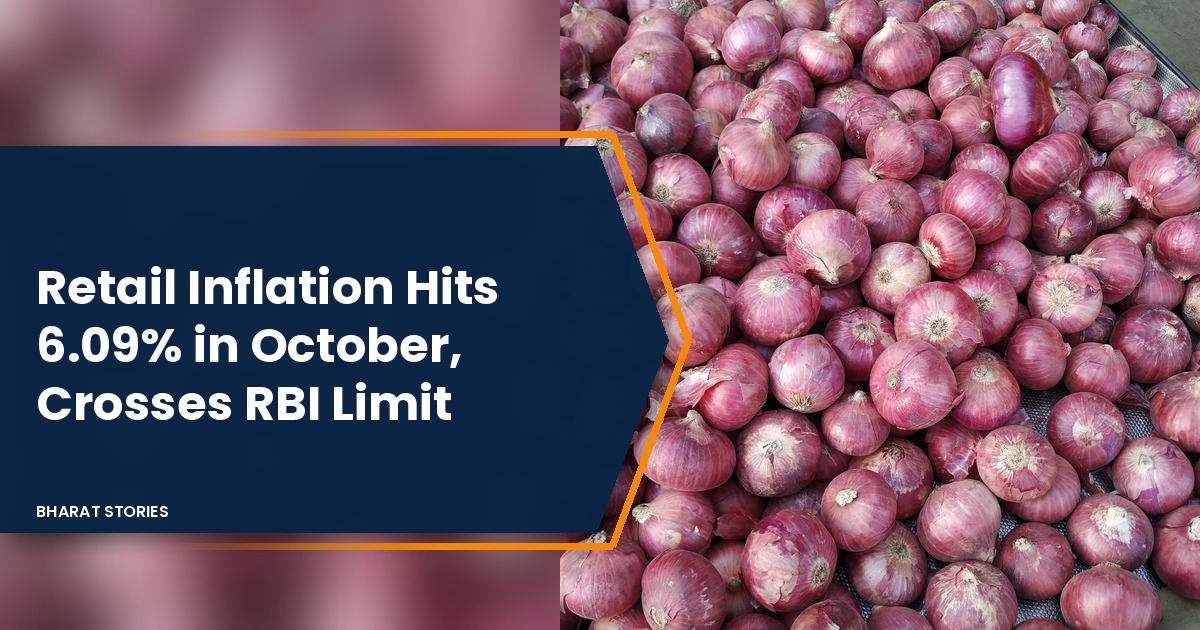

India’s retail inflation rose to 6.09 per cent in October 2026, above the Reserve Bank of India’s upper tolerance limit of 6 per cent. The National Statistics Office under the Ministry of Statistics and Programme Implementation (MoSPI) released the provisional Consumer Price Index figures in New Delhi on Thursday, 12 November. Inflation was 5.54 per cent in September, and food prices did most of the pushing, according to the official MoSPI press release.
Food inflation, measured by the Consumer Food Price Index, climbed to 8.94 per cent from 7.74 per cent a month earlier. Onion prices were up 116.22 per cent on a year earlier. Mint reported that this is the first time inflation has crossed the 6 per cent ceiling since the new CPI series with base year 2024 started in January 2026.
Table of Contents
What does the October retail inflation data show?
The combined CPI rose to 110.05 in October from 109.49 in September. Rural retail inflation was 6.63 per cent, up from 6.08 per cent, while urban inflation was 5.41 per cent, up from 4.88 per cent. Food inflation stood at 9.09 per cent in rural areas and 8.68 per cent in urban areas.
Within the twelve spending divisions tracked by MoSPI, food and beverages showed inflation of 8.51 per cent. Two service divisions rose faster: restaurants and accommodation services at 10.06 per cent, and personal care, social protection and miscellaneous goods and services at 10.14 per cent. Transport was at 5.84 per cent.
The October figure is provisional. MoSPI will release the November index on 14 December 2026, or the next working day if that date is a holiday.
Which items drove prices up?
The MoSPI release names five items with the highest inflation at the all India level:
- Onion: 116.22 per cent, up from 108.13 per cent in September
- Garlic: 60.74 per cent, up from 54.62 per cent
- Silver jewellery: 52.39 per cent, down from 87.82 per cent
- Ginger: 48.32 per cent, down from 62.85 per cent
- Lemon: 47.30 per cent, up from 36.41 per cent
Some vegetables became cheaper. Potato prices fell 14.24 per cent from a year earlier and cauliflower 10.57 per cent, the Business Standard reported from the same data.
Which states saw the highest inflation?
Prices rose fastest in the south and parts of central India. Mint listed Andhra Pradesh, Telangana, Tamil Nadu, Madhya Pradesh, Puducherry, Dadra and Nagar Haveli and Daman and Diu, Uttar Pradesh and Odisha among the places with the highest readings. Delhi, Mizoram, Tripura, Meghalaya and Goa were among those with the lowest.
Business Standard gave rural and urban figures for large states. Andhra Pradesh recorded 7.81 per cent in rural areas and 6.37 per cent in towns, while Delhi was at 5.24 and 3.77 per cent.
Why the 6 per cent mark matters for the RBI
The RBI’s inflation target is 4 per cent, with a tolerance band of 2 per cent on either side. A reading above 6 per cent is outside that band. Business Standard said this was the first breach in two years, and Mint noted that inflation last went above 6 per cent in October 2024, when it reached 6.2 per cent under the old series.
The central bank had already turned cautious. On 7 October its Monetary Policy Committee, chaired by Governor Sanjay Malhotra, voted unanimously to raise the repo rate by 25 basis points to 5.50 per cent and changed its stance to calibrated tightening, according to the RBI’s policy resolution. The committee said inflation and its outlook were “not benign” and projected CPI inflation of 6.0 per cent for the October to December quarter and 5.2 per cent for the full year 2026 to 27. It said rate cuts were off the table in the near term.
Readers can see how that decision changed loan costs in our explainer on the RBI repo rate hike to 5.50 per cent. The committee meets next from 2 to 4 December 2026.
What economists expect next
A Mint poll of 15 economists had estimated October inflation at 6 per cent, so the actual figure came in slightly higher. Several economists quoted by Mint said the data makes another rate increase likely in December.
Ranen Banerjee, partner and leader for economic advisory at PwC India, told Mint that food was the main reason for the breach. “This is seen in the higher rural inflation that stood at 6.6% compared to urban inflation that still printed within the tolerance band at 5.4%,” he said, adding that the committee could raise rates by another 25 to 50 basis points.
Aditi Nayar, chief economist at ICRA, expects a similar reading in November and an average of 6.2 per cent for the October to December quarter, slightly above the RBI’s 6 per cent projection. She told Mint that a further 25 basis point hike in December “appears almost certain”.
How this compares with recent months
October continues a steady climb. The MoSPI data shows combined inflation of 2.74 per cent in January 2026, when the new series began, rising to 4.38 per cent in June, 4.83 per cent in August and 5.54 per cent in September. Our report on September retail inflation covered the onion price surge that was already building then.
Mint pointed out that the new index cannot be compared directly with figures from before January 2026, because it uses 2024 as the base year and weights drawn from the 2023 to 24 Household Consumption Expenditure Survey. Government revenue has held up so far, with GST collections rising to Rs 2.31 lakh crore in October.
What it means for households
For families, food is taking a bigger share of the budget, especially in rural India. If the RBI raises rates again in December, home and car loan EMIs linked to the repo rate could rise further.
Featured image photo: Ravi Dwivedi, CC BY SA 4.0, via Wikimedia Commons. It shows red onions piled on a trolley in India in 2022 and is used here only as an illustration of onion prices. It was not taken for this report.
FAQ
What is the retail inflation rate in India for October 2026?
Retail inflation based on the Consumer Price Index was 6.09 per cent in October 2026, up from 5.54 per cent in September, according to provisional MoSPI data.
What is the RBI’s tolerance band for inflation?
The RBI targets 4 per cent CPI inflation with a tolerance band of 2 per cent on either side, so 6 per cent is the upper limit.
Sources
- Ministry of Statistics and Programme Implementation, 12 November 2026: CPI press release for October 2026, headline, rural, urban and food inflation, divisions, items, monthly series and next release date.
- Mint, 12 November 2026: first breach under the new series, economists’ poll and comments, state rankings and series comparability.
- Business Standard, 12 November 2026: item level prices, state wise rural and urban inflation and the two year comparison.
- Reserve Bank of India, 7 October 2026: Monetary Policy Committee resolution, repo rate, stance, projections and next meeting dates.