

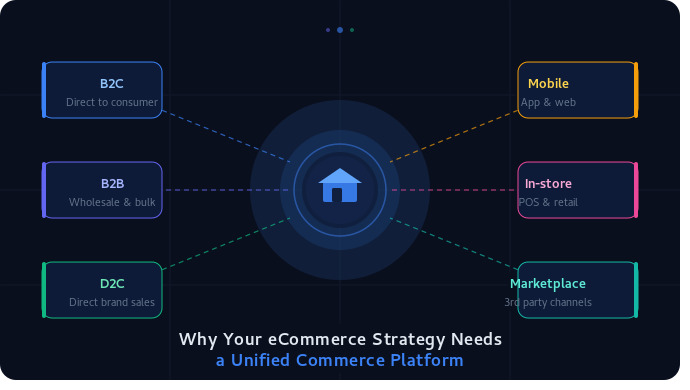

The way people shop has changed so drastically in the last few years that businesses running on fragmented systems are quietly bleeding revenue without even realising it. A customer browses your product on their phone during a lunch break, adds it to cart on their laptop at home, and then walks into a physical store expecting the staff to know exactly what they were looking at. If your backend can’t keep up with that journey, you’ve already lost them.
This is the core problem that unified commerce is trying to solve and why more enterprise brands are making the switch right now.
Table of Contents
The Real Cost of Disconnected Systems
Most growing businesses end up with a patchwork of tools: one platform for their online store, another for inventory, a separate CRM, and maybe a third-party logistics solution bolted on top. Each works fine in isolation. Together, they create data silos, sync delays, and customer experiences that feel fractured.
The numbers tell the story clearly. Cart abandonment rates hover around 70% across industries, and a significant chunk of that comes down to trust issues — slow load times, inconsistent pricing across channels, or a checkout experience that feels clunky. These are problems that better infrastructure can actually fix.
When your commerce operations run from a single, connected platform, everything from product discovery to post-purchase communication becomes faster and more coherent. Inventory updates in real time. Customer data flows between touchpoints. Your team spends less time reconciling spreadsheets and more time making decisions.
B2B Commerce Is No Longer the Quiet Side of the Industry
For years, B2B brands treated their digital presence as a secondary concern. Sales happened through reps, phone calls, and annual contracts. The website was more of a brochure than a revenue channel.
That’s rapidly changing. Buyers even in wholesale and manufacturing now expect the same seamless experience they get as consumers. They want self-service portals, transparent pricing, easy reordering, and real-time stock visibility. They want to place a bulk order at 11pm without waiting for a sales rep to pick up the phone.
Platforms built specifically for this like Dhumi Commerce are gaining serious ground because they address the operational complexity of B2B without sacrificing the experience quality that B2C brands have spent years perfecting. When B2B teams can automate procurement workflows and handle large catalogs without manual intervention, the efficiency gains compound fast.
What “Conversion” Actually Means in 2026
The conversation around conversion rate optimisation has matured. It’s not just about tweaking a button colour or shortening a form. True conversion improvement now comes from deeper alignment between what customers expect and what your platform can actually deliver.
Personalisation is a big part of this. When a returning customer lands on your store, the experience should reflect their history — their preferred categories, past purchases, saved items. This isn’t a luxury feature anymore. Studies consistently show that personalised experiences drive significantly higher order values and repeat purchase rates.
Speed matters just as much. A one-second delay in page load time can drop conversions by 7%. Most brands know this, but fewer take it seriously enough to act on it especially when their site is running on legacy infrastructure that hasn’t been touched in three years.
The Case for Consolidation
There’s a growing argument in the industry for radical simplification: instead of managing five different tools that talk to each other imperfectly, use one platform that handles all of it natively.
The benefits go beyond convenience. A consolidated stack means:
- Fewer points of failure when something breaks
- Cleaner data for reporting and decision-making
- Faster onboarding when you hire new team members
- Lower total cost of ownership over time
This is particularly relevant for mid-market and enterprise brands that have grown organically and now find themselves maintaining a tech stack that’s become more of a liability than an asset.
Getting the Foundation Right
The businesses seeing the strongest results from their commerce investments right now share a few common traits. They’ve invested in understanding their customer journey end to end. They’ve chosen infrastructure that’s built to scale, not just to launch. And they’ve treated their online store not as a cost centre but as a core revenue engine that deserves the same strategic attention as any other part of the business.
If your current setup is making growth harder than it should be, that’s not a sign to work around it. It’s a sign to rethink it from the ground up.
The brands that do that work now will be the ones setting the benchmark a few years from now. The ones that don’t will still be reconciling spreadsheets while their competitors are scaling.