

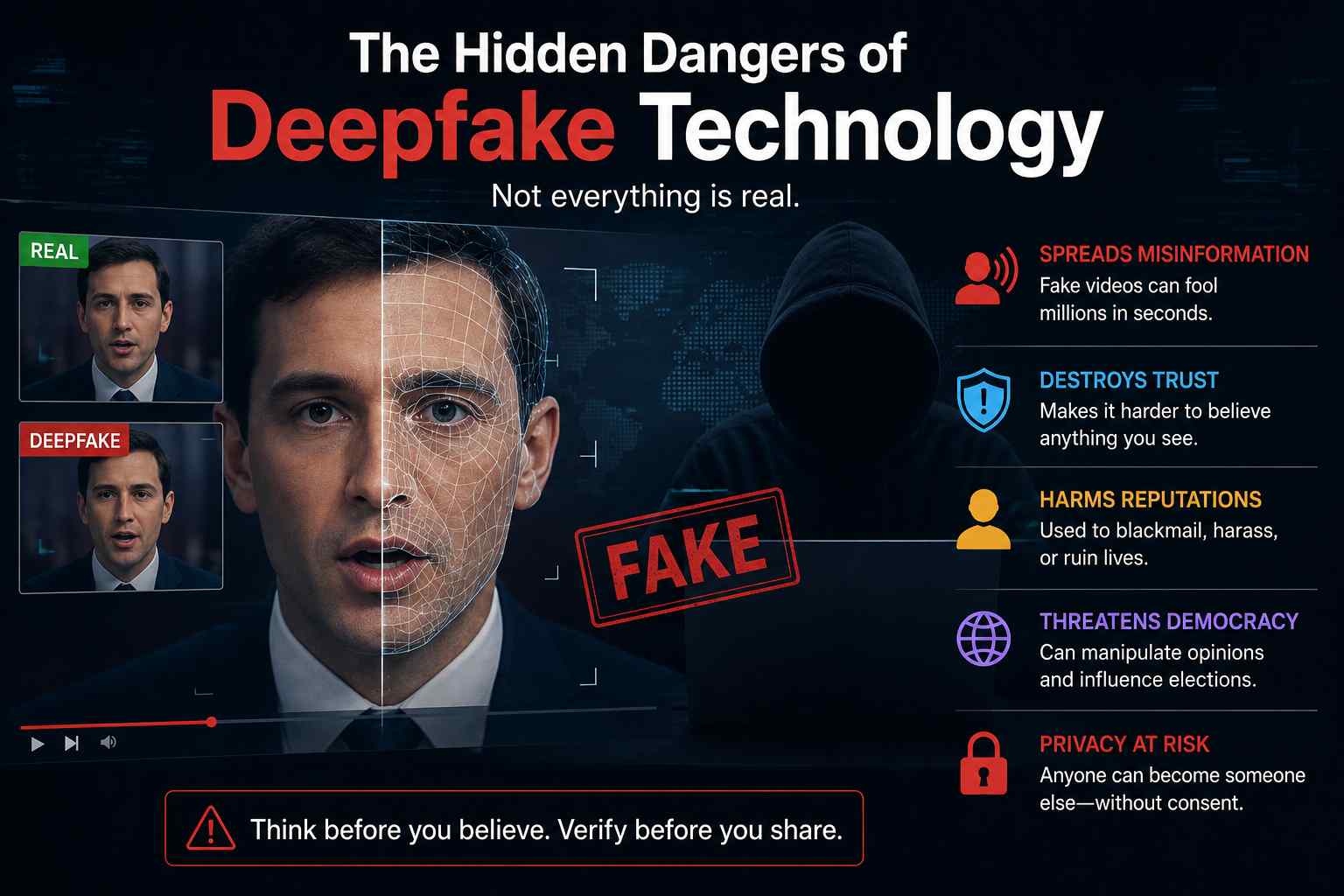
The Hidden Dangers of Deepfake Technology
Deepfake is a noteworthy use of AI that’s seeing rapid growth. It will allow computers to produce videos, pictures, and sounds that make anyone look as if they said or did something they didn’t. This technology has business applications of its own amusement, learning, media, too but it also poses hugely dangerous scenarios.
The availability of such deepfakes is increasing, and with it, criminals have grown adept at using them for attacks such as fraud and identity theft, as well as for spreading misinformation. Many deepfakes are highly realistic representations of content, and it’s often hard to distinguish between real and fake.
Now more than ever, it is important that individual information is protected in the digital world and that digital safety is ensured, which is only possible if one is aware of these risks.
Table of Contents
What Is Deepfake Technology?
The deepfake technique can be considered an emerging deep technology that relies on two computing worlds— artificial intelligence and machine learning. AI can create audio, video, and images from existing ones, making it hard to determine whether it’s human-made or AI-generated.
This can result in a bogus video, image, or audio that looks real. Even careful picture observers sometimes have difficulty identifying manipulations. The applications of deepfakes started with creative and entertaining uses, but they are now gaining traction in cyber crime, misinformation, and fraud.
Why Deepfakes Are Becoming More Common
The deepfake technology has risen to the forefront for various reasons.
-
Easy Access to AI Tools
In fact, there are numerous AIs available online that can help you generate realistic digital content without requiring you to have all the knowledge.
-
Publicly Available Content
There are tons of images, videos, and audio on social media websites. Criminals could leverage this to create deepfakes of real people.
-
Faster Technology
Modern computers and cloud services are fast at processing data, making it faster and cheaper to use AI to create deepfakes.
-
Rapid Sharing Online
This content is easily absorbed and circulated online, leading many people to trust the manipulated media before it has been fact-checked.
This has led us to have an increasing number of scams and frauds on the Internet for the following reasons:
The Connection Between Deepfakes and AI Fraud
What makes deepfakes so dangerous isn’t just that they can be very difficult to detect, but also that they can incorporate artificial intelligence (AI) to commit fraud. Fraudsters have recently begun using tactics to mislead individuals or organizations.
For instance, scammers can record staff audio to obtain financial transfer or private facts. Should the sick call be accepted as being authentic, employees could fall prey to the scam. Similarly, fake video and/or phone contacts with loved ones may also be arranged for an emergency transfer. This can make AI fraud very effective as these methods seem genuine.
How Deepfake Scams Target Individuals
The number of deepfake scams continues to increase as technology advances.Fake Emergency Calls
Scammers can make it sound like when a loved one’s voice changes, they can impersonate their voice and contact their relatives, requesting immediate financial assistance.
Identity Theft
Deep Fakes can be used during the verification phase to impersonate people and to facilitate entry to accounts.
Romance Scams
AI can be used to generate images and videos that can be used to create fake identities and lures. Once they have gained your trust, they’ll likely ask you for money or personal details.
Job Scams
Some fake recruiters use AI-generated videos to solicit sensitive information from applicants. Some fake recruiters have created AI-generated videos prompting applicants to reveal sensitive information.
These are just a few examples in which deepfakes can impact people.
Business Risks Associated with Deepfakes
The use of deepfakes has become more prevalent and poses an increasing threat to organizations. Digital messaging, such as video meetings, emails, and voice calls, is an important mode of communication for businesses. Human resources criminals take advantage of the fact that executives, clients, or suppliers trust them.
Common risks include:
- Fraudulent payment requests
- Theft of confidential information
- Reputation damage
- Social engineering attacks
- Unauthorized access to systems
- Fake company announcements
A number of organizations are requesting additional evidence before approving critical transactions.
Deepfakes and Cyber Crime
Deepfakes can be an extremely useful tool for cybercriminals. Many deepfake schemes do not attack computer systems but instead target people.
Common examples include:
- Voice cloning attacks
- Fraudulent customer service calls
- Social media impersonation
- Fraudulent business meetings
- Fake investment offers
These are techniques used to win over victims’ trust and convince them to divulge sex-specific information or send funds. As Deep Fakes become increasingly realistic, cyber crime investigations can become more difficult.
The Spread of Misinformation
Deepfakes have a huge potential to manipulate public opinion with the help of the spreading of fake information. A realistic fake video can grab one’s attention online very quickly, particularly if trying to attract attention to public figures and/or very important events. People may distribute the material without verifying its authenticity.
Once you’ve been misled into believing a deepfake, you can continue to spread misinformation. This is also bad for a reputation and loss of trust in a reliable source of information. Manipulated media is becoming more prevalent as we use multiple media to watch television or radio programs; footwork must be carefully looked at to ensure that the facts are correct.
Emotional After-Effects on Victims
Deep fake abuse has emotional and psychological impacts, often on the sufferers. An infringement of a person’s face or voice can have repercussions beyond financial. The affected might be embarrassed, which may adversely affect relationships and even job security.
Common consequences include:
- Anxiety and stress
- Loss of privacy
- Reputation concerns
- Emotional distress
- A decline in trust in online platforms
If you are like many, it can be tricky and nuanced to determine which of these is real and what is fake.
Why Digital Safety is Important
In today’s era of advanced technology, such as “deep fakes,” some precautions are necessary with regard to digital safety. Information even on the Internet cannot be taken for granted as “right,” such as a picture, or a video.
Best practices for digital activities promote users’ skepticism towards bogus messages and results, which helps mitigate the risk of users falling for financial fraud.
-
Verify Requests
Verify and/or confirm any amount/large quantity of information securely.
-
Limit Public Content
Restricted reproductive capabilities with a lesser amount of personal images, videos, and voice recordings.
Look for Warning Signs
If the person performing the face movement has an unusual effect in their movement, lips do not line up with speech, speech does not sound normal, etc., then the lips may not have been manipulated properly, or there may be a problem with lip-syncing.
Strengthen Security
If you are using a critical account, employ strong passcodes and have 2-step verification.
Stay Informed
Clients need to be aware of the risks they are exposed to and learn how to identify risks/scams through Artificial Intelligence (AI)-powered online scam tools.
Report Suspicious Activity
Issuing warnings to platforms, financial institutions, or authorities about any fraudulent aspect of the Deepfakes.
Conclusion
Deepfake technology offers useful opportunities in entertainment, education, and media creation. However, its misuse presents serious challenges for individuals, businesses, and society. From identity theft and financial fraud to misinformation campaigns, the risks continue to increase. The rise of deepfake scams highlights the importance of stronger digital safety practices and greater awareness of artificial intelligence misuse.
By verifying information, maintaining secure online habits, and staying informed, people can reduce their exposure to AI fraud, cyber crime, and other online scams. As technology continues to advance, awareness and caution will remain essential for protecting privacy, security, and trust in digital communication.
FAQs
What are deepfake scams?
Deepfake scams are a type of scam in which AI technology is used to create videos, images, or audio recordings that appear to be from a real person but aren’t.
How does AI fraud use deepfakes?
AI fraud is a type of scam that leverages deepfakes to create believable impersonations that deceive individuals into wiring money, revealing personal information, or granting access to accounts.
Can deepfakes be detected?
Yes. The use of detection software, expert analysis, and careful observation can help to detect manipulated content; however, the difficulty of recognizing advanced deepfakes remains.
What should people do to stay safe online from scams?
You can help create a safe digital environment by confirming requests, using strong passwords, enabling 2-factor authentication, being mindful of public information, and staying up to date on new online scams.