

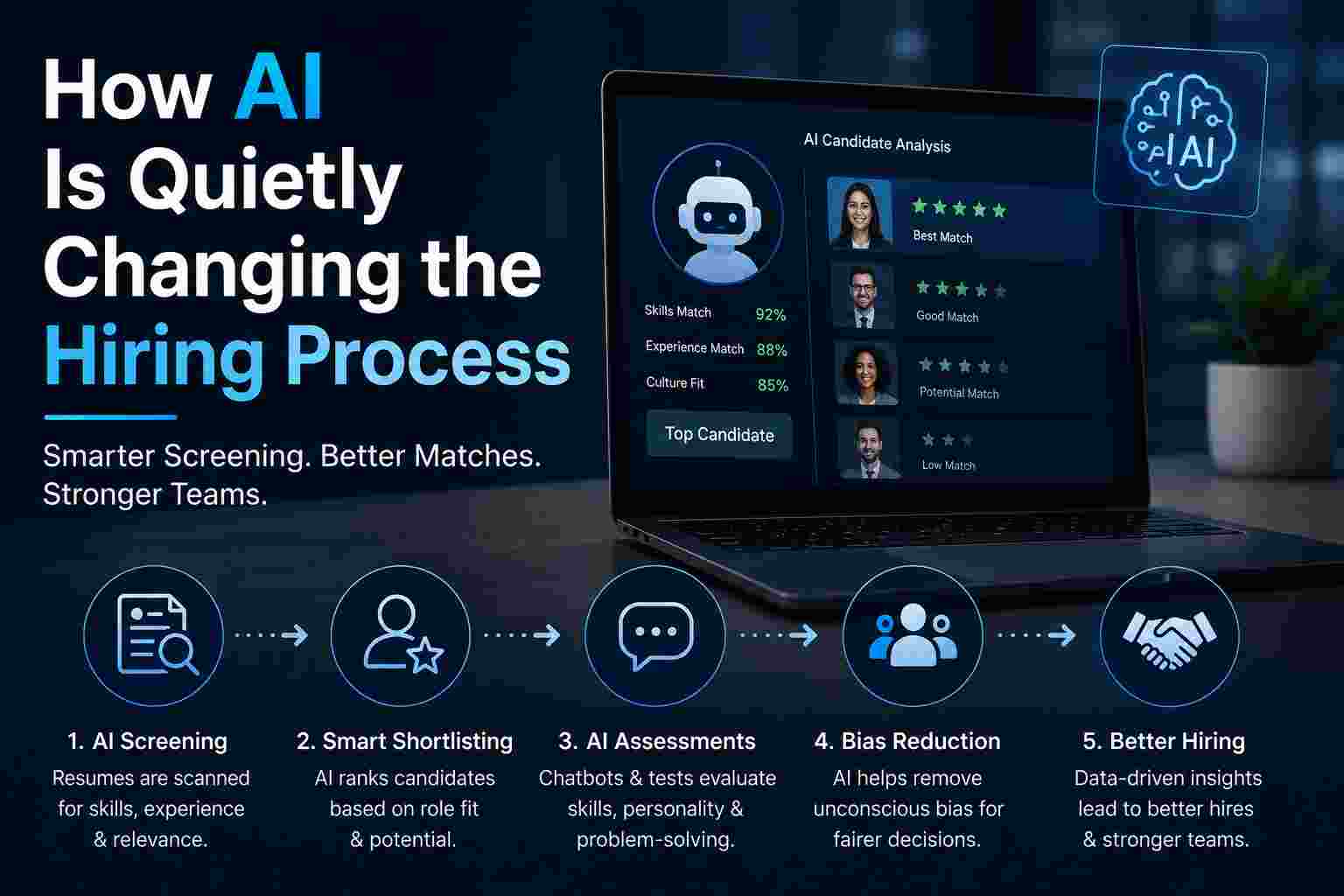
How AI Is Quietly Changing the Hiring Process?
It is easy to see that this is a case of a changed hiring world in the past few years. Previously, HR professionals had to review every application manually, but now tasks are far more likely to be completed with technology that processes information faster. When measured against the standards of the recruitment world, the role of artificial intelligence (AI) is increasingly vital, as it enables organizations to recognize competent candidates, streamline applications, and accelerate the process.
Many employers are already using this AI recruitment software to manage repetitive tasks, and recruiters receive more time to give due attention to candidates for final hiring decisions. But if you’re looking for work, being aware of the impact of artificial intelligence on hiring can make your job applications more effective and help you prepare for today’s hiring strategy.
Table of Contents
What Is AI Recruitment?
With the advent of AI, the concept of AI in recruiting centers on leveraging its capabilities to support the recruiting process. One of the many tasks these systems can perform is to examine resumes, match skills with job requirements, set appointments, and rate resumes according to job qualifications.
AI should be used to aid the recruiter, not replace them. Rather, it helps them manage a large number of programs more effectively. Candidates often come in the thousands for a single position, and with AI, they can scour the pile for qualified candidates. AI recruitment is now a part of businesses’ talent acquisition strategies, as they evolve with the times.
Why Employers Are Using AI
Getting through on the line can be stressful for a recruiter when pressed for time to hire qualified candidates. Automated processes enabled by AI save time on hiring personnel for manual work and free up their energy for more critical tasks.
Here are some of the benefits you’ll enjoy:
- Faster application screening
- Reduced administrative workload
- Improved structure of candidate information
- Consistent evaluation methods
- Better matching of competencies and job specifications
The Growing Importance of ATS Software
An Applicant Tracking System scrapes and centralizes job applications. Modern ATS software often includes AI features to help screen resumes and pinpoint applicants who meet a position’s criteria. Often, candidates fill out applications online, and an ATS scans their resumes before being seen by a recruiter.
The system searches for skills, skill backgrounds, qualifications, certifications, and keywords of the job. As a result, job seekers should ensure their resumes clearly highlight the skills and experience relevant to the position they are seeking.
How ATS Software Reviews Resumes
The majority of the ATS systems take into consideration:
- Relevant job skills
- Work experience
- Educational qualifications
- Certifications
- Industry-specific keywords
- Position-related achievements
Having simple formatting and adding keywords for the job will certainly make the application appear even better in an automated screening process.
How AI is changing Resume Screening
One of the most labor-intensive parts of the hiring trends in the past was screening, which required many person-hours to review hundreds of applications manually. The AI can now help recruiters sift through applications and filter out those that don’t meet their criteria, saving time. You will not have to view all resumes; instead, you will be able to review a smaller set of resumes that have qualified for more in-depth consideration.
Candidates are advised, however, to keep in mind that an AI system is different from a human. You might not be seen at the screening stage if you miss any skills or if your screenings don’t specify which skills to look for.
The Dawn of AI Interviews
In certain organizations, the process goes so far as to require candidates to give a video before a Recruiter. Interviews may consist of prerecorded questions, and applicants respond within a specified time limit. AI interviews evaluate businesses’ communication skills, job-related knowledge, and responses to challenges. Certain systems can assist recruiters in organizing and reviewing interview answers much more successfully.
Applicants could be affected by:
- Recorded video responses
- Timed interview questions
- Automated assessments
- Behavioral interview scenarios
- Communication evaluations
Preparation remains important. Candidates must be organized and answer the question confidently, clearly, and professionally on camera.
How AI Helps Recruiters Find Candidates
In addition, AI is transforming the talent acquisition process. Companies are also transforming their talent-recruiting approach for talent with the help of AI. Instead of searching resumes for relevant keywords and phrases, recruiters can rely on AI tools to scan all professional profiles and identify those that match the professions they are interested in. This makes it easier for a corporation to connect with the right prospects that might not be looking for jobs.
The future of AI and Job Hunting
Today, technology plays a significant role in almost every aspect of the job search process. From application submission to scheduling interviews, AI is shaping candidate-employer interactions. Having a grasp of these systems will allow us to better guide some job seekers in preparing more effectively.
Tips for a Better Job Search
Candidates can strengthen their job search efforts by:
- Customizing resumes for each position
- Including relevant keywords
- Using simple resume formatting
- Maintaining professional profiles, Practicing Video interviewee skills
- Researching a company’s hiring methods
Key Hiring Trends Influenced by AI
As the use of AI in hiring continues, there are significant trends to watch.
Faster Recruitment
Companies can automatically send candidates through various hiring trends, thereby speeding up the process. Various other tasks that used to take days to complete – such as screening and scheduling – can be done in much less time.
Greater Focus on Skills
In an era when employers are increasingly focused on skills rather than just job titles and diplomas, the majority of recruitment specialists consider soft skills the top competency for assessing applicants. As recruiters increasingly prioritize practice over degrees and job titles, most experts in their field believe that soft skills are the No. 1 competency criterion.
Data-Based Decisions
AI tools can sift through candidate data and aid hiring decisions through quantifiable metrics and information.
Remote Hiring
The use of virtual interviews and online assessments is now a common practice. AI enables companies to recruit across locations. AI enables companies to assess applicants, regardless of where they reside.
Such recruitment trends result from the evolving landscape of hiring expectations in today’s world.
Challenges Associated With AI Hiring
Any human-hiring-based process has the potential to reinforce “bias in historical hiring practices,” according to some experts. Automated systems may be problematic if they fail to land with a qualified candidate and are not monitored closely. Many companies regularly check their recruiting technology and retain people based on it, for this purpose.
Why Human Recruiters are Still Necessary
While AI is adept at processing information at speed, it cannot fully grasp work dynamics, motivation, aspirations, career goals, or personality. Judgment, experience, and first-hand knowledge of the person are something that technology can’t replace and what humanize recruiters’ offerings.
This balance can help organizations attract their ideal candidates and establish an advantageous recruiting process.
What the Future Holds
AI will continue to offer insights into recruitment, further shaping the future in new ways. New technologies may enable improved selection matching, improved skills testing, and more individual-based, user experience, and application interactions.
In the recruitment sector, it’s crucial to be educated about the current changes in AI recruitment technologies, AI interview techniques, and new interviewing trends for job seekers. Artificial Intelligence is transforming organizations’ recruitment practices without anyone’s knowledge. These days, technology has facilitated numerous aspects of the recruitment process, from ATS software and automated resume screening to interview technology and even candidate matching.
FAQs
What is AI recruitment?
AI recruitment involves leveraging AI technologies to support the recruitment process, including screening resumes, assessing applications, scheduling interviews, and finding suitable candidates.
How does ATS software work?
All required software automatically scans applications and segregates them based on the skills, experience, and keywords in the job posting, being matched to applications.
Is AI interviewing mainstream?
Yes. As stated, that is what many firms are now doing – they are verifying candidates’ suitability in the initial hiring with AI interviews, before booking them for an interview with someone in the company.
How can job seekers succeed in an AI-driven hiring process?
Use keywords uncommon in resumes, neatly outline resumes for each position sought, and be ready for virtual interviews and assessments.