


Small borrowers and first time business owners will keep their safety net for five more years. The Union Cabinet on Wednesday, 11 November 2026, approved the continuation of the Stand Up India scheme and of the Credit Guarantee Fund for Micro Units, which backs loans under the Pradhan Mantri Mudra Yojana, until 31 March 2031, according to official statements released after the meeting.
The two decisions together carry a guarantee corpus of Rs 9,111 crore: Rs 5,000 crore for the micro units fund and Rs 4,111 crore for Stand Up India. They were part of a wider set of approvals worth Rs 77,101 crore that Union Minister Ashwini Vaishnaw announced at the Cabinet briefing, which also covered a national museum in North and South Block, a Noida metro extension and fertiliser subsidy for the rabi season.
Table of Contents
What the Stand Up India scheme offers until 2031
Stand Up India was launched in April 2016 to help women, Scheduled Caste and Scheduled Tribe entrepreneurs start new enterprises. The Press Information Bureau said it has so far helped more than 2.75 lakh such borrowers get bank loans. For the next five years the government has set a target of at least 2.5 lakh additional entrepreneurs.
The basic terms stay familiar. Loans above Rs 10 lakh and up to Rs 1 crore are available for greenfield units, meaning businesses being set up for the first time, in manufacturing, services, trading and activities allied to agriculture. Borrowers can take a term loan or a composite loan that mixes term finance with working capital, and the loan can cover up to 85 per cent of the project cost.
The credit guarantee given to banks will cover 85 per cent of the loan amount, with a standard guarantee fee of 0.50 per cent. The Hindu BusinessLine reported that the fresh corpus targets an average of two loans per bank branch, that there is no extra risk premium on top of the fee, and that the 85 per cent cover now applies to all loan sizes. It also said entrepreneurs will receive handholding through the loan process and the early years of the business.
Mudra guarantee fund gets a lower fee
The second decision concerns the Credit Guarantee Fund for Micro Units, set up in January 2016. It protects lenders against default on small loans and is run through the National Credit Guarantee Trustee Company. Under the approved terms it will guarantee three kinds of credit: Mudra loans of up to Rs 20 lakh to micro enterprises, overdrafts of up to Rs 10,000 on Jan Dhan accounts, and loans to self help groups where the portfolio is between Rs 10 lakh and Rs 20 lakh.
The biggest change is the price of the cover. The annual guarantee fee paid on eligible loans comes down from 1 per cent to 0.75 per cent. Self help groups will keep paying the existing rate of 0.25 per cent in the first year and 0.50 per cent after that. Coverage will also be tied more closely to what lenders actually have at risk: the disbursed amount for working capital limits and the outstanding amount for term loans.
Speaking to reporters, Vaishnaw said, as quoted by The Economic Times, that “several changes have been made, such as reducing the guarantee fee to lower costs and ensuring an increase in the total amount of credit available.” The government expects the Rs 5,000 crore corpus to support Mudra loans worth Rs 12.6 lakh crore over the next five years, covering all such loans given during the 16th Finance Commission cycle from 2026 to 27 through 2030 to 31.
How big Mudra lending has become
The official figures show the scale the guarantee fund now sits behind. As of September 2026, lenders had sanctioned more than 60.36 crore loans worth Rs 43.34 lakh crore since the Mudra scheme began. The official statement credits the guarantee fund with acting as a major catalyst for that growth, since banks are more willing to lend without collateral when part of the risk is covered.
Prime Minister Narendra Modi called the approval “a major boost for India’s aspiring entrepreneurs, especially our youth” in a social media post quoted by the BusinessLine, and said the aim was to help more young Indians “turn their ideas into enterprises, create opportunities and become job creators.”
What it means for borrowers
For a first time borrower, the practical effect is continuity. Banks will keep receiving a guarantee on Mudra and Stand Up India loans, so the schemes can go on offering credit without asking for collateral. The lower fee on Mudra loans reduces the cost of that cover for lenders, which the government hopes will make banks more willing to lend to very small units.
The rest of the Cabinet package was summed up by Mint. It includes Rs 62,370 crore in nutrient based subsidy on phosphatic and potassic fertilisers for the rabi 2026 to 27 season, an 8.449 km Aqua Line extension from Noida Sector 51 to Greater Noida Sector 4 costing Rs 2,390 crore, and Rs 3,230 crore for the Yuge Yugeen Bharat Museum.
Last month, on 6 October, the Cabinet also cleared a separate Rs 10,000 crore fund for small and medium firms meant to help growing companies scale up. Readers weighing a first venture can look at our list of small business ideas with low investment, and our piece on India’s young founders looks at how a new generation is building companies.
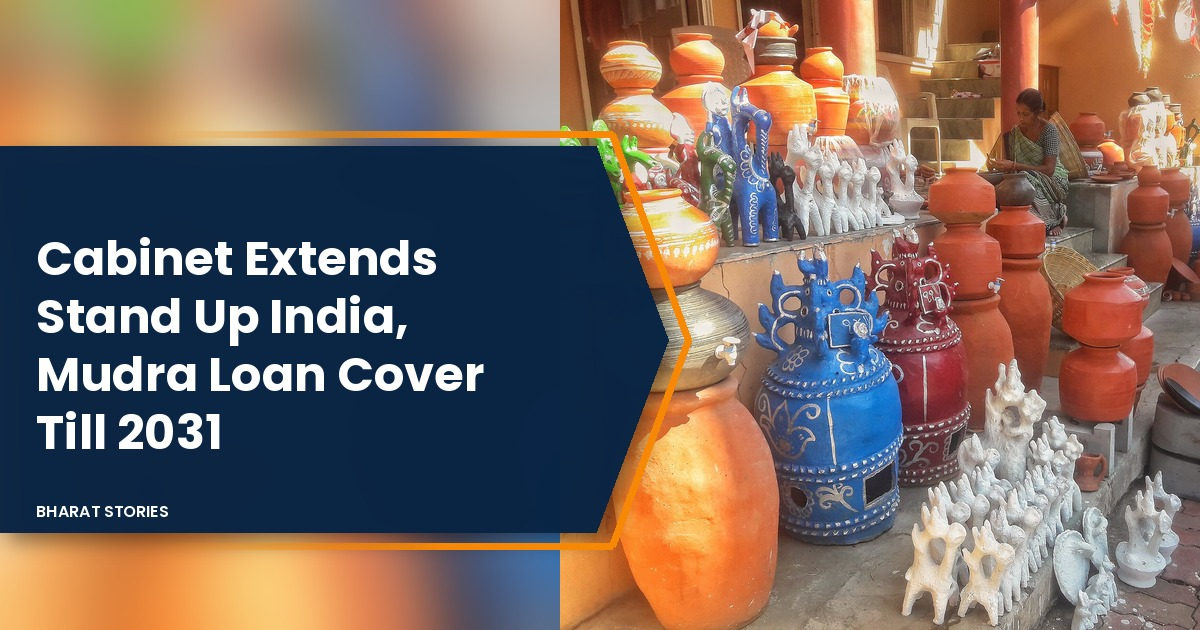
Featured image photo: Chalunote, CC BY SA 4.0, via Wikimedia Commons. It shows a small home based shop selling handmade clay and craft items for the Adivasi community and is used here only to illustrate small enterprise in India. The shop has no connection to either scheme.
FAQ
Who can apply under the Stand Up India scheme?
Women, Scheduled Caste and Scheduled Tribe entrepreneurs setting up a new enterprise in manufacturing, services, trading or agriculture allied activities, for loans above Rs 10 lakh and up to Rs 1 crore.
What changes for Mudra loans?
Mudra loans of up to Rs 20 lakh stay covered by the guarantee fund until March 2031, and the annual guarantee fee on eligible loans falls from 1 per cent to 0.75 per cent.
How much money has been set aside?
Rs 5,000 crore for the micro units fund and Rs 4,111 crore for Stand Up India, a combined Rs 9,111 crore.
Sources
- Press Information Bureau, 11 November 2026: Cabinet approves continuation of Credit Guarantee Fund for Micro Units (coverage, fee cut, corpus, Mudra figures).
- Press Information Bureau, 11 November 2026: Cabinet approves continuation of Stand Up India scheme (eligibility, loan size, cover, target).
- Cabinet briefing presentation, 11 November 2026: amounts for all five decisions and the Rs 77,101 crore total.
- The Economic Times, 11 November 2026: Ashwini Vaishnaw’s remarks on the changes.
- The Hindu BusinessLine, 11 November 2026: Prime Minister’s post, two loans per branch target, no extra risk premium, handholding.
- Mint, 11 November 2026: full list of the day’s Cabinet decisions.