

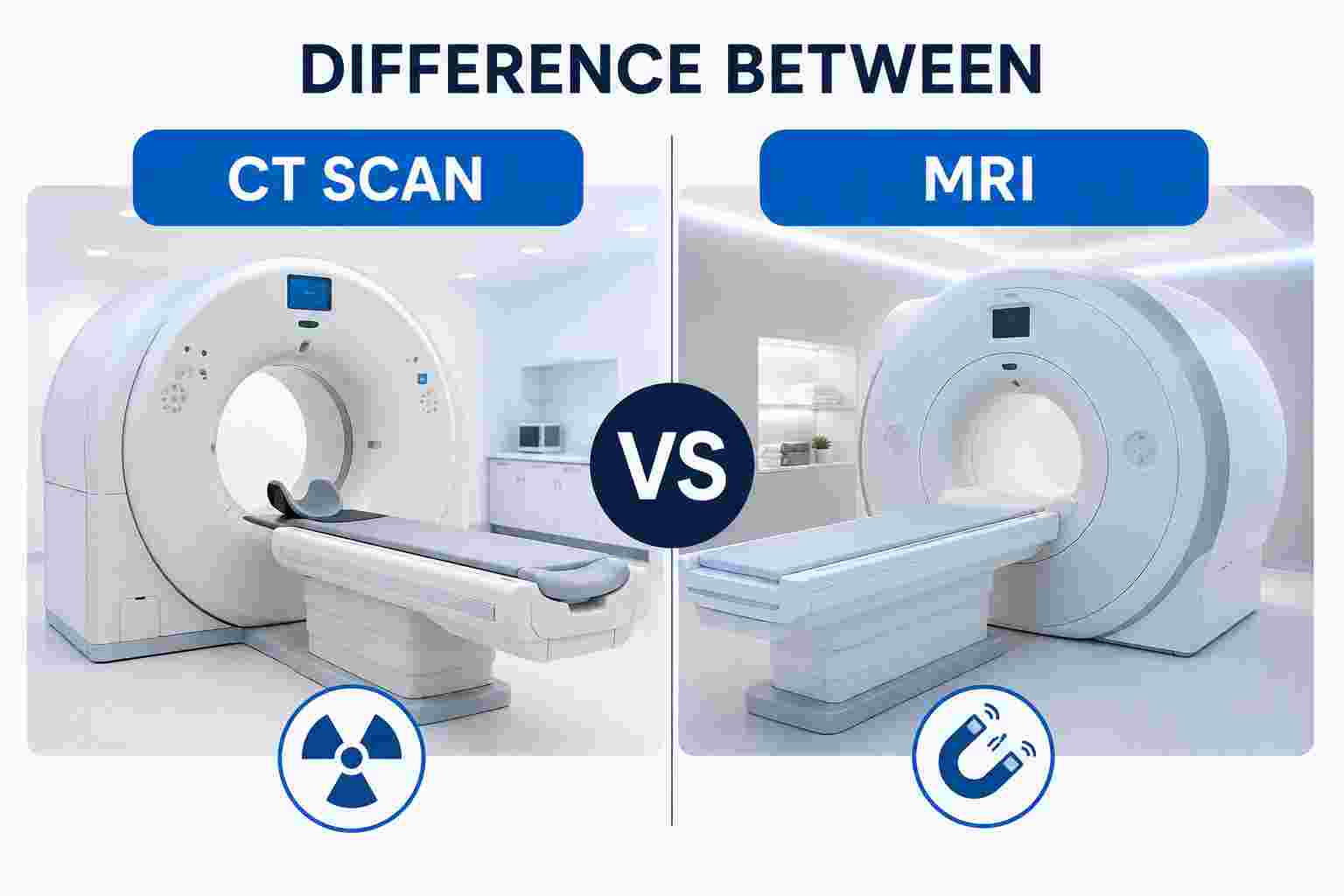
Difference Between CT Scan and MRI
When a doctor says you need a scan, most people nod and then quietly wonder — which kind? And does it really matter? The answer is yes, it matters quite a bit. The choice between a ct scan vs mri is not just about the machine. It is about what the doctor is trying to see, how quickly they need to see it, and what is safe for the person being scanned.
This article breaks down what each scan does, where one works better than the other, and how to make sense of what your doctor recommends.
Table of Contents
What Is a CT Scan?
A ct scan — short for computed tomography — uses X-rays. The machine rotates around the body and takes multiple images from different angles. A computer combines those images into a detailed cross-sectional picture of the inside of the body.
The whole process usually takes between five and fifteen minutes. That speed makes it especially useful in emergencies. CT scans produce clear images of bones, blood vessels, and solid organs. They are also effective at detecting internal bleeding, tumours, and fractures quickly.
One important thing to know — a ct scan exposes the patient to a small amount of radiation. The dose is generally safe for most adults, but doctors use CT scans only when the benefit clearly outweighs any potential risk, especially for children and pregnant women.
What Is an MRI Scan?
An mri scan — short for magnetic resonance imaging — uses a strong magnetic field and radio waves instead of X-rays. No radiation is involved. The magnetic field temporarily changes the alignment of hydrogen atoms in the body. The radio waves then detect those changes to build detailed images.
An MRI scan takes longer, usually between 30 and 60 minutes. The machine is louder, and the enclosed space can be uncomfortable for people with claustrophobia. Some patients need a mild sedative beforehand.
Because MRI does not involve radiation, it is considered safer for repeated use. It also produces much more detailed pictures of soft tissue — the brain, spinal cord, muscles, ligaments, and tendons — than a ct scan can.
CT Scan vs MRI: A Simple Side-by-Side View
Here is a clear comparison of ct scan vs mri:
- Technology — CT uses X-rays; MRI uses magnetic fields and radio waves
- Radiation — CT involves radiation; MRI does not
- Speed — CT takes 5 to 15 minutes; MRI takes 30 to 60 minutes
- Best for — CT suits bones, bleeding, and acute injuries; MRI suits soft tissue, nerves, and the brain
- Noise — MRI machines are loud; CT machines are quieter
- Cost — CT scans are generally less expensive than MRI scans
- Availability — CT machines are more widely available, including in smaller towns
Both are forms of diagnostic imaging. The doctor chooses based on what they need to find and how urgently.
When Doctors Recommend a CT Scan
Doctors reach for a CT scan when speed matters or when they are looking at structures where X-ray detail works well. Common situations include:
- Road accident injuries — to check for internal bleeding or fractures quickly
- Stroke — to identify whether it involves a blood clot or a bleed in the brain
- Suspected tumours in the chest, abdomen, or pelvis
- Lung assessment — CT scans show lung tissue in excellent detail
- Kidney stones and gallbladder problems
- Guiding surgical procedures or biopsies
In emergency departments, a CT scan is often the first choice for diagnostic imaging because results come back fast and machines are usually available around the clock.
When an MRI Scan Is the Better Choice
Doctors choose an mri scan when they need detailed images of soft tissue or when radiation should be avoided. Common situations include:
- Brain disorders — tumours, multiple sclerosis, and dementia
- Spinal cord problems — disc herniation, nerve compression
- Joint injuries — torn ligaments and meniscus tears in the knee
- Heart and blood vessel abnormalities
- Breast, liver, uterus, and prostate evaluation
For anything involving the brain or spine, an mri scan is almost always the preferred medical scan. The soft tissue detail it provides simply cannot be matched by a CT scan.
Which Is Safer?
Both are safe when used appropriately, but there are differences worth knowing.
A ct scan exposes you to ionising radiation. The amount is small, but repeated scans over time do add up. Doctors are more cautious about using CT frequently for children and during pregnancy. Contrast dye is sometimes injected before a CT scan to highlight blood vessels and organs. Some people have allergic reactions to this dye, so the team always asks about allergies first.
An mri scan does not use radiation at all. However, because of the strong magnetic field, people with certain metal implants — pacemakers, cochlear implants, some surgical clips — may not be able to have one safely. Always tell the scanning team about any metal in your body before the scan.
For pregnant women, MRI is generally preferred over CT when a medical scan is absolutely necessary.
The Role of Contrast Dye
Both types of diagnostic imaging sometimes use contrast agents — substances injected into the bloodstream to make certain structures show up more clearly on the images.
CT scans use iodine-based dye. MRI scans use a substance called gadolinium. Both are generally well tolerated. Both carry a small risk of allergic reactions or, in rare cases, kidney-related complications in people with existing kidney disease.
If you have kidney problems, tell your doctor before any contrast-enhanced medical scan. They will adjust the approach accordingly or monitor you carefully during the procedure.
Practical Things to Know Before Your Scan
If you are going for a ct scan or mri scan, a few practical things are worth keeping in mind.
Remove all jewellery and metal objects before either scan. For MRI, this is especially important — the magnetic field is extremely strong and can interact with any metal near or in the body. Wear loose, comfortable clothing without metal fastenings if possible.
For abdominal scans, you may be asked not to eat or drink for a few hours beforehand. Arrive a little early to complete paperwork and ask the radiographer any questions you have about the process.
Bring previous scan reports if you have them. Comparing a new scan with older ones often gives doctors far more useful information than a single image alone.
Frequently Asked Questions
-
What is the main difference between a CT scan and an MRI?
The core difference in ct scan vs mri is the technology used. A CT scan uses X-rays and is fast. An mri scan uses magnetic fields and radio waves, takes longer, and produces more detailed soft tissue images. CT is preferred for emergencies, bones, and detecting bleeding.
-
Is a CT scan or MRI painful?
Neither is painful. You simply lie still inside the machine. If contrast dye is used, you will feel a brief needle prick and sometimes a warm sensation when the dye is injected. Some people find the enclosed space of an MRI scan uncomfortable, and the noise can be surprising.
-
How long does each scan take?
A CT scan typically takes 5 to 15 minutes. An mri scan usually takes 30 to 60 minutes, depending on which part of the body is being scanned and how many imaging sequences the radiologist needs. Preparation time changing, positioning — adds a few minutes to either scan.
-
Can everyone have an MRI?
Most people can have an mri scan without any issue. However, people with certain metal implants — pacemakers, cochlear implants, some surgical clips — may not be suitable candidates because of the strong magnetic field. Always inform the scanning team about any implants, previous surgeries, or metal in the body before the scan begins.
-
Which scan is better for detecting cancer?
It depends on where the cancer is. A ct scan is often used first because it is quick and gives a broad overview of the chest, abdomen, and pelvis. An mri scan gives better detail for cancer in the brain, spinal cord, liver, prostate, and soft tissue.