

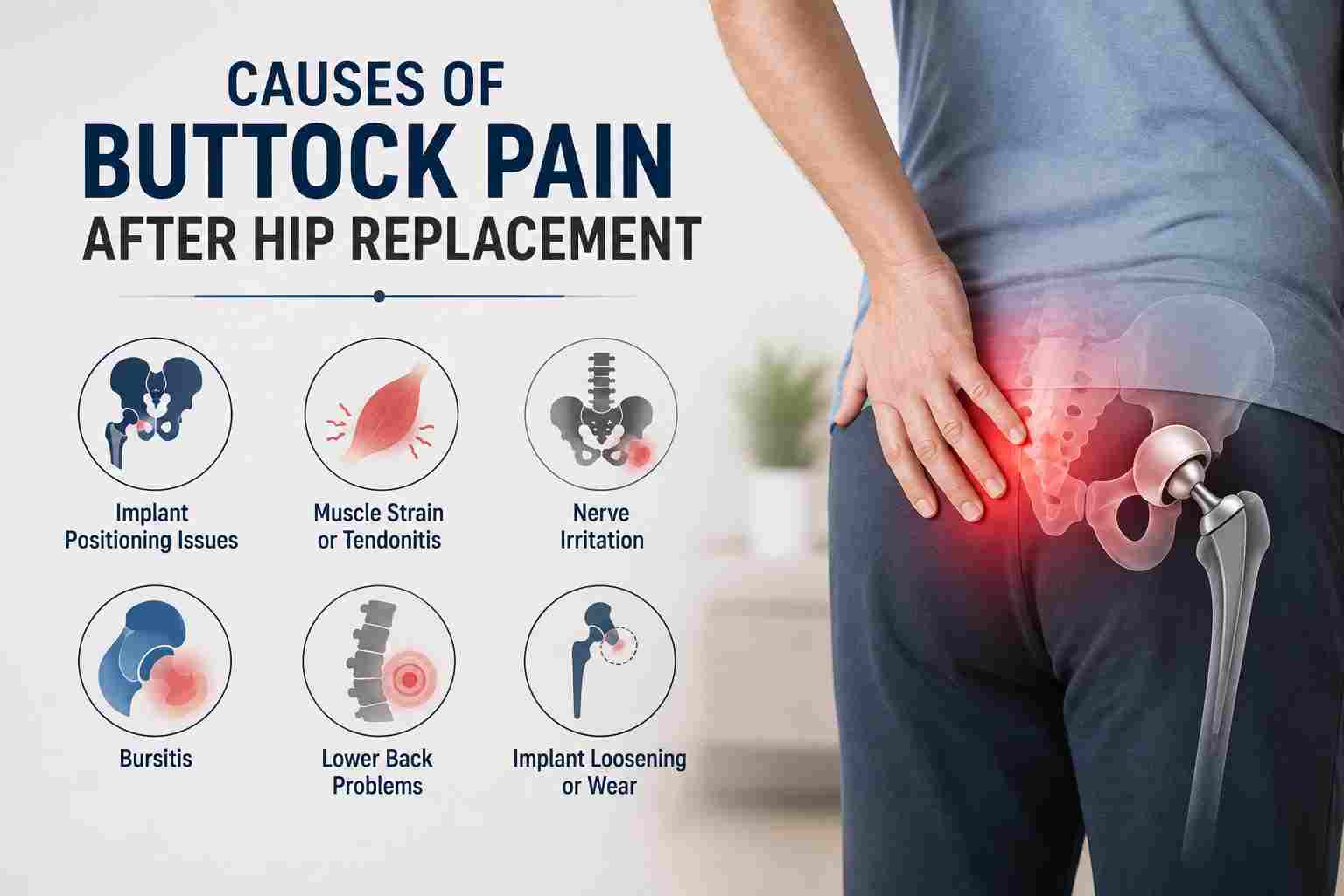
Causes of Buttock Pain After Hip Replacement
Hip replacement surgery is supposed to be the end of the pain story. You go through weeks of planning, the procedure itself, and then a recovery period — all with the expectation that things will get better. And for most people, they do. Around 95% of patients report real, meaningful relief after the surgery. But then some of them start noticing something strange: the hip feels okay, but the buttock hurts.
That is a confusing situation to be in. You did the surgery. You followed the instructions. So why does the buttock region feel sore, tight, or achy?
The short answer is — the hip does not work in isolation. Everything around it, the muscles, nerves, tendons, and soft tissue, goes through a significant experience when a joint is replaced. Buttock pain after hip replacement is more common than most patients are told beforehand.
Table of Contents
Understanding the Anatomy: Muscles, Tendons, and Nerves Near the Hip Joint
Before getting into the specific causes, it helps to picture what the hip and buttock region actually contains.
The hip joint itself is a ball-and-socket structure. The ball is the top of the femur (thigh bone), and the socket is a cup-shaped part of the pelvis called the acetabulum. Surrounding all of this are large muscles — the gluteus maximus and the gluteus medius — which handle most of the work of walking, sitting, standing, and keeping the body balanced. Tendons connect these muscles to bone. Nerves run through the area supplying sensation and motor signals.
When a surgeon goes in to replace the hip joint, all of this surrounding tissue gets disturbed to some degree. Even the most careful surgery involves cutting, retracting, and working around these structures.
The Real Causes of Buttock Pain After Hip Replacement
Gluteal Tendinopathy
The gluteal tendons attach the gluteal muscles to the bony parts of the hip. After surgery, these tendons often deal with changes in load and movement that they were not used to. They can become inflamed, irritated, and painful — a condition called gluteal tendinopathy.
The pain from gluteal tendinopathy sits deep in the outer buttock. It tends to get worse after sitting for a while, walking up stairs, or lying on the affected side at night. Most patients improve with physiotherapy and time.
Trochanteric Pain Syndrome
The greater trochanter is the bony protrusion on the outer side of the upper thigh. Several muscles and tendons attach here, and the surgical approach used during hip replacement can put stress on this area.
Trochanteric pain syndrome causes aching and tenderness on the outer hip that often spreads into the buttock. It is one of the more frequently overlooked causes of buttock pain after hip replacement, often because patients and even some doctors assume the pain is just part of general recovery.
Damage to the Abductor Muscles
The abductor muscles — particularly the gluteus medius — keep you stable when you walk. When one foot is off the ground, it is the gluteus medius on the opposite side that stops you from falling. These muscles can be stretched or injured during hip replacement surgery, and in some cases, a gluteus medius tear can occur.
Patients with abductor muscle issues typically notice:
- A limp that does not seem to be improving
- Weakness when trying to move the leg outward
- Deep buttock or outer hip aching that gets worse with activity
- Difficulty standing on one leg without swaying
Superior Gluteal Nerve Injury
The superior gluteal nerve passes very close to the hip joint. During surgery, it can be stretched, compressed, or otherwise disturbed. Injury to the superior gluteal nerve leads to pain, but it also affects the muscles the nerve controls — mainly the gluteus medius and the tensor fasciae latae.
Patients with superior gluteal nerve involvement often describe a burning or shooting type of pain in the buttock. There may be numbness, a tingling sensation, or noticeable weakness in the hip. Nerve injuries tend to recover slowly, and treatment usually involves targeted physiotherapy, nerve pain medications, and sometimes ultrasound-guided injections to calm the area down.
Hematoma in the Buttock Region
A hematoma is a collection of blood that pools outside of blood vessels, usually following trauma or surgery. After hip replacement, a hematoma can form in the buttock or hip region, causing swelling, firmness, and a throbbing or pressure-type pain.
Small hematomas generally get reabsorbed by the body over a few weeks. Larger ones can be uncomfortable, take longer to resolve, and occasionally become infected. If you notice a soft or firm swelling in the buttock area that appeared after your surgery, that is something to mention to your doctor rather than wait out on your own.
Referred Pain From the Spine or SI Joint
This is the cause that catches a lot of patients and doctors off guard. Buttock pain after hip replacement does not always come from the hip. Pain can travel — it can start somewhere else entirely and be felt in the buttock.
Studies suggest that around 71% of patients who experience referred pain report feeling it in the buttock, and about 22% notice it going below the knee as well. The sources of this referred pain include:
- The sacroiliac joint — the joint where the spine meets the pelvis. It can become irritated or dysfunctional, especially when walking patterns change after surgery.
- The lumbar spine — degenerative disc disease or nerve compression in the lower back is a well-known cause of buttock and leg pain that can easily be mistaken for hip or post-surgical symptoms.
- Sciatic nerve entrapment — the sciatic nerve passes right through the buttock region. If it gets compressed or irritated anywhere along its path, it creates pain, tingling, or numbness in the buttock that feels exactly like a surgical complication.
What makes this tricky is that many people who needed hip replacement also had some degree of spinal or SI joint issues beforehand. The hip pain was simply louder.
How Doctors Diagnose the Source of Your Buttock Pain
Getting to the bottom of buttock pain after hip replacement takes a proper clinical assessment, not guesswork.
A physical examination is always the starting point. The doctor will assess how you walk, how you move the joint, where exactly the pain is located, and how the muscles respond to strength testing.
An MRI scan is usually the most useful imaging tool. It shows soft tissue in detail — tendons, muscles, bursae, and nerves — that a standard X-ray simply cannot capture. A gluteus medius tear, trochanteric inflammation, or nerve changes all become visible on a good MRI scan.
Treatment Options: From Physiotherapy to Targeted Injections
Physiotherapy
For the majority of patients, physiotherapy is the most important treatment. A skilled physiotherapist builds a program around the specific cause — whether that is gluteal tendinopathy, abductor weakness, or nerve recovery. Consistency is what makes the difference. Patients who attend regularly and do their home exercises tend to recover significantly faster than those who skip sessions.
Prolotherapy
Prolotherapy involves injecting a mildly irritating solution into damaged tissue to kickstart the body’s own healing process. It is used for chronic tendon and ligament pain that has not responded to physiotherapy alone.
Anti-Inflammatory Medications
Pain medications — particularly anti-inflammatory drugs — help manage swelling and pain enough to make physiotherapy possible. They are typically used short-term and alongside other treatments rather than as the main solution.
Targeted Injections
For trochanteric pain syndrome, bursitis, or sacroiliac joint dysfunction, a corticosteroid injection into the affected area can provide meaningful relief. These are usually done under ultrasound guidance to make sure the medication goes exactly where it needs to go.
A Few Things That Make Recovery Easier
Recovery after hip replacement is a longer process than most people expect. These habits genuinely help:
- Stick to the movement precautions your surgeon gave you — they exist for good reason
- Keep up with physiotherapy even when progress feels slow
- Stay at a healthy weight to reduce load on the hip and surrounding muscles
- Report new or worsening symptoms early rather than hoping they go away
- Do not miss follow-up appointments — that is when small problems get caught before they become bigger ones
FAQs
Is it normal to have buttock pain after hip replacement?
Yes, quite common actually. The muscles, tendons, and nerves around the hip all go through a lot during surgery. Some degree of buttock discomfort during recovery is expected.
How long does buttock pain after hip replacement usually last?
It depends on the cause. General muscle soreness and mild tendon irritation often settle within a few weeks. Conditions like gluteal tendinopathy or superior gluteal nerve injury may take several months to fully resolve with proper treatment and physiotherapy.
Could the pain be coming from my spine, not my hip?
Absolutely, yes. Referred pain from the lumbar spine, sacroiliac joint, or sciatic nerve is a well-documented cause of buttock pain in hip replacement patients. If pain does not improve as expected or does not match the typical recovery pattern, spinal involvement should be properly ruled out.
What are the warning signs of something serious?
Sudden worsening of pain, fever, unusual swelling or warmth around the joint, redness at the incision site, or difficulty bearing weight are all signs that need prompt medical attention.
Does prolotherapy actually work for this?
For the right patient and the right diagnosis, prolotherapy can be effective — particularly for chronic tendon pain that has not responded to physiotherapy. It is not the right choice for everyone, and a doctor should assess whether it is appropriate based on the specific cause of the buttock pain.
When should physiotherapy not be enough?
If there is a confirmed large gluteus medius tear, significant nerve injury, or a structural problem with the implant, physiotherapy alone will not be sufficient. In those cases, the treatment plan needs to be escalated based on what imaging and clinical assessment shows.