

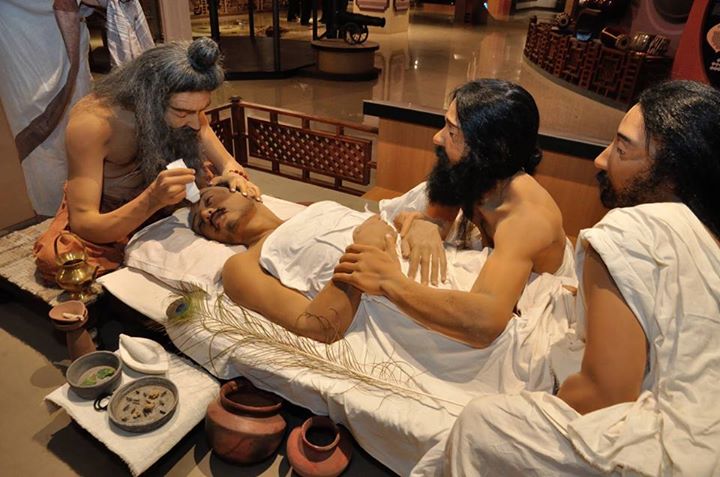
Sushruta: The Father of Plastic Surgery
Over 2,500 years ago, in a city beside the Ganga, a physician was teaching his students a practice far ahead of its time — surgical procedures that the rest of the world would not formally adopt for another thousand years or more.
His name was Sushruta. And what he left behind wasn’t just a set of techniques. It was an entire system — a way of thinking about the human body, disease, and healing that was so advanced for its time that historians and medical scholars are still studying it today.
The title father of surgery belongs to him. So does the title father of plastic surgery. Both are earned, not honorary.
Table of Contents
Who Was Sushruta?
Sushruta was an ancient Indian physician who lived and practised in what is believed to be the city of Varanasi (Kashi) — one of the oldest living cities in the world. The exact period of his life is debated among historians, but most scholarly estimates place him somewhere between 800 BCE and 600 BCE, though some researchers date his work even earlier.
He was a student of the sage Dhanvantari — considered in Hindu tradition to be the god of Ayurveda and medicine. Sushruta received his training under Dhanvantari and went on to teach his own students, passing down a detailed system of medical and surgical knowledge.
What made Sushruta different from other healers of his era was the combination of theoretical understanding and practical application. He didn’t just classify diseases and prescribe herbs. He cut into the human body, repaired it, and reconstructed it. That was extraordinary — and almost unthinkable in the ancient world.
The Sushruta Samhita: Where His Knowledge Lives
Everything we know about Sushruta’s work comes from the Sushruta Samhita — a Sanskrit medical text that is one of the foundational documents of Ayurveda. Samhita means collection or compendium. This text is Sushruta’s compiled knowledge, likely written down by his disciples after being transmitted orally for some time.
The Sushruta Samhita covers general surgical principles, human anatomy, surgical procedures and instruments, disease classification, toxicology, ophthalmology, and Ayurvedic medicine. It isn’t a narrow guide on one technique — it’s a full medical education in written form.
Historians of medicine consider the Sushruta Samhita one of the earliest comprehensive surgical texts in human history. The version studied today includes later revisions attributed to Nagarjuna, a scholar who refined and expanded the original text.
Sushruta as the Father of Surgery
The reason Sushruta is called the father of surgery is not symbolic. It comes from the specific, detailed surgical knowledge recorded in the Sushruta Samhita.
At a time when most ancient civilisations treated illness through prayer, herbs, or simple wound dressing, Sushruta was classifying surgical operations into categories, describing step-by-step procedures, discussing pre-operative preparation, and — remarkably — talking about post-operative care and recovery.
He identified and described over 300 surgical procedures. He classified surgical operations into eight types — incision, excision, scarification, puncturing, probing, extraction, draining, and suturing. Each had its own set of techniques and instruments.
He also described and catalogued over 120 surgical instruments. These included scalpels, forceps, needles, catheters, syringes, and retractors. Some of his instrument designs are remarkably similar to tools used in modern surgery — not because modern surgeons copied him, but because the requirements of surgical work naturally converge on similar solutions.
Sushruta’s contribution to surgery extended to understanding the importance of the surgeon’s training. He insisted that students learn on models — vegetables, wax, dead animals — before operating on living patients. This is the principle of simulation-based surgical training, which is now standard practice in medical education worldwide. The fact that it was articulated over 2,500 years ago is extraordinary.
Sushruta as the Father of Plastic Surgery
The title father of plastic surgery is the one that draws the most attention — and it’s the most specific and direct of his claims.
Sushruta described rhinoplasty — surgical reconstruction of the nose — in detailed, replicable terms.
In ancient India, nose amputation was used as a punishment and a consequence of battle injuries. People who had lost noses needed them restored — functionally and socially. Sushruta developed a method using a skin flap from the cheek or forehead to rebuild the nose.
The procedure described in the Sushruta Samhita is strikingly similar to techniques “rediscovered” in 18th-century Europe. When British surgeons in India encountered local practitioners performing nasal reconstruction in the late 1700s — using methods nearly identical to the Samhita’s descriptions — they documented and published the techniques in British medical journals. That documentation contributed directly to the development of modern plastic surgery in Europe.
This chain of influence — ancient Indian text, living Indian practice, European surgical adoption — is why the title father of plastic surgery is taken seriously by medical historians, not just celebrated as cultural pride.
Sushruta’s Contribution to Surgery: The Key Innovations
Sushruta’s contribution to surgery covers a wide range, but several specific areas stand out as particularly significant from a historical perspective.
Anatomy and Dissection
Sushruta understood that a surgeon cannot operate on what they don’t understand. The Sushruta Samhita describes a method for anatomical study involving a human body — wrapped in grass and allowed to decompose slowly in water — examined layer by layer as the process progressed. It was methodical and direct. His students came away with a genuine structural understanding of the body that surface examination alone could never provide.
Wound Management and Suturing
The Sushruta Samhita describes wound types, cleaning principles, and suturing techniques using plant fibres, hair, and leather depending on the wound’s nature and location. Sushruta also discussed which conditions led to clean healing versus which led to complications — an early understanding of infection risk, articulated long before germ theory existed as a concept.
Cataract Surgery and Surgical Training
The Sushruta Samhita also describes a technique for treating cataracts — called couching — involving a needle to displace the clouded lens and restore some vision. It’s one of the earliest records of ophthalmic surgery in history.
Sushruta’s approach to surgical training was equally advanced. He insisted students practise on models before touching living patients — fruits for incisions, animal bladders for puncturing, leather pieces for suturing. This is simulation-based training, and it’s now standard in modern medical education worldwide.
Why Sushruta Still Matters Today
Simulation before live surgery. Post-operative care. Systematic tool classification. Careful wound cleaning. Direct anatomical study. All of these are foundational principles in modern surgery — and all of them appear in a text written over two thousand years ago.
Medical historians debate exactly how directly Sushruta influenced later traditions — whether his techniques passed into Greek, Islamic, and then European medicine, or whether some connections were more indirect. What is not debated is that the Sushruta Samhita is one of the most sophisticated surgical records from the ancient world.
The titles father of surgery and father of plastic surgery are not courtesy labels. They reflect the fact that what Sushruta described, tested, and taught was centuries ahead of what was being practised almost anywhere else.
Frequently Asked Questions (FAQs)
-
Why is Sushruta called the father of surgery?
Sushruta is called the father of surgery because the Sushruta Samhita — the ancient text attributed to him — contains some of the earliest and most detailed descriptions of surgical procedures in recorded human history. He described over 300 surgical procedures, classified surgical operations into eight categories, catalogued more than 120 surgical instruments, and advocated simulation-based training for surgeons. This body of work predates comparable surgical literature from other ancient civilisations.
-
Why is Sushruta called the father of plastic surgery specifically?
The title father of plastic surgery comes from Sushruta’s detailed description of rhinoplasty — surgical reconstruction of the nose using a skin flap from the cheek or forehead. This technique was described in the Sushruta Samhita and was later observed being practised in India by British surgeons in the 18th century. Their documentation of the technique contributed to the development of modern plastic surgery in Europe.
-
What is the Sushruta Samhita?
The Sushruta Samhita is an ancient Sanskrit medical text — one of the founding texts of Ayurveda — that records the surgical and medical knowledge attributed to Sushruta. It covers anatomy, surgical procedures and instruments, wound management, ophthalmology, toxicology, and principles of medical training. It is considered one of the most important documents in the history of medicine globally.
-
When did Sushruta live?
Historians generally place Sushruta between 800 BCE and 600 BCE, though the exact dates are uncertain and debated. Some researchers argue for an even earlier period. He is believed to have lived and taught in Varanasi, learning under the sage Dhanvantari and later passing his knowledge to his own students. The oral transmission of his teachings before they were written down makes precise dating difficult.
-
What are the most important of Sushruta’s contributions to surgery?
The most significant Sushruta contribution to surgery includes the description of rhinoplasty (nasal reconstruction), a systematic classification of surgical procedures and instruments, detailed anatomical study through controlled dissection, wound management and suturing techniques, the description of cataract surgery (couching), and the development of a structured simulation-based training programme for surgical students. Together, these contributions make him one of the most remarkable medical figures in human history.