

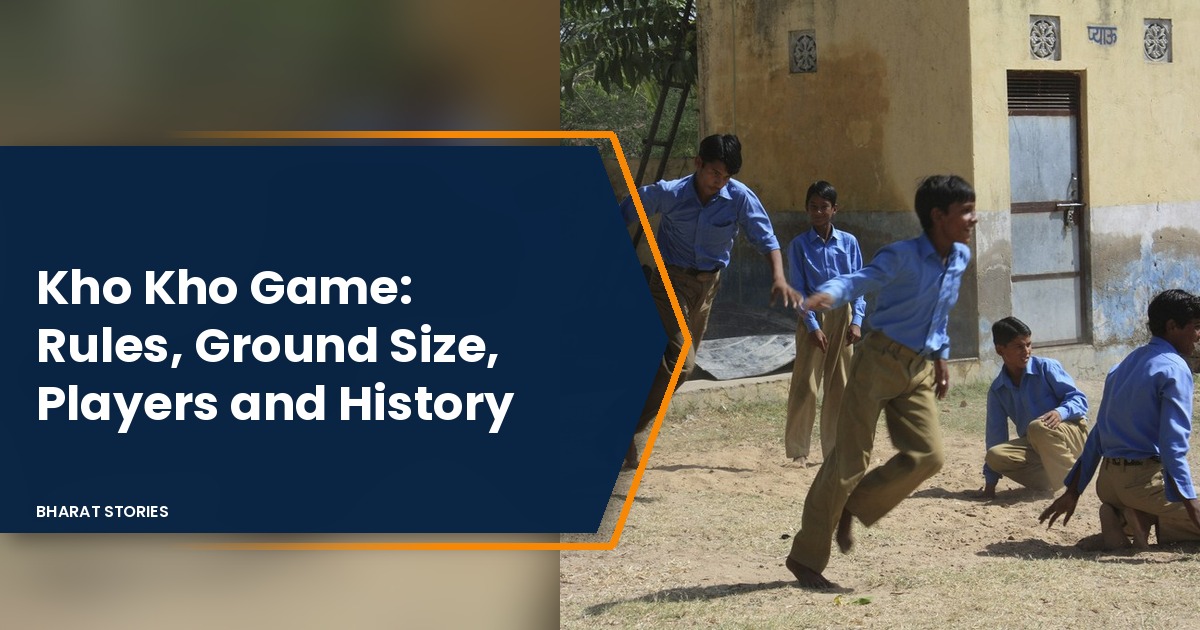
Kho Kho Game: Rules, Ground Size, Players and History
Kho kho is one of India’s oldest tag games and, since January 2025, a world championship sport too. Two teams take turns to chase and defend on a rectangular court: one runner chases, eight teammates sit in a line, and a slap on the back with a loud shout of “kho” hands the chase over. This guide explains how the kho kho game is played, the official ground measurements, the number of players, how points are scored and where the sport came from.
Table of Contents
What is kho kho?
Kho kho is a traditional Indian team tag game in which a chasing side tries to touch and dismiss the players of the defending side within a fixed time. The team that dismisses more opponents over the match wins.
What makes it different from playground tag is the rulebook. The chaser can only run in one direction, cannot cut across the middle of the court and must pass the chase to a seated teammate to switch sides. The India Today explainer published for the first World Cup notes that the game has moved from muddy surfaces to mats, and it is now played indoors at the top level.
Where did kho kho come from?
Kho kho is believed to have started in the Maharashtra region, and its modern rules were first written down in Pune in 1914. India Today records that an early form called Rathera was played on chariots, and that the game was also known as Kho Dhwani Krida, “a game where the sound kho is made”.
The same report gives the milestones that turned a village pastime into an organised sport:
- 1914: Pune’s Deccan Gymkhana framed the rules. The first rule book is credited to Bal Gangadhar Tilak.
- 1936: kho kho was demonstrated at the Berlin Olympics.
- 1959: the first national championship was held at Vijayawada under the Kho Kho Federation of India (KKFI).
- 1982: it was shown as a demonstration sport at the Asian Games in New Delhi.
- 1996: Kolkata hosted the first Asian Championship.
- 2016: it became a medal sport at the South Asian Games in Guwahati.
If you enjoy the story of desi games, our guide to Indian games and sports covers kabaddi, gilli danda and other traditional favourites.
How many players are there in kho kho?
A kho kho team has 12 players in the squad, and 9 of them take the field at the start of a match. According to India Today, the other three are substitutes.
When a team is chasing, eight players sit (crouch) in a line down the middle of the court and the ninth is the active chaser, also called the attacker. When a team is defending, its players enter the court in batches of three. The defenders in a batch, and the order in which batches enter, stay the same through a turn.
What are the kho kho ground measurements?
For men, women and juniors the field is 27 metres long and 16 metres wide; for sub juniors it is 23 metres by 14 metres. These figures, and the rest of the table below, come from the ground specifications published by the Tamil Nadu Kho Kho Association, a state association for the sport.
| Part of the ground | Men, women and juniors | Sub juniors |
|---|---|---|
| Field (length by width) | 27 m by 16 m | 23 m by 14 m |
| Central lane | 24 m long, 30 cm wide | 20 m long, 30 cm wide |
| Cross lanes (8) | 35 cm wide | 30 cm wide |
| Chaser block | 35 cm by 30 cm | 30 cm by 30 cm |
| Gap between adjacent chaser blocks | 230 cm | 190 cm |
| Free zone at each end | 1.5 m by 16 m | 1.5 m by 14 m |
| Posts | 120 to 125 cm high, 9 to 10 cm thick | Same |
A few more details are useful if you are marking a ground for a school or club. The posts must be smooth, untapered and free of sharp edges at the top. Every line should be between 2 and 4 cm wide. A lobby 1.5 metres wide surrounds the field, and outdoor grounds are made on levelled clay while indoor courts use a wooden surface or a synthetic mat.
What is the central lane, and what are the free zones?
The central lane is the 30 cm strip joining the two posts, and the free zones are the 1.5 metre areas behind each post. The central lane splits the court into two halves. The eight cross lanes cut across it at right angles, and where they meet the central lane they form the eight chaser blocks where the seated chasers crouch. In the free zones the attacker is not bound by the direction rule, so this is where a chaser turns around or switches halves by going round the post.
How is kho kho played, step by step?
A coin toss decides who chases first, eight chasers sit facing alternate sides, the attacker starts from a free zone and tries to touch the three defenders on court. India Today sets out the core rules:
- Seating: consecutive seated chasers must face opposite side lines, so each half of the court is covered.
- Taking a direction: the attacker can only keep running the way they first step, and may not cross the central lane.
- Giving a kho: to hand over the chase, the attacker touches a seated teammate on the back, between the shoulder line and the waist, and says “kho” loudly. That teammate becomes the attacker and the old attacker sits in the vacated block. A seated chaser who stretches out an arm or a foot to receive the kho commits a foul.
- Using the post: the other way to change direction or halves is to enter the free zone and go round the post.
- Dismissals: a defender who is touched is out and leaves the court. When all three are out, the next batch of three must come in.
- New batch: an attacker who dismisses the last defender of a batch cannot carry on chasing. They have to give a kho first.
How long is a kho kho match, and how are points scored?
A standard match has two innings, and each innings has one chasing turn and one defending turn for each side, with turns of nine minutes. In the traditional format, every defender dismissed earns the chasing team one point, and the side with more points after both innings wins.
India Today adds two features borrowed in spirit from cricket. In the first innings a chasing captain who has scored more than nine points can end the turn early, much like a declaration, and in the second innings a captain can end the turn at any time. A team that chases first and builds a big lead can also enforce a follow on. Yellow and red cards exist too, for disorderly behaviour or rough play.
How is the fast format used at the World Cup different?
The World Cup used a faster format with seven minute turns, two points for each dismissal and a bonus for defenders who survive. As News9 explained, the key changes are:
- Seven chasers on the mat: six seated in the central lane, facing alternate directions, plus the active chaser.
- Four batches of three defenders in each defending turn.
- Two points for every defender tagged.
- Dream run: if a batch of three defenders lasts at least three minutes without being dismissed, the defending team earns a point.
- The Wazir: one chaser wears a different coloured jersey and may run back and forth, unlike other chasers, though still without crossing the central lane.
Who won the first Kho Kho World Cup?
India won both titles at the first Kho Kho World Cup, beating Nepal in the men’s and women’s finals on 19 January 2025 in New Delhi. The women won 78 to 40 and the men won 54 to 36 at the Indira Gandhi Indoor Stadium, and both teams went through the tournament unbeaten, India Today reported. The men led 26 to 0 after the first turn, with captain Pratik Waikar among the standout players.
The tournament, backed by the Indian Olympic Association, had 20 men’s and 19 women’s teams. Sportstar noted that Waikar is from Pune and that former women’s captain Nasreen Shaikh, a 2023 Arjuna Award winner, announced her retirement after the final.
Is kho kho played in the Olympics?
No. Kho kho is not an Olympic sport, though it was demonstrated at the 1936 Berlin Games and the government has said it wants it in the Olympics. At a felicitation for the World Cup winners on 22 January 2025, Sports Minister Mansukh Mandaviya said the government’s effort is to take kho kho to the 2036 Olympic Games, according to the Press Information Bureau release. The same release says 23 countries took part in the World Cup, and women’s head coach Sumit Bhatia said the next edition would be held in England four years later.
That goal is tied to India’s wider hosting ambitions. Read more about India’s 2036 Olympics bid and how the race is shaping up.
What is Ultimate Kho Kho?
Ultimate Kho Kho is India’s franchise league for the sport, played in a fast, televised format. Its third season was scheduled to begin on 29 November 2025, News9 reported when the season anthem was released, featuring players such as Dilip Khandavi, Rohan Singhade and Avdhut Patil. The report also linked the league’s push to India’s bid for the 2030 Commonwealth Games, where organisers hope indigenous sports can find a place. India’s recent Commonwealth Kabaddi Championship double shows how far desi sports have travelled.
What skills does a good kho kho player need?
Speed off the mark, quick changes of direction, judgement of when to give a kho, and the patience to sit still until the touch comes. Because the game needs only a flat patch of ground, two posts and some chalk, it remains one of the cheapest team sports a school can offer.
Quick answers
Why is it called kho kho?
The name comes from the word “kho” that the attacker shouts while touching a seated teammate to pass on the chase.
Which country is number one in kho kho?
India. It won both the men’s and women’s titles at the first World Cup in 2025, beating Nepal in each final.
How high is the kho kho pole?
Each post stands 120 to 125 cm above the ground and is 9 to 10 cm in diameter.