

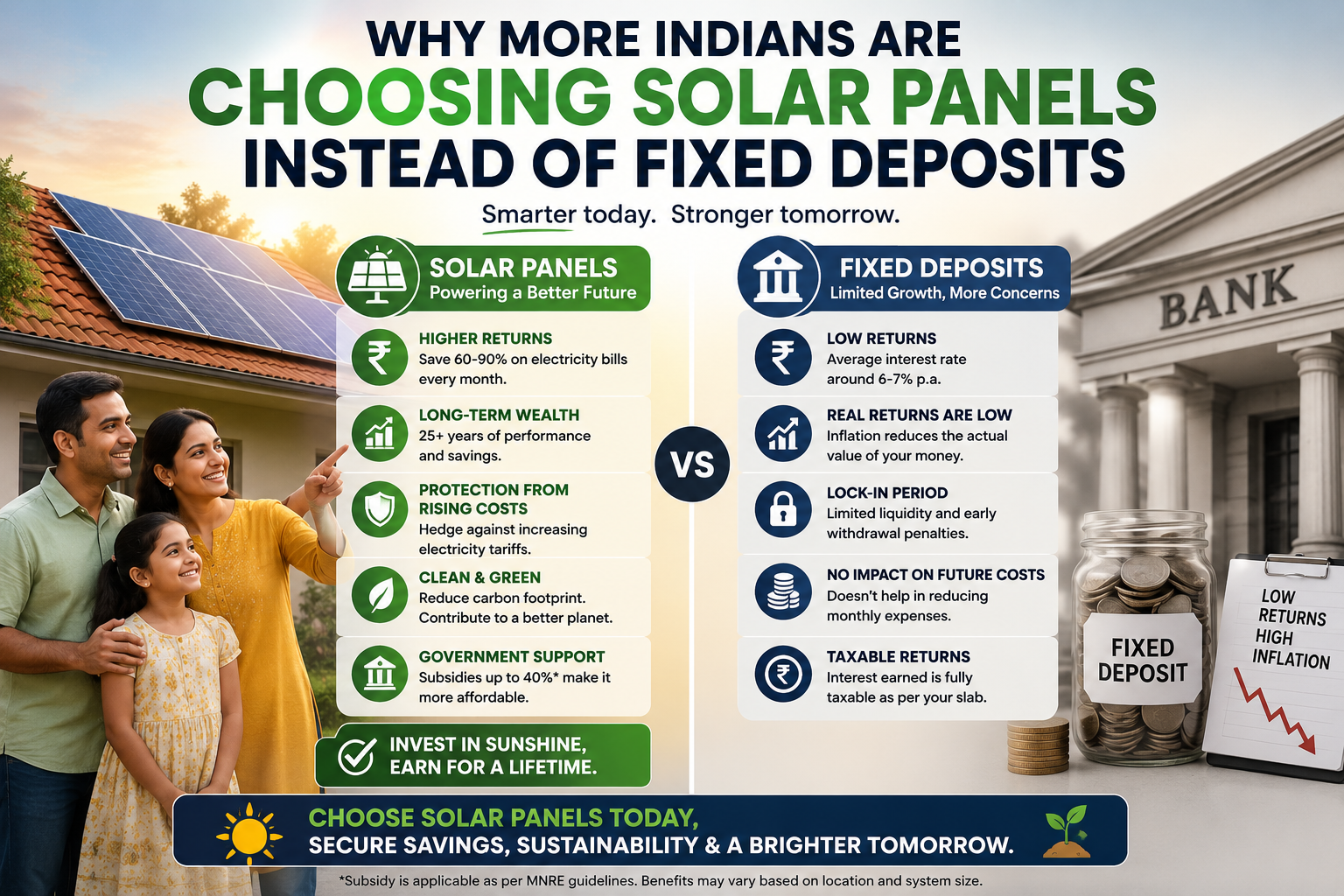
Why More Indians Are Choosing Solar Panels Instead of Fixed Deposits
Fixed deposits (FDs) are investment products that have been popular in the Indian market for the last several decades and are among the most common and trusted. They’re recognized for their safety, for you can expect the returns, and they’re easily investable. With the help of FDs, many families have built their reserves and achieved their financial objectives. However, investing is a mind-changing process—people seek opportunities and ways they can benefit and generate interest earnings.
Energy-efficient solar investment is one of the alternatives gaining popularity. The benefit of solar is that homeowners can save on their electricity bills for years to come; many are choosing it instead of making an upfront deposit. With the continued rise in power prices, the Government is fostering the use of clean energy. As renewable energy gains popularity, many are considering installing solar at their residences.
Table of Contents
Why Fixed Deposits Have Been Popular
They are a popular investment because of their surety and stability. The investors are aware of the amount of investment, the interest rate they will receive, and the value at the end of the period. Some of the main reasons people choose fixed deposits include:
- Guaranteed returns
- Low investment risk
- Capital protection
- Flexible tenure options
- Easy access through banks
These are just some of the features that will make FDs popular, particularly for conservative investors. But whether traditional returns are now to be coupled with ever-increasing returns is widely seen as questionable.
Understanding Solar Investment
An investment in solar means installing panels designed to convert sunlight into electricity. The system generates value rather than interest – in this instance, the monthly electricity bills are lower. This power can be used for household appliances, reducing dependence on power/utility providers.
While solar systems can be used to construct a physical asset, unlike fixed deposits, they offer many extra benefits. Once installed, they are part of the property and can benefit for decades on end.
Rising Electricity Costs Are Changing Decisions
Electricity costs are a major budget item for households across most states in India. As the use of appliances like air conditioning systems, refrigerators, and other electronic appliances has increased, energy consumption has indeed increased, and so have the ever-rising electric bills.
Many families would like financial assistance to help save money on their electric bills. This has been aiding the growth of India’s Rooftop Solar Power Sector. Building their own electricity generation will improve their net access to electricity, free from the grid. Households will be better able to control future electricity generation if they generate electricity at home.
What are the Differences Between Solar Panels and Fixed Deposit?
Mention some investment plans available in solar technology: deposit plans and fixed deposit plans. Returns on fixed deposits are fixed interest paid over a specified period. Those who invest receive a fixed return on investment, based on the investment time frame and the amount invested. The benefit of solar comes from the savings it offers. Once the solar panels are installed, they begin producing electricity, allowing the utility to issue electricity bills during the first few months. These savings can go on for many years!
There is another significant difference regarding ownership. A fixed deposit is still a financial product; a solar system would become an asset. Homeowners become the owners of a valuable object, one that has real-world uses every day. Furthermore, solar installations contribute to renewable energy development, providing environmental benefits and economic savings.
Solar Energy and Passive Income
Some investors look for investment opportunities that provide passive income. Unlike a conventional solar system, there is no actual monthly profit; however, there is a continual monthly savings. Once installed, the solar panels require very little upkeep (auto-operation)—the electricity they generate reduces demand from the electricity grid.
Net metering may allow exporting excess energy to the electrical grid with credits. This can help to raise the system’s value. These savings will not revert to zero over time, making it seem viable as a means of a constant passive income.
Government Support for Rooftop Solar in India
Promoting rooftop solar in India as a product is important, and the government has played an important role. Several programs have now been launched for the domestic consumer to promote renewable energy.
Common benefits include:
- Subsidies for eligible homeowners
- Net metering facilities
- Simplified approval procedures
- Financial assistance programs
- Awareness campaigns
These increase the likelihood that a solar investment is within reach and lower installation expenses.
Long-Term Savings Matter
The tremendous benefit of solar energy is that it can create long-term savings. Only during the term of a fixed deposit will the interest be earned. Chances are, solar electricity systems last over 20 years of service, while a solar panel. This could be because the electricity usage is on the savings from the system could be worth more as the cost of electricity increases.
This is why solar is appealing to homeowners who are planning for the long term. Over time, many families are pleased with the idea of something better than a function that’ll be reliable enough to save them from future problems, and there is satisfaction in knowing it’s a reliable benefit.
Supporting Renewable Energy
Eco-awareness affects attitudes towards people’s household behaviors. Solar panel installation is a way to expand the renewable energy industry and reduce reliance on conventional energy sources.
Benefits include:
- Lower carbon emissions
- Directly reduce the use of fossil fuels
- Cleaner electricity generation
- Support for sustainable development
- Greater environmental awareness
Homeowners seeking to save money and to be green are looking favorably at Solar.
How Homeowners Calculate Solar Returns
Typically, a solar citizen vs cost analysis occurs before an investment in solar. Key factors include:
Installation Cost
Overall investment will be influenced by the equipment specifications, size, quality, and system size.
Electricity Usage
There are greater opportunities to achieve electricity savings in high-electricity-consuming households.
Government Incentives
The use of available subsidies can help to lower installation costs.
System Lifespan
There are significant benefits to having a high-quality solar panel that will last around 20 to 25 years.
Once the capital is recouped, electricity savings can be regarded as a cost saving.
Which People Benefit Most from Solar Panels?
While many households can benefit from installing solar energy, in some cases, it is particularly beneficial to specific groups of households.
Ideal for:
- Those with electricity bills will find solutions here
- Owners of independent homes
- Long-term residents
- Environmentally conscious consumers
- People with a passion for passive income from savings
Common Concerns regarding Solar Investment
Upfront Cost
While the up-front cost might be steep, these savings can offset the investment over time.
Maintenance
So, the modern solar panels hardly need any maintenance; it is typically limited to cleaning and occasional checks.
Weather Conditions
Solar systems generate the most electricity on sunny days but can still provide some power on cloudy days.
Financial Returns
The cost of the energy saved over the lifetime of the upgrades has proved worthwhile for many homeowners.
The Future of Solar Energy in India
India has been further moving towards the adoption of Renewable energy, and solar energy remains a key energy option in the future. They are increasingly promoting more affordable, improved, and cost-effective solutions, along with government incentives to encourage homeowners to use solar energy.
Awareness is increasing, and as more families become aware of solar investments, they are also considering it a business move. This technology not only lowers electricity bills but is also becoming increasingly desirable due to the amount of electricity produced.
Conclusion
While fixed deposits are still considered a safe investment, many Indians are looking for alternatives that could offer them additional advantages beyond the interest they would earn. Reliable, planned solar investment can lead to savings on electricity bills, support for renewable energy sources, and long-term savings.
Rooftop solar in India is increasingly popular among households, thanks to their affordability, and sentiment towards sustainable living, and a surge in electricity prices. The installation of solar panels not only reduces electricity bills but also builds an important asset for the family and brings them financial benefits for many years.
FAQs
Is solar investment better than a fixed deposit?
Reducing electricity costs through a solar investment and the earnings on a fixed deposit are ways to lower one’s costs. The choice of the appropriate one will depend on a person’s finances and needs.
How long do solar panels last?
Most Solar Panels have a lifespan of 20-25 years and will produce electricity after the initial period.
Will Rooftop Solar be a source of passive income?
Yes. Savings over time may be equivalent to passive income through lower electricity and net metering.
Why is renewable energy important in India?
The use of renewable energy reduces dependence on fossil fuels, improves environmental sustainability, and contributes to long-term sustainability.