

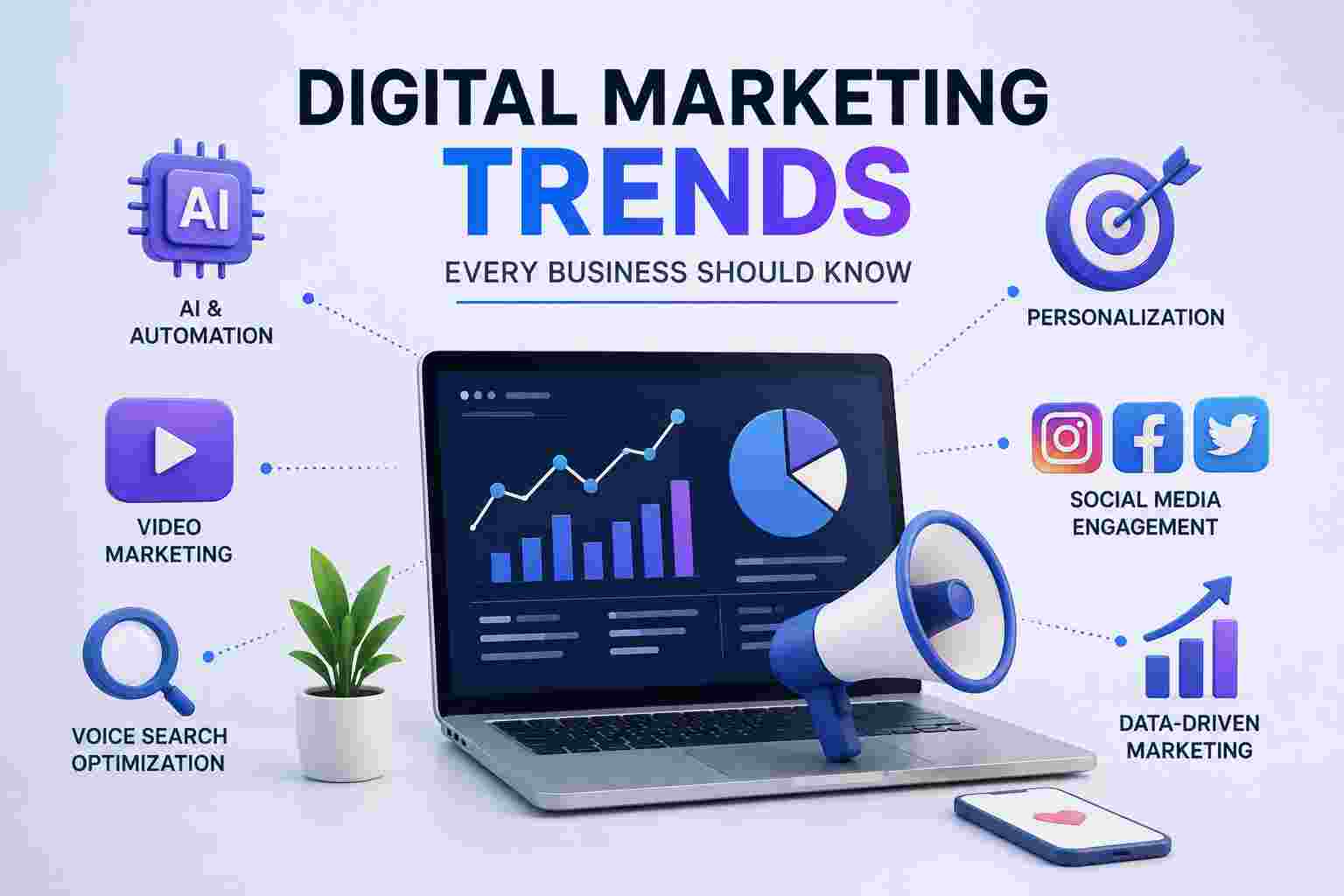
Digital Marketing Trends Every Business Should Know
A few years ago, having a website and a Facebook page was enough to say you had an online presence. That bar has moved significantly. Customers now expect faster experiences, more personal communication, and content that actually speaks to them — not generic promotional posts that could apply to any business in any industry.
The digital marketing trends shaping business right now are not just technical shifts. They reflect real changes in how people search, consume content, and decide who to trust with their money. Understanding these trends is not optional for businesses that want to stay relevant.
This piece covers the most important shifts happening right now, what they mean for your business, and how to act on them without wasting budget on the wrong things.
Table of Contents
Search Has Changed — And Your SEO Needs to Change With It
Search engine optimization is not dead. But the version of SEO that worked five years ago — stuffing pages with keywords and building as many backlinks as possible — is much less effective today.
Google has gotten significantly better at understanding intent. It does not just look at what words are on your page. It tries to understand what the person searching actually needs and whether your content genuinely serves that need.
What Works in SEO Right Now
The biggest seo trends shaping search performance today include:
- Experience-led content: Google’s E-E-A-T guidelines (Experience, Expertise, Authoritativeness, Trustworthiness) reward content written by people with real knowledge and experience in a subject. Generic content produced purely for traffic is losing ground fast.
- Search intent alignment: Your page needs to match what the searcher actually wants — not just include the keyword they typed. A page targeting “how to fix a leaking tap” needs to be a practical how-to, not a sales page for plumbing services.
- Page experience signals: Loading speed, mobile friendliness, and stability as the page loads all factors into rankings. A slow site loses rankings and visitors at the same time.
- Zero-click searches: A growing number of searches are answered directly on the Google results page. Structuring content to appear in featured snippets is now part of a realistic seo trends strategy — even if those clicks do not always come through to your site.
- Voice and conversational search: More people search using natural language, especially on mobile. Content that answers specific, conversational questions performs better than content written purely around short keywords.
Short-Form Video Is the Dominant Content Format
If you are not producing short-form video yet, you are missing the most engaged format on the internet right now. Instagram Reels, YouTube Shorts, and similar content have reshaped what people expect from brands online.
Short videos get significantly more reach and engagement than static image posts on most platforms. And the cost to produce them has dropped to almost zero — a decent smartphone and natural light are genuinely enough to get started.
What works is authenticity. Over-produced brand videos often underperform against raw, genuine content from the same business. Show the behind-the-scenes. Answer a common customer question in 30 seconds. Share a real result.
Social Media Marketing Has Become Pay-to-Play
Organic reach on most social media marketing platforms has declined sharply over the last several years. Posting consistently still matters for brand credibility and community building. But expecting organic posts alone to drive significant business results is unrealistic on most major platforms today.
The shift is toward a paid-plus-organic hybrid model. Businesses that do social media marketing well use organic content to build trust and keep their audience warm — and paid advertising to reach new people and drive specific actions like sign-ups, purchases, or enquiries.
What makes this work is targeting. Platforms like Meta (Facebook and Instagram) and LinkedIn have very sophisticated audience targeting. You can reach people based on location, age, interests, job title, purchase behaviour, and dozens of other signals.
Personalisation Is No Longer a Nice Extra — It Is Expected
Customers notice generic marketing. They also respond positively when communication feels relevant to them specifically.
Personalisation in online marketing has moved well beyond using someone’s first name in an email. It means serving different content to different segments based on their interests, where they are in the buying journey, and what problems they are trying to solve.
Email marketing is still one of the highest-ROI channels available — but only with proper segmentation. Sending the same email to your entire list leaves a significant amount of potential on the table.
For e-commerce businesses, product recommendations based on browsing history drive a meaningful share of revenue. For service businesses, personalised follow-up sequences based on how a lead first engaged with you convert at much higher rates than generic campaigns.
AI Tools Are Changing How Marketing Gets Done
Artificial intelligence has entered almost every area of digital marketing trends. Businesses that use it well are getting a real productivity advantage.
AI tools are used for content drafting, keyword research, ad copy testing, image generation, and customer segmentation. They are not replacing strategic and creative thinking — but they are cutting the time it takes to produce first drafts, test variations, and analyse results.
The businesses getting the most value are those that use AI to speed up production while keeping human judgment at the centre of strategy. Fully automated content with no editorial oversight tends to be generic and sometimes inaccurate.
What a Strong Marketing Strategy Looks Like Right Now
Given all of these shifts, what does a grounded marketing strategy actually look like for a business that is not a large corporation with a dedicated marketing team?
A few principles that hold across most business types and sizes:
Pick channels where your audience actually is. Not every business needs TikTok. Not every business needs LinkedIn. Research where your specific customers spend time online and concentrate effort there rather than spreading thinly across every platform.
Measure what actually matters. Traffic numbers feel good but do not pay salaries. Track conversions, cost per lead, and revenue attributable to specific channels. Those are the numbers that tell you whether your online marketing spend is actually working.
Be consistent over time. Most businesses that fail at digital marketing give up too early. SEO takes months to show results. Social media audiences build slowly. Email lists need time to grow. The businesses that win are usually the ones that commit to a direction and stick with it long enough to see the compounding effect.
Final Thought
The digital marketing trends covered here are not short-term fads. They reflect structural changes in how people use the internet and how they make buying decisions. Businesses that understand these shifts and build their marketing strategy around them will have a real advantage over those still doing things the way they did three years ago.
Frequently Asked Questions
-
What are the most important digital marketing trends for small businesses right now?
For small businesses, the most practical digital marketing trends to act on are short-form video, local SEO, email marketing with segmentation, and paid social with tight targeting. These channels deliver strong returns without large budgets when executed consistently with good creative.
-
How has SEO changed and what should businesses focus on?
The biggest shift in seo trends is toward intent-matching and content quality. Google now rewards pages that genuinely serve the searcher’s needs. Focus on well-written, experience-led content, fast page loading, mobile optimisation, and building real authority in your niche — not gaming rankings with outdated tactics.
-
Is social media marketing still worth investing in for businesses?
Yes, but the approach has changed. Social media marketing today needs a combination of organic content for trust-building and paid advertising to reach new audiences. Organic-only strategies deliver very limited reach on most platforms.
-
How important is personalisation in online marketing?
Customers increasingly tune out generic messaging. Online marketing that uses segmentation and relevant follow-up sequences consistently outperforms one-size-fits-all campaigns. Email and retargeting are the two channels where personalisation has the most immediate impact on conversion rates.
-
How do I know if my marketing strategy is actually working?
Track metrics that connect to business outcomes — leads, cost per acquisition, conversion rates, and revenue from specific channels. Vanity metrics like follower counts feel good but tell you very little. Review these numbers monthly and adjust based on data, not assumptions about what your marketing strategy should be doing.