

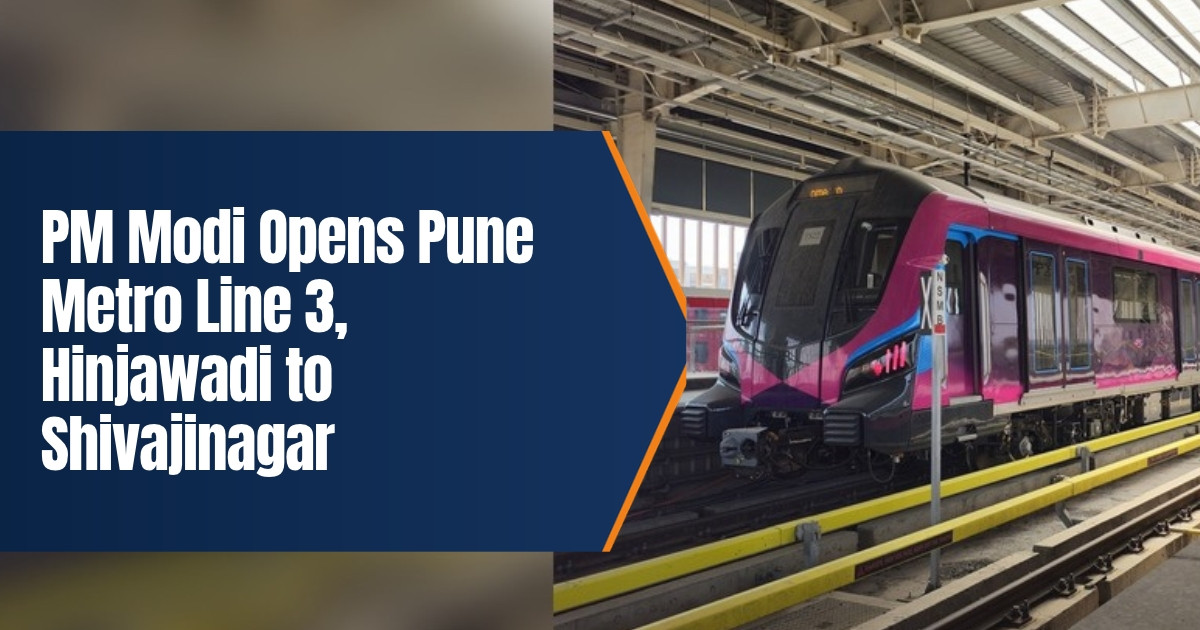

Pune Metro Line 3, the Pink Line linking the Hinjawadi IT hub with Shivajinagar in the heart of the city, opened to passengers at 6 am on Wednesday, 4 November 2026. Prime Minister Narendra Modi inaugurated the elevated corridor by video link on Tuesday and laid the foundation stone for four more metro lines in the city, in projects the Prime Minister’s Office put at around Rs 21,800 crore.
For the thousands of software professionals who spend hours each day in traffic on the roads into Hinjawadi, the new line offers a direct rail option for the first time. The Indian Express reported that the line will be run by an all women team of around 100 train drivers, which it described as a first in the country.
Table of Contents
Pune Metro Line 3 at a glance
The line runs from Maan, beyond the Rajiv Gandhi Infotech Park in Hinjawadi, to the District Court station at Shivajinagar. The Indian Express gives its length as 23.203 km and its cost as Rs 8,313 crore, including land acquisition and the shifting of utilities. The Hindu put the cost at over Rs 8,300 crore.
- Length: about 23 km, fully elevated, with 23 stations.
- Opening: 17 stations open from 4 November; the other six follow in phases.
- Hours: first trains at 6 am from both ends; last train 10.30 pm from Maan and 11.40 pm from Shivajinagar.
- Interchange: District Court station, with Lines 1 and 2 of Mahametro.
- Expected riders: two to 2.5 lakh a day, according to PMRDA estimates cited by the Indian Express.
Of the 17 stations opening now, seven will at first have only one usable staircase: Maan, Maan MIDC Circle Phase 2, Maan Bus Depot, Hinjawadi Phase 2 Circle 1, Padmabhushan Chowk, Agricultural College and District and Sessions Court, the Indian Express said. Work at two of the six closed stations is expected to finish by the end of November 2026, and the other four by January 2027.
Frequency and journey time
Reports differ slightly on how often trains will run. The Indian Express said services will run every six minutes at peak hours and every 12 minutes at other times. The trade journal Railway Gazette International reported intervals of five and a half minutes at peak and 10 minutes off peak, with a full journey of about 45 minutes.
At District Court, passengers can change to Mahametro’s Line 1 between Pimpri Chinchwad and Swargate and Line 2 between Vanaz and Ramwadi. Chief Minister Devendra Fadnavis said a common ticketing app will let people use both networks on the same platform.
Built under a private partnership
Unlike the two Mahametro lines, Line 3 was built under a public private partnership. The Pune Metropolitan Region Development Authority (PMRDA) awarded the contract in September 2019 to Pune IT City Metro Rail Ltd, a joint venture of Siemens and Tata Group’s TRIL Urban Transport, under a 35 year design, build, finance, operate and transfer deal, Railway Gazette reported. It said this was the first contract awarded under the metro rail policy approved by the Centre in August 2017, and Fadnavis called it the country’s first metro project on the PPP model.
Alstom’s Sricity plant supplied 22 three car trains, each able to carry 1,000 passengers at an operating speed of 85 km/h. Siemens Mobility provided the signalling, power supply and communication systems, and the operator Keolis holds a 10 year contract to run the trains, according to Railway Gazette. The Hindu reported that around 30% of the line’s power needs will be met through solar energy.
Phase II and what Modi said
Modi also laid the foundation stone of Pune Metro Phase II, which The Hindu said is estimated at around Rs 13,500 crore and covers four corridors, Lines 2A, 2B, 4 and 4A, serving residential, commercial and IT areas.
In his address, the Prime Minister said India had only 248 km of metro lines in 2014 and now has around 1,200 km. “While metro services were available in only five cities in 2014, they are now operational in 26 cities. More than one crore people travel by metro every day,” he said, as quoted by The Hindu. He added that India’s network is now among the top three in the world.
On Maharashtra, the PMO release said Modi noted that only 10 to 11 km of metro lines were working in the state in 2014, against nearly 175 km now, with construction under way on over 680 km and investment of more than Rs 2.5 lakh crore. The Hindu reported his figure for the current network as nearly 200 km. “This money is going into the pockets of laborers, this money is giving employment to engineers, and this money is creating employment in shops and in factories,” he said, according to the PMO.
Modi also pointed to the Urban Challenge Fund approved in February this year, backed by Rs 1 lakh crore in central assistance, and urged local bodies and private firms to help turn smaller cities into growth hubs.
Fadnavis said Pune and its metropolitan region would become a mobility centre by 2030 and that the Phase II network would later be extended to the new airport proposed at Purandar. “Metro rail is important not only for mobility but is an economic multiplier,” he said, as reported by the Indian Express.
Pune joins a growing list of cities adding metro capacity this year, including Chennai, where we covered the opening of the Poonamallee to Vadapalani stretch. For more on the state, read our guide to Maharashtra’s history, economy and tourism, and if you are heading out of the city for a weekend, see our piece on Lonavala, the hill station near Pune.
Featured image photo: Just a dude from earth, CC0 1.0 (public domain dedication), via Wikimedia Commons. It shows a Pune Metro Line 3 train at an elevated station.
FAQ
When does Pune Metro Line 3 open to the public?
Passenger services began at 6 am on Wednesday, 4 November 2026, at 17 of the line’s 23 stations.
Which areas does the Pink Line connect?
It runs from Maan and the Hinjawadi IT parks through Wakad, Balewadi, Aundh and Savitribai Phule Pune University to the District Court station at Shivajinagar.
Who operates the line?
It was built by Pune IT City Metro Rail Ltd, a Tata and Siemens venture, and Railway Gazette reports that Keolis operates the trains with an all women driver team.
Sources
- Press Information Bureau, Prime Minister’s Office, 3 November 2026: projects worth around Rs 21,800 crore, metro network figures, Maharashtra figures, Urban Challenge Fund.
- The Indian Express, 3 November 2026: length, cost, stations, timings, frequency, women drivers, ridership estimate, Fadnavis quotes.
- The Hindu, 3 November 2026: Phase II cost and corridors, solar power share, Modi quotes.
- Railway Gazette International, 3 November 2026: PPP contract, rolling stock, signalling, Keolis, frequency and journey time.