

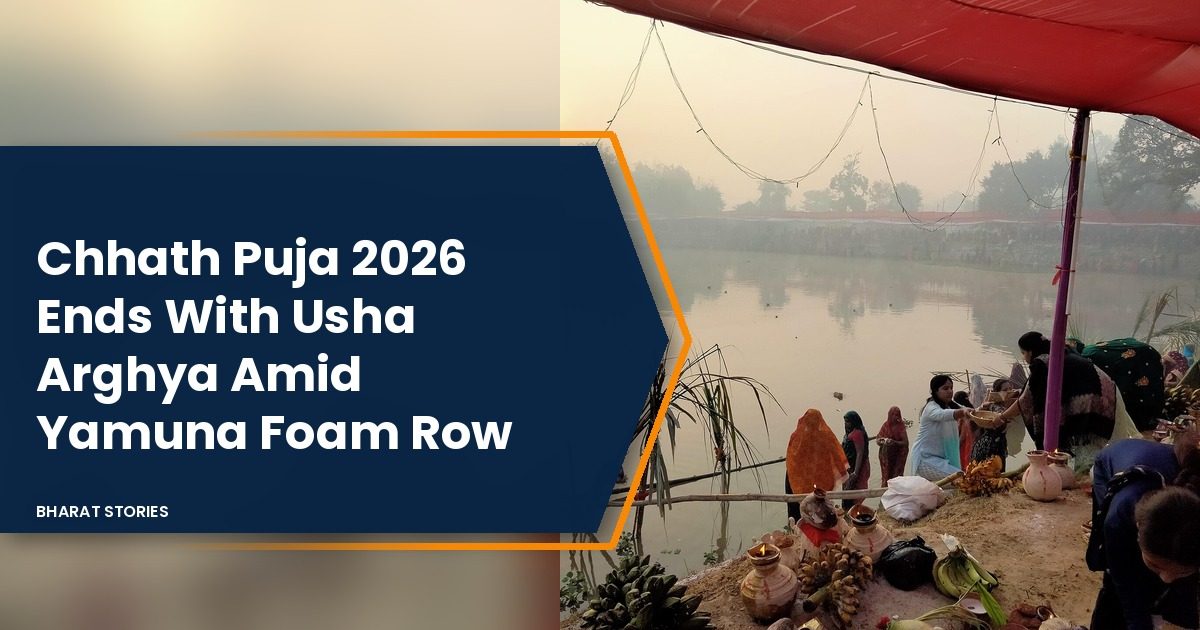

Chhath Puja 2026 came to an end on the morning of Monday, 16 November, as devotees stood in rivers, ponds and other water bodies across Bihar, Uttar Pradesh, Delhi and other states to offer Usha Arghya to the rising sun. With that offering, vratis who had kept the 36 hour nirjala fast since Saturday evening broke it with prasad, closing the four day festival.
In Delhi the morning was not only about faith. Pictures of devotees standing in thick white foam on the Yamuna set off a fresh fight between the Aam Aadmi Party and the BJP over who is to blame for the state of the river.
Table of Contents
When did Chhath Puja 2026 end?
It ended at sunrise on Monday, 16 November 2026. The festival began on Friday, 13 November with Nahay Khay, followed by Kharna on Saturday, Sandhya Arghya to the setting sun on Sunday evening and Usha Arghya on Monday morning, IANS reported. Parana, the breaking of the fast, follows the morning offering.
What was the Usha Arghya time on 16 November?
Sunrise times differ by city. News18, citing Drik Panchang, listed these for 16 November:
- New Delhi: 6:44 AM
- Patna: 6:07 AM
- Ranchi: 6:03 AM
- Lucknow: 6:26 AM
- Kolkata: 5:50 AM
- Mumbai: 6:46 AM
- Bengaluru: 6:19 AM
The same report reminded readers that the sunrise time is not the Parana time. Families break the fast after the offering and other rituals are complete, going by their own tradition and the local panchang.
How did Bihar mark the last day?
Patna’s ghats filled up well before dawn. The district administration prepared 90 ghats along the Ganga and 62 permanent or temporary pond ghats in the city, from Danapur to Patna City, and declared 13 ghats unsafe, according to IANS. Devotees carried bamboo baskets of fruit, thekua and sugarcane, and Chhath songs played from the riverfront to neighbourhood ponds.
Chief Minister Samrat Chaudhary offered arghya at a ghat in Lakhanpur in his home district of Munger. In Patna, BJP national president Nitin Nabin carried the daura, the bamboo basket of offerings, on his head while his wife Deepmala performed the rituals, India TV reported. For more on the state where the festival runs deepest, read our guide to Bihar’s history, geography and culture.
Who else joined the celebrations?
Prime Minister Narendra Modi marked the close of the festival on X, writing that this “divine festival dedicated to nature witnessed a wonderful confluence of firm resolve and spiritual practice.” He said he prayed to Chhathi Maiya to bless all the devotees keeping the fast and “my family members across the country”.
Chhattisgarh Chief Minister Vishnu Deo Sai offered arghya in Jashpur and BJP MP Ravi Kishan did so at Bhim Sarovar in the Gorakhnath temple complex in Gorakhpur, India TV reported. The Indian Express reported that Uttarakhand Chief Minister Pushkar Singh Dhami joined devotees in his hometown Khatima, Delhi Chief Minister Rekha Gupta performed the rituals at ITO Ghat, and MP Manoj Tiwari was at Sonia Vihar Ghat.
Delhi’s ghats were busy from the small hours too. Devotees with soop and daura full of thekua, coconut, banana and sugarcane waited for the first light before stepping into the water, Navbharat Times reported.
Why is there a row over Yamuna foam?
AAP posted photos and videos of devotees wading through foam and said they showed the BJP government’s claim of a cleaner Yamuna was false. One video carried the line “not AI, this is Yamuna on Chhath”, and Delhi AAP chief Saurabh Bharadwaj shared it with the words “Today’s video under BJP rule”, DNA reported.
The BJP hit back, blaming the previous AAP government for the river’s condition. “The same Yamuna where Chhath was banned is now more than half clean in just 2 years,” the party said. Rekha Gupta wrote that Delhi was celebrating Chhath at nearly 1,400 ghats and called it a celebration not seen in decades.
A PTI photo carried by The Indian Express showed devotees on the foam covered Yamuna in Noida during Sunday’s Sandhya Arghya too. Bad air is the other seasonal worry in the capital; our earlier report covered how Delhi’s AQI turned severe after Diwali.
What causes the foam on the Yamuna?
The froth is a sign of pollution. Surfactants and phosphates from household and industrial detergents reach the river through sewage that is not fully treated, Sushmita Sengupta of the Centre for Science and Environment told The Indian Express in an explainer on the problem. In the lean winter months the river carries little water, so the pollutants are not diluted, and the turbulence of water falling at the Okhla barrage whips them into foam.
That explainer also cited a CPCB report which found foam forming downstream of the ITO and Okhla barrages, with phosphates and surfactants not detected upstream of Wazirabad. This is why the foam keeps returning around Kalindi Kunj and Okhla, often in Chhath week.
What happens after Usha Arghya?
Once the morning arghya is done, vratis worship Chhathi Maiya and Surya, break the fast with prasad and share thekua and fruit with family and neighbours. The ghats empty out by mid morning. Chhath songs are part of every ghat, and many of the most loved ones were sung by the late Sharda Sinha; read about her Padma Vibhushan honour. For the meaning of each day and the rituals, see our full guide to Chhath Puja.
Featured image photo: Sntshkumar750, CC BY SA 4.0, via Wikimedia Commons. It shows devotees at a pond ghat during a Chhath morning in November 2023 and is used as an illustration; it was not taken this year.
FAQ
Is Chhath Puja over for 2026?
Yes. The Kartik Chhath festival ended with Usha Arghya on the morning of 16 November 2026.
What is Usha Arghya?
It is the final offering of Chhath Puja, made to the rising sun on the fourth morning while standing in water. It closes the 36 hour fast.
Sources
- IANS, 16 November 2026: festival dates, Patna ghats, Samrat Chaudhary in Munger.
- India TV, 16 November 2026: PM Modi’s post, leaders at ghats.
- News18, November 2026: sunrise times for Usha Arghya (Drik Panchang).
- The Indian Express live updates, 16 November 2026: Dhami, Rekha Gupta, Manoj Tiwari; AAP and BJP row.
- DNA, 16 November 2026: AAP and BJP statements on Yamuna foam, Rekha Gupta’s post.
- Navbharat Times, 16 November 2026: Delhi ghats on Usha Arghya morning.
- The Indian Express explainer: what causes frothing in the Yamuna.