

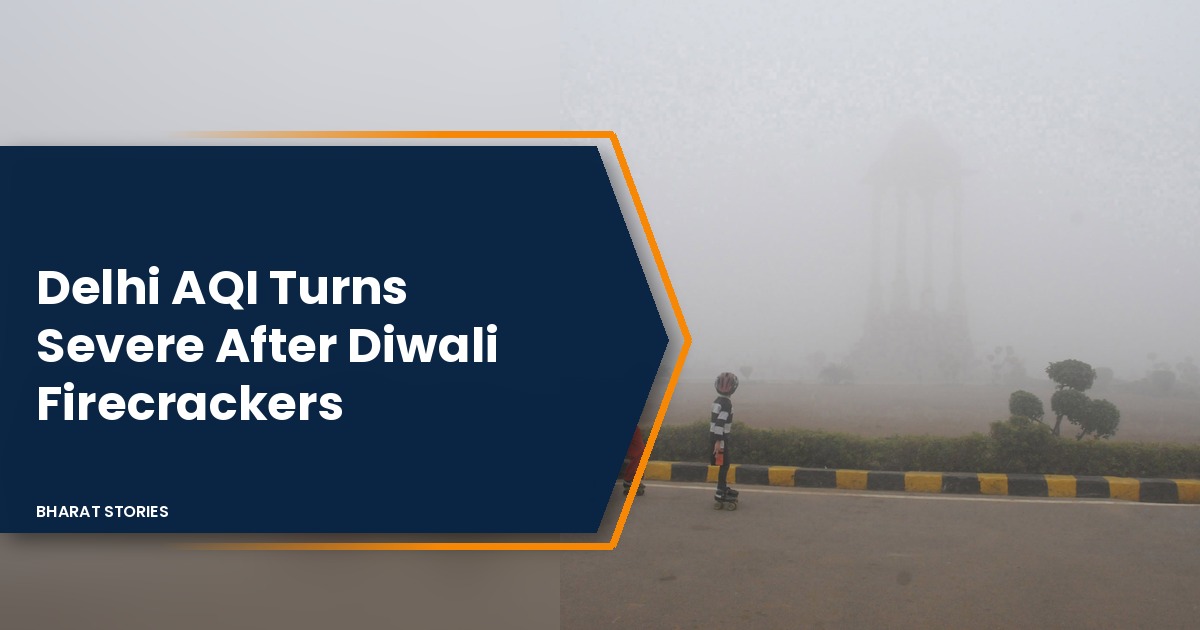

Delhi woke up on Monday, 9 November 2026, under thick post festival smog, with several Central Pollution Control Board stations pushing the city into the severe Air Quality Index band a day after Deepavali. The Hindu said the CPCB live dashboard showed Delhi AQI at 404 at 4 a.m., after many residents burst crackers well past the Supreme Court window that ended at 10 p.m. on festival night.
The Times of India and The Indian Express reported the same pattern: a severe reading above 400 at multiple stations, poor morning visibility, and Stage III Graded Response Action Plan rules already in force across Delhi NCR.
Table of Contents
How bad the readings were
Station wise CPCB figures listed by The Hindu put Burari Crossing highest at 441, followed by Vivek Vihar at 437, Delhi Technological University at 434, the North Campus of Delhi University and Jahangirpuri at 433 each, and Rohini at 430. Those six sites alone sit in the severe band, which CPCB defines as 401 to 500.
The Times of India added further severe or near severe spots, including Mundka at 417, Punjabi Bagh at 409, NIH Narela at 407 and ITO at 407, with Ghazipur at 418. The Indian Express separately noted Chandni Chowk at 418 and said the CPCB Sameer app showed a 24 hour average near 370, still in the very poor range even when some private monitors flashed higher US scale numbers.
CPCB bands, as restated by The Hindu, run from good (0 to 50) through satisfactory, moderate, poor and very poor, up to severe at 401 to 500. That ladder is what agencies use when they decide how hard to tighten traffic, construction and industrial curbs.
Why Deepavali night made it worse
The Supreme Court had allowed only green crackers in Delhi NCR for limited hours on 7 and 8 November 2026. Our earlier report on how the Supreme Court allowed green crackers in Delhi NCR on November 7 and 8 set out that window. On the ground, The Hindu said people kept lighting fireworks past 10 p.m., adding a sharp local spike on top of winter stagnation.
Deepavali itself remains the largest festival of lights for many families, a point covered in our explainer on Diwali, the biggest festival in India. The festival story and the pollution story now sit side by side every year in the capital: celebration at night, and a public health bill by morning.
What Stage III GRAP means right now
The Commission for Air Quality Management had already moved Delhi NCR to Stage III of the Graded Response Action Plan before the festival, The Hindu and The Indian Express reported. Stage III keeps tighter rules on construction dust, older diesel vehicles, industrial activity and related sources across Delhi and adjoining districts of Haryana, Uttar Pradesh and Rajasthan.
GRAP has four stages that grow stricter as forecasts worsen. Agencies lean on India Meteorological Department and Indian Institute of Tropical Meteorology outlooks so curbs can start before a citywide severe reading settles in. With several stations already above 400 on Monday morning, those Stage III measures stay the main official brake on further decline.
Smog beyond Delhi
The Hindu said Mumbai also woke to haze, with Kherwadi Bandra East at 264, Sewri at 226, Ghatkopar at 221 and Chembur at 216 on local monitors. Lucknow, Amritsar, Jodhpur, Ahmedabad, Dehradun, Jaipur, Udaipur and Surat all fell in the poor band on the city figures it listed, while Chennai stood at 208. Bengaluru, Hyderabad and Thiruvananthapuram were relatively better.
That wider map matters because festival emissions travel with calm winter winds, and because fuel and transport policy is changing in parallel. Readers can place Monday’s smog next to our report on how the Centre allowed E100 fuel for flex fuel vehicles in India, another clean air related policy thread from recent weeks.
What residents are being told
Health advice from past severe episodes still applies: limit outdoor exercise when the air looks grey, keep windows closed during the worst morning hours when possible, and use a well fitting mask if travel cannot wait. Children, older people and anyone with asthma or heart disease face higher risk when AQI sits in the severe band.
Officials have not announced a Stage IV jump in the reports cited here. The near term outlook from the Air Quality Early Warning System, as summarised by The Indian Express, had already flagged severe conditions for 8 and 9 November. Whether readings ease after the festival burst will depend on wind, moisture and how strictly Stage III is enforced.
For now, the verified Monday morning picture is a capital with multiple CPCB stations above 400, a citywide reading that touched 404 at 4 a.m., and Stage III GRAP already active across Delhi NCR after a Deepavali night that ran past the court set cracker window.
Featured image photo: Ministry of Environment, Forest and Climate Change, Government of India, GODL India, via Wikimedia Commons. It shows India Gate in fog in New Delhi and is used here to illustrate low visibility in the capital. It is not a photo from Diwali night 2026.
FAQ
What was Delhi AQI on the morning after Diwali 2026?
The Hindu said the CPCB live dashboard showed Delhi AQI at 404 at 4 a.m. on 9 November 2026, with several stations higher.
Which station was worst?
Burari Crossing at 441, according to the station list carried by The Hindu.
Is Stage III GRAP in force?
Yes. CAQM had already invoked Stage III across Delhi NCR before the festival, and reports say those curbs continue.
Did people follow the cracker timing rules?
The Hindu reported that many residents burst crackers past the 10 p.m. Supreme Court deadline on Deepavali night.
Sources
- The Hindu, 9 November 2026: CPCB dashboard 404 at 4 a.m.; Burari 441 and other station readings; Mumbai and other city AQIs; CPCB category bands; Stage III GRAP framing.
- The Times of India, 9 November 2026: additional Delhi station readings including Mundka, Punjabi Bagh, Narela, ITO and Ghazipur; morning haze notes.
- The Indian Express, 9 November 2026: Jahangirpuri and Chandni Chowk figures; Sameer 24 hour average; Stage III timing; early warning severe outlook for 8 and 9 November.