


The Centre has changed India’s motor vehicle rules to recognise E100 fuel, or petrol replaced almost entirely by ethanol, for vehicles built and certified as flex fuel models. The Ministry of Road Transport and Highways said on Sunday, 26 October 2026, that it had notified amendments to the Central Motor Vehicles Rules, 1989, which now name E100 alongside E85 in the emission certification provisions, according to a Press Information Bureau release.
The changes were notified on 23 October, CNBC TV18 reported, and took effect from the date of publication in the Official Gazette. The ministry stressed that the move does not touch the cars and two wheelers already on Indian roads.
Table of Contents
What the E100 fuel amendment changes
The amendments revise Rule 115, which sets emission standards for motor vehicles, and Rule 115E, which deals with additional emission testing provisions, The Hindu reported. E100 has been added next to E85 in several tables under Rule 115. An explanatory note says E85 or E100 shall be used in vehicles designed by original equipment manufacturers as flex fuel vehicles.
In fuel labels, the letter E stands for ethanol and the number shows its share by volume. E85 contains up to 85 per cent ethanol, while E100 is a fuel made up predominantly of ethanol, subject to the applicable fuel specification. Vehicles certified for these fuels still have to meet the emission and safety requirements that apply to their category, the ministry said.
The notification also updates provisions on biodiesel and makes technical corrections. One of these fixes a fuel classification so that it correctly refers to petrol blended with 20 per cent ethanol, or E20, in place of an earlier notation that mentioned E10, according to The Hindu.
Existing vehicles do not need to change
With many motorists already uneasy about E20 petrol, the ministry went out of its way to reassure owners. “A vehicle’s compatibility with E10 or E20 alone does not establish suitability for E85,†it said. It added that the notification does not require owners of existing vehicles to switch to E85 or modify their vehicles, “either at present or in the future.â€
The ministry said E85 and E100 are meant only for vehicles specifically designed and certified for them, and will not apply to other vehicles generally available in the market. Officials quoted by the Economic Times put it more plainly: vehicles that run on E20 or regular fuel cannot use E85 or E100. Drivers have been advised to check the fuel compatibility sticker on their vehicle and to follow the owner’s manual when choosing fuel at the pump.
How flex fuel vehicles work
Flex fuel vehicles are already common in Brazil and the United States. They run on a range of petrol and ethanol blends from a single fuel tank. Their fuel system parts and materials are chosen for the approved blends, and the engine controls adjust automatically to the mix in the tank, the PIB release explained. Depending on how a vehicle is designed and certified, that range can go up to E85 or E100.
The government argues that more domestically produced ethanol can cut India’s dependence on imported crude oil. Officials also said ethanol has a lower fossil carbon footprint than conventional petrol, and that higher blends can reduce tailpipe emissions of carbon monoxide and certain hydrocarbons. The ministry added a caveat that the overall greenhouse gas benefit depends on the feedstock and how the ethanol is produced.
Why the timing matters for carmakers
The rule change comes as manufacturers prepare to sell high ethanol models. In June, Petroleum Minister Hardeep Singh Puri launched India’s first flex fuel passenger car, a Maruti Suzuki model that can run on blends from E20 up to E100, with Road Transport Minister Nitin Gadkari present, according to an earlier PIB release.
Gadkari said at the time that 12 manufacturers were preparing flex fuel models, naming Tata, Mahindra, Hyundai, Toyota, Suzuki and MG among them, CNBC TV18 reported in June. CNBC TV18 noted on Sunday that the amendment arrives months before some carmakers are expected to launch E100 models.
The fuel station question
Buyers will need somewhere to fill up. The roadmap Puri outlined in June identifies E85 as the standard fuel for flex fuel vehicles under BIS specifications. It plans an initial 50 to 100 fuel outlets ready for such vehicles in the Delhi NCR region and along the Mumbai, Pune and Nagpur corridor, rising to nearly 500 outlets by December 2026 and about 5,000 across major cities by the end of 2027.
The government has also said it is working on pricing support, road tax concessions and consumer awareness. No tax or pricing relief has been announced yet.
India’s ethanol push so far
India’s ethanol blending in petrol has climbed from less than 1.5 per cent in 2013 to 2014 to 20 per cent in the 2025 to 2026 year, which the petroleum ministry says met its target five years early. Ethanol production capacity has grown nearly five times, from 421 crore litres in 2014 to about 2,000 crore litres in 2026, according to the June PIB release.
Ethanol holds less energy per litre than petrol, so mileage on high ethanol blends is usually lower, which is why pricing at the pump will matter to buyers. The new rules settle the legal side of certifying such vehicles; how quickly they catch on will depend on launches, prices and how many stations actually sell E85 and E100.
Read more on Bharat Stories about the difference between petrol, diesel and electric cars, the rise of electric vehicles in India, and recent changes to windfall tax on fuel exports.
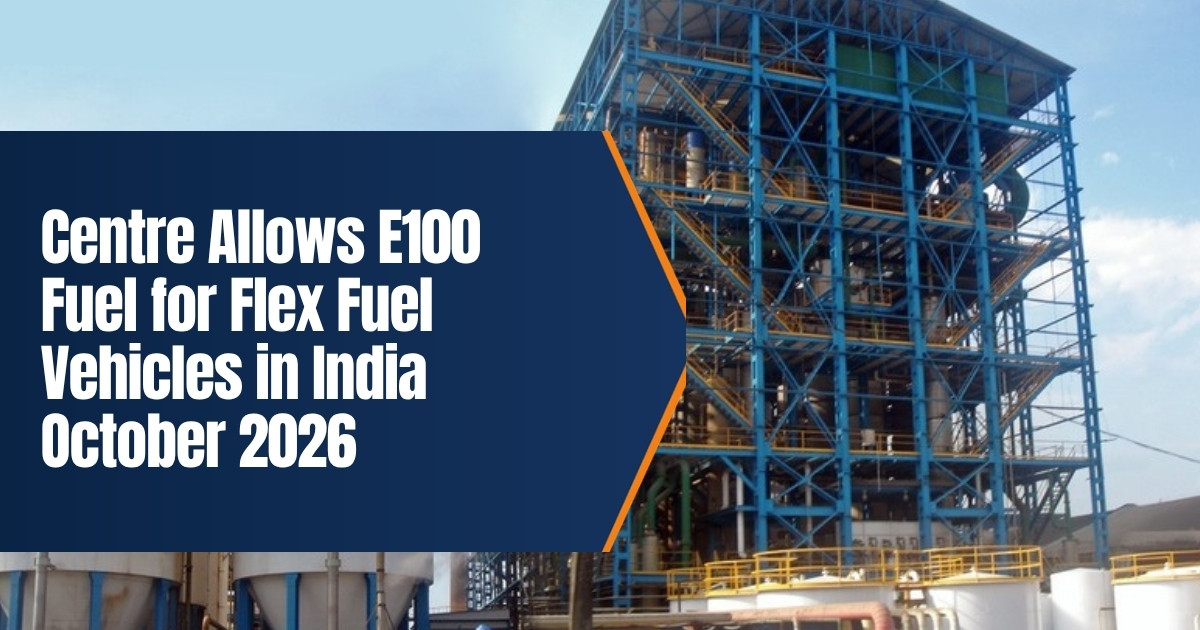
Featured image photo: Mariordo (Mario Roberto Duran Ortiz), CC BY SA 3.0, via Wikimedia Commons (an ethanol distillery in Piracicaba, Brazil; not an Indian plant).
FAQ
What is E100 fuel?
E100 is a fuel made up predominantly of ethanol, subject to the applicable specification. E85 contains up to 85 per cent ethanol, with petrol making up the rest.
Can my current car use E85 or E100?
Only if the maker designed and certified it as a flex fuel vehicle. The ministry said compatibility with E10 or E20 does not make a vehicle suitable for E85. Check the fuel sticker and the owner’s manual.
Do existing vehicle owners have to do anything?
No. The notification does not require owners to switch fuel or modify their vehicles, now or in the future.
Sources
- Press Information Bureau, Ministry of Road Transport and Highways, 26 October 2026: amendments, E85 and E100 definitions, advice to motorists.
- The Hindu, 26 October 2026: Rules 115 and 115E, explanatory note, E20 correction.
- The Economic Times, 26 October 2026: officials on E20 vehicles and emissions.
- CNBC TV18, 26 October 2026: notification date of 23 October and upcoming E100 launches.
- Press Information Bureau, Ministry of Petroleum and Natural Gas, 4 June 2026: flex fuel car launch, blending figures and outlet roadmap.
- CNBC TV18, June 2026: Gadkari on 12 manufacturers preparing flex fuel models.