

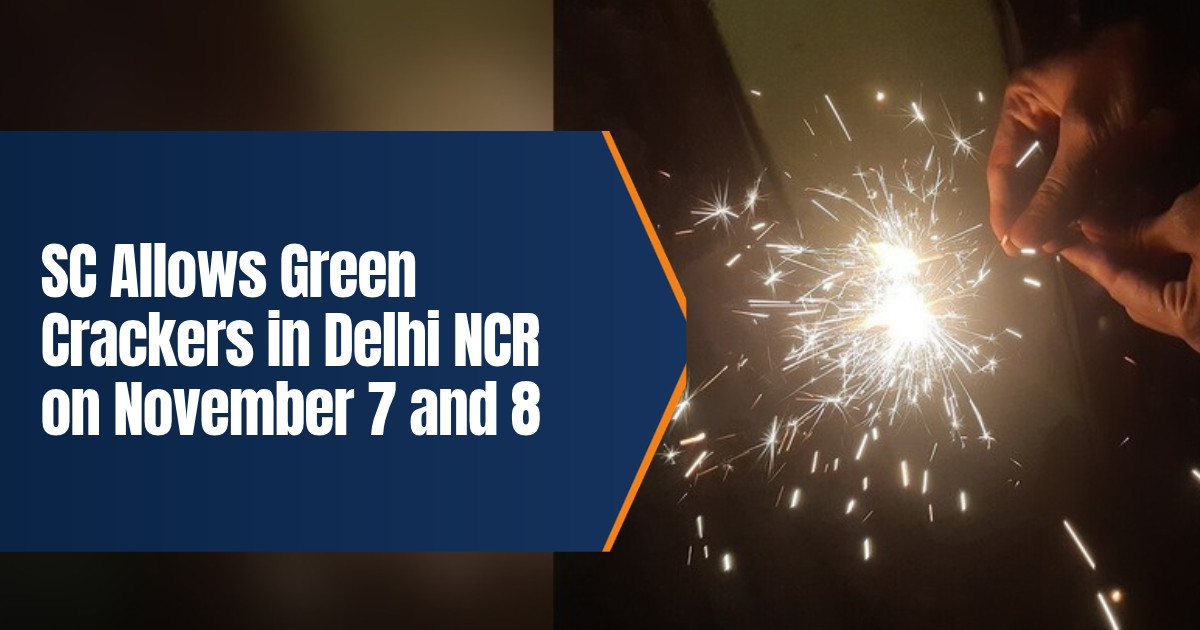

The Supreme Court has allowed people in Delhi NCR to burst only certified green crackers for two days around Diwali this year, on 7 and 8 November 2026, and only in two short time slots each day. The complete ban on firecrackers in the region will return from 9 November, according to the court’s written order in the long running Arjun Gopal case.
A Bench of Justices M M Sundresh and Prasanna B Varale signed the 23 page order on 29 October, and it was made public on Monday, 2 November, The Hindu reported. The order follows the pattern of the court’s relaxation in October 2025 and comes as Delhi’s air has already slipped into the very poor category this season.
Table of Contents
Green crackers: allowed hours and no cracker zones
Under the order, bursting of green crackers is allowed only between 6 am and 7 am and between 8 pm and 10 pm on 7 and 8 November.
There can be no fireworks within 300 metres of hospitals, nursing homes, primary and district health centres, old age homes, notified silence zones and educational institutions. These will be marked and published as no cracker zones.
What manufacturers and traders must follow
The key conditions for the supply chain are:
- Only makers certified by CSIR NEERI and the Petroleum and Explosives Safety Organisation (PESO) may manufacture, and only the green crackers listed on the CSIR NEERI website, between 2 and 6 November.
- Boxes must be fully sealed so that they cannot be mixed with conventional crackers.
- Every box must carry a QR code for that product and batch. Scanning it should show the maker, NEERI registration, PESO or district licence, formulation and test certificate. QR codes cannot be transferred, and selling them will lead to cancellation of registration.
- No crackers joined in series (laris) or garlands, and no crackers containing barium.
- Cancelled trader licences will be restored only from 4 to 6 November to sell approved green crackers, and will be cancelled again at once if rules are broken.
- Manufacturers and traders must deposit a monetary security, a “handsome amount” set by the authorities, which will be forfeited on any violation.
Sales are allowed only at locations chosen by District Collectors or Commissioners with the district police. Selling anywhere else, including through online platforms, is banned. Shops must display the directions and explain how to spot a genuine green cracker and how to complain.
Police checks and pollution monitoring
Police and district officials must form patrolling teams to watch sale points, check QR codes at random, seize illegal or conventional crackers and prosecute offenders. Vehicles entering Delhi NCR are to be checked for banned crackers.
The Central Pollution Control Board, working with state boards, must prepare daily air quality reports for three periods: 2 to 6 November, 7 and 8 November, and 9 to 30 November. Monitoring stations said to be faulty must be inspected and repaired. States must also file an affidavit on the rise in hospital admissions across Delhi NCR after the festival, up to 30 November.
All compliance reports must reach the court by 14 December 2026. The Bench warned of contempt action against officials who fail to comply and listed the matter for 16 December.
Why the court relaxed the ban again
The order says the court does not yet have enough data to decide whether a complete ban is the best answer. It noted it had not been shown whether the ban imposed in 2024 in Delhi NCR had worked, since air quality readings showed no significant improvement. The Bench said the October 2025 relaxation was also meant to help states study the effect of green crackers, but the states had “utterly failed” to comply.
The judges also recorded that air quality spiked on Dussehra and the next day this year even with the ban in force, and that conventional crackers continued to be sold as green ones. In the court’s view, the complete ban was feeding illegal sales while keeping tested green crackers off the market.
Amicus curiae Uttara Babbar and senior advocate Gopal Sankaranarayanan, appearing for the petitioners, had argued for a complete ban on making, storing, selling and using firecrackers, the order records. Senior advocate J Sai Deepak, for licensed traders and manufacturers, argued that refusing to restore licences would only help illegal crackers brought in from outside.
Religion, health and the right to clean air
The Bench described bursting crackers during Deepavali as a religious practice but said that, if left unregulated, it causes serious air and noise pollution and solid waste. “The right of an individual to engage in a particular practice, which may have a religious colour, is only a qualified one,” the court held, as quoted by The Hindu.
Bar and Bench reported that the Bench stressed that religious freedom under Article 25 is subject to public health and to the right to a pollution free environment under Article 21. Hindustan Times noted that the court also recognised the festival’s social and emotional importance. You can read more about the festival itself in our piece on Diwali, India’s biggest festival.
Background and current air quality
The case dates back to a 2015 petition. A complete ban was imposed across Delhi NCR in December 2024, and in October 2025 the court allowed green crackers for three days, from 18 to 20 October, as a temporary step, Hindustan Times reported.
The new relaxation comes while pollution is already rising. On 2 November the Commission for Air Quality Management invoked Stage II of the Graded Response Action Plan across NCR after Delhi’s AQI reached 324 at 4 pm, in the very poor category for the first time this season, according to a Hindustan Times news brief.
The court also appealed to lawyers, celebrities and sportspersons to back a voluntary awareness campaign. For practical advice, see our tips for a happy and safe Diwali, and for how polluted air affects daily health, our explainer on pollution and health.
Featured image photo: AdhiRajamanickam, CC BY SA 4.0, via Wikimedia Commons. It is a representative photo and does not show a certified green cracker.
FAQ
When can green crackers be burst in Delhi NCR in 2026?
Only on 7 and 8 November, from 6 am to 7 am and from 8 pm to 10 pm. The complete ban returns on 9 November.
How can buyers check a genuine green cracker?
Each box must be sealed and carry a product and batch QR code that shows the maker, NEERI registration, licence, formulation and test certificate.
Sources
- Supreme Court order in Arjun Gopal and Ors v Union of India, dated 29 October 2026 (PDF hosted by LiveLaw): all directions, dates, hours, reasoning, counsel submissions, next hearing.
- The Hindu, 2 November 2026: order made public on Monday, religious practice remarks, quotes, “utterly failed”.
- Bar and Bench, 2 November 2026: Article 25 and Article 21 reasoning, permitted dates.
- Hindustan Times, 2 November 2026: December 2024 ban, October 2025 relaxation, festival significance.
- Hindustan Times, 2 November 2026: GRAP Stage II and AQI 324.