

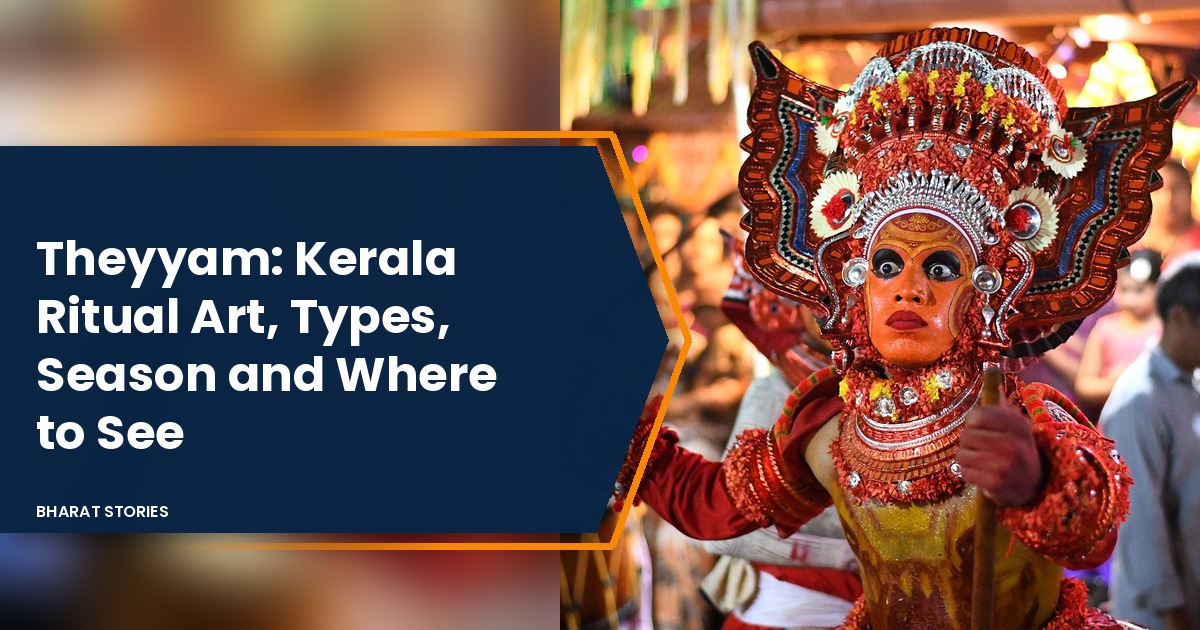
Theyyam: Kerala Ritual Art, Types, Season and Where to See
Theyyam is the ritual art of North Kerala in which a performer, painted and dressed as a deity, is believed to become that god for the length of the performance. People in the villages of Kannur and Kasaragod do not treat it as a show. They come to receive blessings, ask for help and settle worries. This guide explains what Theyyam is, where and when it is performed, who performs it, how a performance unfolds, and how a visitor can watch one with respect.
Table of Contents
What is Theyyam?
Theyyam is a ritual performance of North Malabar in Kerala that mixes dance, music and mime, in which the performer is believed to take on the form of a god, goddess, hero or ancestor. The name is generally traced to the word daivam, meaning god. The Kerala Tourism page on Theyyam in Malabar calls it a socio religious ritual performed since remote times and notes that it is also known as Kaliyattom.
For believers, the performer stops being an ordinary man once the ritual reaches its peak. Kerala Tourism puts it simply: for the people of North Malabar, God means Theyyam. In that moment the deity is said to stand among people of every caste, from Brahmin to Pulayan, and to listen to them directly. That is why devotees bow and speak their troubles to the Theyyam rather than watching from a distance.
Kerala Tourism also lists Thira and Thirayattam as other names used for the art. A separate ritual form called Thirayattam is performed further south, and our post on Thirayattam of South Malabar describes that tradition.
Which state is famous for Theyyam?
Kerala is famous for Theyyam, and within Kerala it belongs to North Malabar, mainly the Kannur and Kasaragod districts. According to Kerala Tourism, the region known as Kolathunadu, today covering Kannur, Kasaragod, Vadakara and Quilandy in Kozhikode and Mananthavady in Wayanad, is the home of the art. Some areas of Karnataka near the border also have Theyyam.
Across the border in coastal Karnataka, the Tulu speaking community follows a close cousin called Bhuta Kola. The Wikipedia article on Buta Kola describes it as closely related to the Theyyam of North Malabar. If you want the wider picture of the state, our profile of Kerala, its history, culture and tourism places Theyyam beside Kathakali and Mohiniyattam among the arts of Kerala.
How old is Theyyam and what is its history?
The official Theyyam calendar of Kerala Tourism describes Theyyam as more than eight centuries old, and its roots lie in village worship at sacred groves called kavu. In ancient times, the Malabar page says, every village had a common shrine called a kavu, and the Kaliyattom was performed in front of it.
That village link is still strong. Kerala Tourism notes that most families and communities in North Malabar have a Theyyam as their family deity, and each village has a Theyyam as its village god. The deities honoured include major gods and goddesses, tree gods, mountain gods, warriors and forest and hunting spirits. There are also minor characters such as Pottan and Muthala, the crocodile.
The tradition has also absorbed figures from other faiths. Kerala Tourism lists Muslim characters such as Bappiriyan Theyyam, Ummachi Theyyam and Aalibhootham, which it reads as a sign that the art form crossed religious lines.
How many types of Theyyam are there?
There are about 400 types of Theyyam, each with its own face painting, costume and story. Kerala Tourism says there are nearly 400 different Theyyams, grouped as major and minor ones, and DTPC Kannur, the district tourism council, puts the figure at more than 400.
Some of the best known names are:
- Muchilottu Bhagavathy: listed by Kerala Tourism among the major Theyyams, representing the goddess Kali.
- Kathivannur Veeran: a warrior Theyyam whose skirt is made of bamboo pieces wrapped in red cloth.
- Raktha Chamundi and Kari Chamundi: named by DTPC Kannur among the most famous forms.
- Theechamundi: one of the Theyyams that, in DTPC Kannur’s words, have fire in their hair.
- Gulikan, Pottan and Wayanadu Kulaven: also on DTPC Kannur’s list of well known forms.
- Muthappan: a deity of North Kerala worshipped in the form of Theyyam, covered in the quick answers below.
Who performs Theyyam?
Theyyam is performed by men from specific hereditary communities, chiefly the Malayan and Vannan communities, which are listed as Scheduled Castes. Kerala Tourism names these two as the chief performers, with members of other smaller communities also taking part. DTPC Kannur lists Vannan, Malayan, Mavilan, Velan, Munnoottan, Anjunnoottan, Pulayar and Kopalar among the performer communities.
This is one of the striking things about Theyyam. The chief performers come from communities listed as Scheduled Castes, yet during the ritual people of every caste, Brahmins included, bow before them as before a god. The performer gains standing in the village through seniority, skill and dedication.
Before a performance, the performer goes through a period of discipline called vrutham, which includes fasting, daily rituals, prayer and meditation. A 2023 Kerala Tourism newsletter article says the performer leads a life of abstinence for two weeks before the ritual.
What happens during a Theyyam performance?
A Theyyam begins with sung invocations called thottam, followed by hours of make up, and ends with the fully dressed performer dancing as the deity and blessing devotees. The steps below follow the descriptions from Kerala Tourism and DTPC Kannur.
- Thottam: the performer and drummers sing the ritual song of the deity, telling its story. The Kerala Tourism newsletter says these songs are called thottam.
- Make up: the face is painted in set patterns. For certain forms, the Malabar page says, painting the face alone can take eight to ten hours.
- The headgear: the tall crown, called mudi, is the most important part of the costume. Kerala Tourism says that after the thottam the performer gradually changes into the god.
- The dance: the deity dances to folk drums such as the chenda and cymbals such as the elathalam. DTPC Kannur notes that the performance begins slowly and builds as the spirit of the deity is believed to take over.
- Blessings: devotees come forward with their problems. DTPC Kannur says the Theyyam showers rice grains on onlookers as a sign of blessing.
Each form taken by a performer is called a kolam, a word Kerala Tourism translates as shape or form. Every god and goddess has its own kolam with its own face painting.
What colours and costumes are used in Theyyam?
Theyyam costumes are made from natural materials, and red is the main colour of the make up, traditionally prepared by mixing turmeric and limestone. The Kerala Tourism artforms page says the face paint uses natural colours such as rice flour, turmeric and charcoal, and that red stands for energy, power and anger.
The costume changes with each character. Skirts are made from coconut fronds, areca leaves and bamboo slivers, while some forms wear only a simple mundu. Wooden breastplates called marmula, face masks, bangles, anklets and amulets complete the look. Bhagavathy Theyyams wear a long silver ornament for teeth called ekir.
The 2023 newsletter names the main colours as red, orange, yellow, black and white. It lists praakezhuthu, sankezhuthu, naagam thathal ezhuthu and varezhuthu as styles of face painting, and Parunthuvaal Ezhuthu and Anchupulli Ezhuthu as styles of body painting.
When is the Theyyam season?
The Theyyam season starts in mid October and runs to about late May, with the busiest months from December to April. Kerala Tourism says the season begins on the tenth day of the Malayalam month of Thulaam, usually mid October, and lasts until the middle of Edavam, usually late May. DTPC Kannur describes December to April as the main Kaliyattam season in Kannur and Kasaragod.
Some temples hold a much larger festival only once in 12 years or more. Kerala Tourism calls this a Perumkaliyattam. Grand Theyyam performances held at temples or by prominent families are called Kaliyattam.
Where can you see Theyyam?
You can see Theyyam at village shrines, temples and family houses in Kannur and Kasaragod districts, and the official calendars list the dates. The DTPC Kannur Theyyam calendar lists each venue with its taluk, panchayat, dates, timings, contact numbers and the Theyyams to be performed. Its 2026 listings already include performances from late October and November.
Kerala Tourism also runs a Theyyam calendar. Its disclaimer is worth reading: dates follow the Malayalam calendar and local custom, they can change, and they should be confirmed with local authorities. The 2023 newsletter names Karivallor, Nileshwaram, Kurumathoor, Cherukunnu, Ezhom and Kunnathoorpadi among places known for well known performances.
A few simple habits help a first time visitor:
- Call the contact number in the calendar before you travel, since dates can shift.
- Many performances run through the night, so plan your stay nearby.
- Remember that you are at a place of worship. Dress modestly, follow what the organisers and locals ask, and keep clear of the performer’s path.
- Ask before taking close photos, and never use a flash in the performer’s face.
Quick answers
Can girls perform Theyyam?
Theyyam is generally performed by men, even when the deity is a goddess. The known exception is Devakkoothu, which the Wikipedia article on Devakkoothu describes as the only Theyyam performed by a woman. It is held once in two years at a temple near Cherukunnu in Kannur district.
What is the difference between Theyyam and Muthappan?
Theyyam is the art form, while Muthappan is a deity. According to the Wikipedia article on Muthappan, he is worshipped in the form of Theyyam rather than through an idol, and his shrines, called madappura, are open to people of any caste or religion.
Is Theyyam a classical or a folk dance?
Neither label fits well. Theyyam is a ritual form of worship with dance, music and mime, not one of the recognised classical dances. Our list of Indian classical and folk dances shows where it sits among the dances of India.
Is Theyyam the same as Kathakali?
No. Both come from Kerala and use bold face painting, but Kathakali is a classical dance drama staged for an audience, while Theyyam is worship in which the performer is believed to become the deity. Our post on Kathakali explains that art form.