

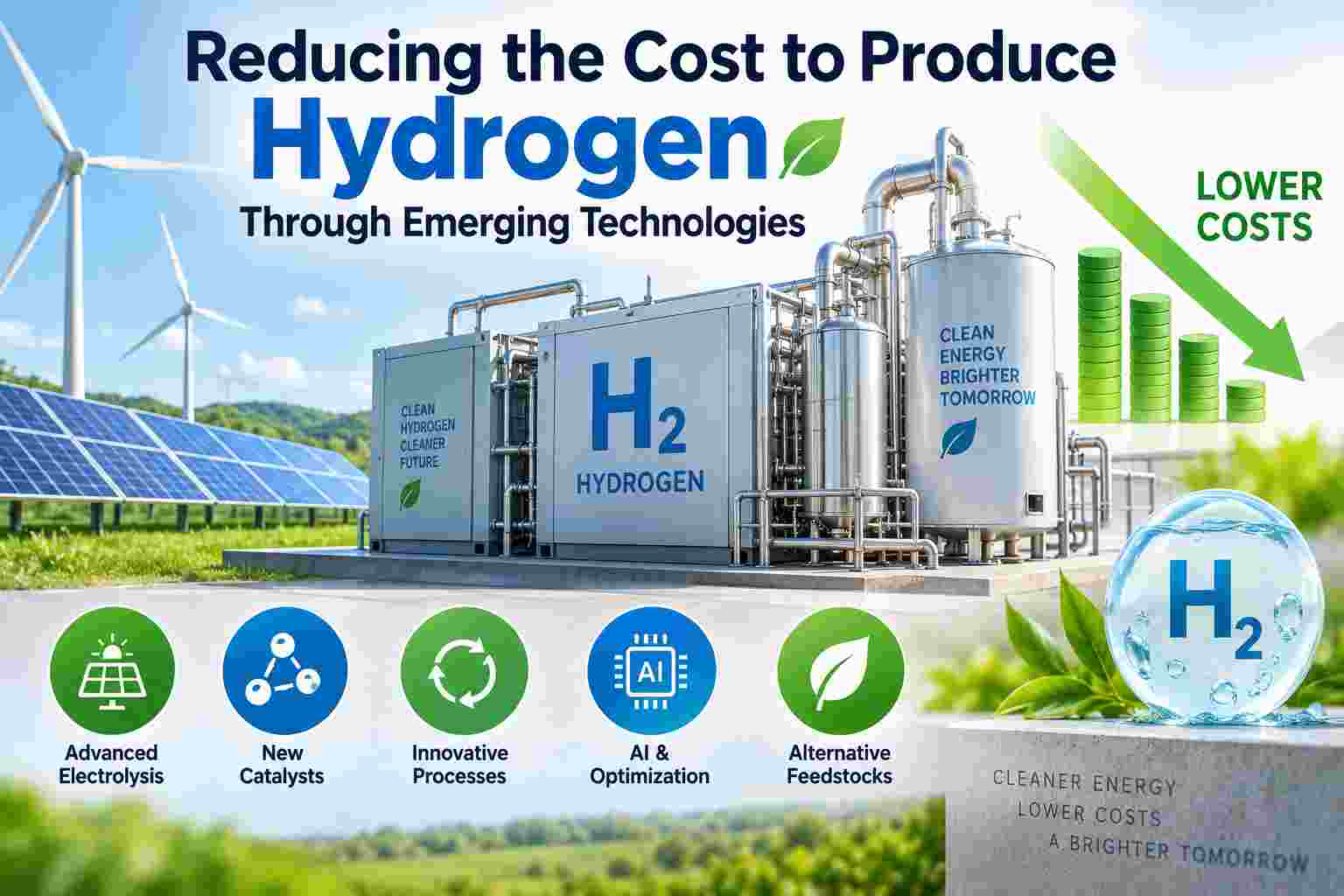
Reducing the Cost to Produce Hydrogen Through Emerging Technologies
$3.5 to $6 per kilogram. That’s roughly where green hydrogen sits today, according to a techno-economic review published in the Journal of Industrial and Engineering Chemistry. Grey hydrogen, made from natural gas, still costs a fraction of that.
That price gap is the whole story of why hydrogen hasn’t scaled the way solar or wind did. Fixing the cost to produce hydrogen isn’t one problem. It’s several smaller ones stacked on top of each other, and each one is being chipped away right now by a different piece of technology.
Table of Contents
Electrolyzer Cost Is Still the Biggest Lever
Most of the cost in green hydrogen traces back to one machine: the electrolyzer. It’s the unit that splits water into hydrogen and oxygen using electricity, and its capital cost dominates the economics of the cost to produce hydrogen more than almost anything else in the chain.
RMI’s modelling puts it plainly. Reduced electrolyzer capital expenditure is the single largest driver of near-term cost reduction, with a 50 to 70 percent cost drop achievable between 2026 and 2030 through scale, manufacturing improvements, and better system design. That’s not a marginal gain. That’s the difference between a pilot project and a commercially viable plant.
Manufacturing at scale matters more here than in most energy hardware. A factory producing a few hundred electrolyzer stacks a year behaves nothing like one producing tens of thousands. Standardized components, automated assembly, fewer custom parts per order. All of those compounds.
One Company Just Claimed Cost Parity
Here’s a data point worth sitting with. Chinese electrolyzer maker HydoTech announced in July 2026 that it had reached a $2 per kilogram production cost, roughly matching fossil-based hydrogen. Aramco Ventures and Conch Cement are backing the claim with actual capital, not just interest.
Whether that number holds up at scale, outside a single demonstration site, is a fair question. Vendor claims and independent third-party verification are two different things. But the direction is consistent with what RMI and other analysts have been projecting for a while: sub-$2/kg green hydrogen is achievable in the right locations well before 2030.
Renewable Electricity Cost Sets the Floor
Electrolyzers only get you so far. The electricity feeding them matters just as much, arguably more, once the hardware is optimized.
Industry analysis shows renewable electricity below $20 to $30 per megawatt-hour is essentially required for green hydrogen to reach cost parity with fossil-based production. That’s a specific, narrow band. Most regions aren’t there yet. Some already are.
The Middle East, parts of Australia, the western United States, and pockets of Africa have exceptional solar and wind resources. PwC’s analysis puts current green hydrogen production costs in those regions at €3 to €5 per kilogram, compared to €5 to €9 in less favourable markets. Geography isn’t a footnote here. It’s a primary input.
Anyone wanting the full breakdown of what drives that regional cost spread, including capital cost, utilization rates, and electricity procurement, can find it in this detailed look at the cost to produce hydrogen and the factors that shape it.
Policy Is Doing Some of the Heavy Lifting Too
Technology alone won’t close the gap fast enough for some governments’ climate targets. That’s where subsidies come in to lower the cost to produce hydrogen, and the US has gone further than most.
The Inflation Reduction Act’s 45V tax credit can inject up to $3 per kilogram for hydrogen produced with near-zero lifecycle emissions. On paper, that could push effective costs down to somewhere between $0.50 and $1.50 per kilogram, which would make green hydrogen genuinely competitive with grey.
The catch is qualifying for it. The credit’s “three pillars” carbon accounting rules are strict enough that many projects have delayed their final investment decisions just trying to structure compliance correctly. Only 4 to 7 percent of the roughly 520 gigawatts of globally announced hydrogen projects have actually reached FID so far. A generous subsidy on paper doesn’t automatically translate into shovels in the ground.
Downstream Losses Are an Underrated Cost Driver
Production cost gets most of the attention, but a meaningful chunk of the total cost happens after the hydrogen is already made.
Liquefaction, the process used to compress hydrogen for storage and transport, consumes 30 to 40 percent of the hydrogen’s own energy content. Ammonia conversion, used for some shipping and export routes, sees round-trip efficiency collapse to as low as 11 to 19 percent in some cases. These physics-driven penalties can add another $2.70 to $3.20 per kilogram to delivered costs, on top of whatever the electrolyzer and electricity already cost.
This is why pipeline retrofitting is getting more attention lately. It can cut transport costs by 50 to 70 percent compared to liquefaction or chemical carriers. Not every region has existing gas infrastructure worth retrofitting, though, so this option isn’t universal either.
Where the Cost Curve Realistically Goes from Here
The US Department of Energy’s Hydrogen Shot Initiative has set a target of $1 per kilogram by 2031. That’s an aggressive number, and it assumes electrolyzer costs keep falling, renewable electricity keeps getting cheaper, and policy support stays in place long enough to matter.
None of those three things are guaranteed on their own. Together, they’re not impossible either, especially given how fast the electrolyzer manufacturing side has already moved in the last two years.
What’s clear is this: the cost to produce hydrogen isn’t dropping because of one breakthrough. It’s dropping because manufacturing, electricity procurement, policy design, and logistics are all improving in parallel. That’s a slower story than a single miracle technology, but it’s probably a more durable one.
For engineers and researchers building lab infrastructure around these systems, understanding where each cost component sits today, and how fast each one is likely to move, matters more than chasing whichever headline number looks best this quarter.