

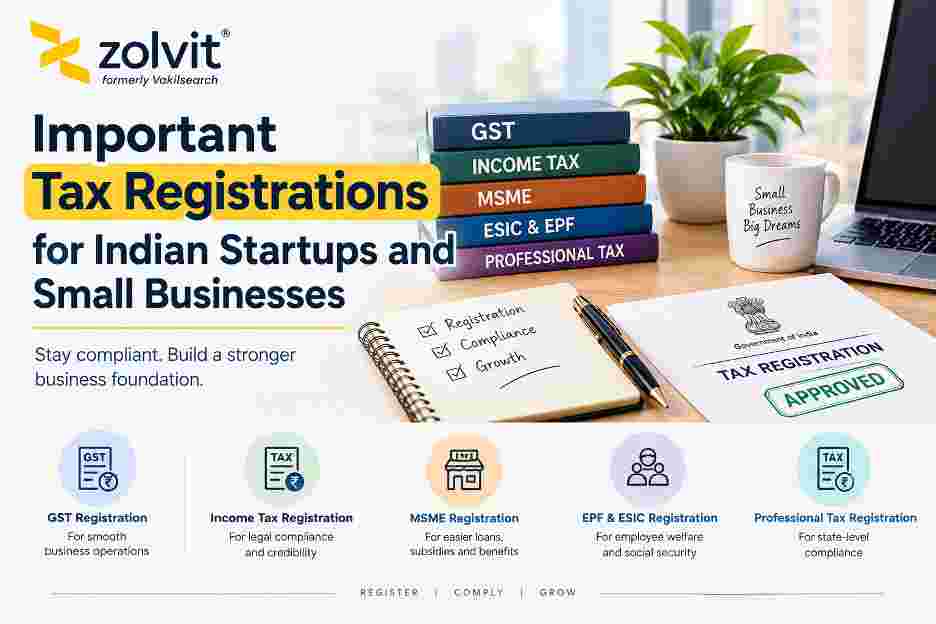

The founders may concentrate more on company name registration but ignore other registrations till someone asks for a GST invoice, evidence of being in business, or when the online platform demands GSTIN. Registration in advance could be helpful to keep oneself away from last-minute chaos.
Each registration serves some objective. The PAN card helps in identifying the taxpayer, while GST registration would be done only in case it is required and allows claiming eligible input tax credit. The TAN is for those cases where TDS and TCS is to be paid, while Udyam enables one to get MSME registration.
The sole proprietorships don’t have the incorporation certificate as their business identity depends on registration and licences. Sole proprietorship registration online is a common search term.
Table of Contents
What Are Tax Registrations for Startups and Small Businesses?
Tax registrations are the official numbers and certificates issued by government authorities that allow a business to pay tax, collect tax from customers, deduct tax at source, and claim legal benefits.
In plain terms, they answer three questions authorities ask about your business:
- Who are you? PAN, Udyam, and your incorporation or proprietorship records.
- What tax are you responsible for? GST registration, TAN, and professional tax.
- What benefits can you claim? Input tax credit, MSME schemes, and startup incentives.
Did You Know? GST registration costs nothing on the government portal. After you apply, you receive a Temporary Reference Number (TRN) that stays valid for 15 days, so you can save your progress and return to finish the form. The fees people pay are for professional help, not for the registration itself.
Why Tax Registrations Matter
Tax registrations matter because the right registration determines whether you can collect GST, claim eligible input tax credit, deduct tax at source, and access particular government or MSME benefits.
Once the applicable registrations are in place, they support several parts of day-to-day business operations:
- Builds credibility. Business customers prefer suppliers with a valid GSTIN.
- Protects your margins. Registered businesses can claim input tax credit on purchases.
- Opens funding. Banks and NBFCs ask for PAN, GST, and Udyam details before lending.
- Keeps you legal. Late or missed registration leads to tax, interest, and penalties.
- Unlocks benefits. MSME and startup schemes require the right registration first.
With those purposes in mind, the following table gives a quick view of the registrations most commonly relevant to startups and small businesses.
Important Tax Registrations
Not every business needs every registration. Start with your business structure, turnover, and activity, then use this table to identify the registrations that may apply.
| Registration | Authority | Who Needs It | Cost to Apply |
| PAN | Income Tax Department | Every taxpayer and business | Nominal government fee |
| GST registration | GST Portal / GST authorities | Businesses crossing the applicable threshold or falling in a compulsory-registration category | Free on the portal |
| TAN | Income Tax Department | Anyone who deducts or collects tax at source | Nominal government fee |
| Udyam registration | Ministry of MSME | Eligible micro, small and medium enterprises | Free |
| Professional tax | State government | Employers and professionals in states that levy it | Varies by state |
| Shops and Establishment | State or local authority | Shops, offices and commercial establishments | Varies by state |
| PF and ESI | EPFO and ESIC | Employers above the employee limits | Free to register |
| DPIIT recognition | DPIIT (Startup India) | Eligible startups seeking benefits | Free |
| Startup tax-benefit approval | Inter-Ministerial Board / applicable authority | Eligible DPIIT-recognised companies and LLPs seeking the startup tax benefit | No government filing fee stated here |
Before applying for individual registrations, there is one decision that can affect almost everything that follows: the business structure.
Choosing the Right Business Structure First
Your business structure affects which registrations apply, how income is taxed, and what kind of compliance follows. Choosing the structure first therefore makes the registration sequence clearer.
| Feature | Sole Proprietorship | LLP | Private Limited Company |
| Legal identity | Same as the owner | Separate entity | Separate entity |
| Incorporation required | No | Yes (MCA) | Yes (MCA) |
| Liability | Unlimited | Limited | Limited |
| PAN | Owner’s personal PAN | Separate PAN | Separate PAN |
| Income taxed in | Hands of the owner | Hands of the LLP | Hands of the company |
| DPIIT recognition | Not available | Available | Available |
| Section 80-IAC holiday | Not available | Available (if eligible) | Available (if eligible) |
| Best for | Freelancers, small traders, early testing | Professional services, partnerships | Funded startups and scaling businesses |
A sole proprietorship can be a simple way to start, but the owner remains personally liable for the business. It is also not eligible for DPIIT startup recognition. If outside investment, limited liability, or startup-specific benefits are part of the plan, an LLP or company may be more suitable.
Sole Proprietorship Registration Online: How It Works
A sole proprietorship has no separate incorporation certificate. Registration generally means obtaining the registrations, licences, and business proofs applicable to the proprietor and the activity.
This is where many first-time founders get confused. A proprietorship is not incorporated through the Registrar of Companies. Instead, its business identity is established through the registrations and licences that apply to the activity:
- Use your PAN and Aadhaar. The proprietor’s personal PAN serves as the business PAN.
- Choose a trade name for invoices, signboards, and your bank account.
- Register on Udyam. The Udyam certificate is the most widely accepted online proof of a proprietorship.
- Apply for GST registration if you cross the threshold or choose to register voluntarily.
- Get a Shops and Establishment registration or trade licence under your state or local law, where required.
- Open a current account in the business’s trade name, using the above documents.
- Add optional registrations such as IEC, FSSAI, or trademark, depending on what you sell.
Tax treatment: Your business income is added to your personal income and taxed at your slab rates. You file ITR-3, or ITR-4 if you opt for presumptive taxation.
PAN: The Foundation of Every Tax Registration
PAN, or Permanent Account Number, is a ten-character alphanumeric identifier issued by the Income Tax Department. It is a foundational tax identifier and is required for several other registrations and financial transactions.
- Sole proprietors use their personal PAN for the business.
- Companies, LLPs, and firms need a separate PAN in the entity’s name. For companies and LLPs, it is usually issued along with incorporation.
- Link PAN with Aadhaar to keep it operative and to avoid hurdles in filing, banking, and GST.
A PAN is used for GST registration, income-tax filings, and many business and financial transactions. Check the name and other identity details carefully, because mismatches between PAN, Aadhaar, and other records can delay later applications.
GST Registration: Who Needs It and How to Get It
GST registration is required when a person becomes liable under the CGST Act and the applicable rules, including when the prescribed aggregate turnover threshold is crossed, or a compulsory-registration category applies.
GST Registration Thresholds
| Type of Supplier | Threshold (Aggregate Annual Turnover) |
| Suppliers of goods | ₹40 lakh (₹20 lakh in some states) |
| Suppliers of services | ₹20 lakh (₹10 lakh in special category states) |
| Certain compulsory-registration categories, including casual taxable persons, non-resident taxable persons, e-commerce operators and persons required to deduct or collect tax under specified GST provisions | Registration may be mandatory regardless of turnover, subject to the applicable provision |
The threshold depends on the nature of supply and the applicable state rules, so check the current limit for your business. A normal taxpayer generally has 30 days from the date the liability to register arises to apply. Where an application is filed late, the effective registration date can differ from the date on which the liability first arose.
Simplified GST Registration: What Changed
Latest News: From 1 November 2025, Rule 14A provides an optional simplified route for eligible small taxpayers. The GST portal states that the Rule 14A option applies where the expected output tax liability on supplies to registered persons is up to ₹2.5 lakh per month. The application involves Aadhaar authentication and is subject to the conditions built into the rule and portal process. Rule 9A also provides a separate route for eligible low-risk applications.
For other applications, the GST portal provides prescribed processing timelines, but the actual time can vary depending on Aadhaar or biometric authentication, risk parameters, document verification, and whether the tax officer raises a query. Where verification is not completed successfully, the application can move to a site-visit or officer-processing route.
How to Apply for GST Registration Online
- Open the GST Portal and select New Registration under Services.
- Enter Part A details: legal name, PAN, mobile number, and email, then verify by OTP.
- Receive your TRN, valid for 15 days, and log in to complete Part B.
- Fill in business details, including trade name, constitution, principal place of business, and goods or services supplied.
- Upload documents and complete Aadhaar authentication.
- Submit with DSC, e-Sign or EVC, depending on your entity.
- Track your ARN and respond to any notice within the time allowed.
If you qualify, select Yes for the Rule 14A option while filling the application form.
Documents Required for GST Registration (Sole Proprietor)
- PAN and Aadhaar of the proprietor
- Passport-size photograph
- Proof of principal place of business: electricity bill, property tax receipt, or rent agreement with the owner’s consent letter
- Bank account proof: cancelled cheque or first page of the bank statement
- Mobile number and email address
- Business details and HSN or SAC codes (optional but helpful)
GST is not the only tax registration linked to business payments. If your business starts deducting or collecting tax, TAN may also come into the picture.
TAN: Needed If You Deduct or Collect Tax
TAN, or Tax Deduction and Collection Account Number, is a ten-character alphanumeric number generally required by persons responsible for deducting tax at source or collecting tax at source under the applicable provisions.
You typically need a TAN if you:
- Pay salaries above the exemption limit
- Pay contractors, professionals, rent or commission above prescribed limits
- Collect TCS on specified sales
TAN is quoted in specified TDS and TCS challans, statements and certificates. Failure to obtain or quote TAN when required can attract a penalty of ₹10,000. A sole proprietor should therefore check the nature of the payments being made before assuming TAN is not required.
Alongside tax registrations, many small businesses also choose to formalise their MSME status through Udyam Registration.
Udyam Registration: Your MSME Identity
Udyam Registration is a free, online and paperless registration with the Ministry of MSME that classifies an enterprise as micro, small or medium based on the applicable investment and turnover criteria.
| Category | Investment in Plant, Machinery or Equipment | Annual Turnover |
| Micro | Up to ₹2.5 crore | Up to ₹10 crore |
| Small | Up to ₹25 crore | Up to ₹100 crore |
| Medium | Up to ₹125 crore | Up to ₹500 crore |
Why register:
- Access to priority-sector lending and collateral-free credit schemes
- Eligibility for government subsidies and tenders
- Protection under the MSMED Act, 2006, including the 45-day payment rule for buyers
- A widely accepted proof of business for banks and marketplaces
The Udyam portal states that registration is free, paperless, and based on self-declaration. The process provides a permanent Udyam Registration Number and an online certificate, with no renewal requirement. Keep the enterprise details updated when there are changes that affect classification.
Federal tax registrations are only part of the setup. Depending on where and how you operate, state and labour registrations may also apply.
State and Labour Registrations
Not every business registration is a tax registration. Several obligations come from state governments, local authorities, or labour departments, but they still belong on the same startup compliance checklist.
| Registration | Applies When | Notes |
| Shops and Establishment | You run a shop, office, or commercial establishment | State law, so rules and fees vary |
| Professional tax | Your state levies it on employers or professionals | Maximum ₹2,500 per person per year |
| Trade licence | Local municipal rules require it | Varies by city |
| PF registration | 20 or more employees (voluntary below that) | Through EPFO |
| ESI registration | 10 or more employees with wages up to ₹21,000 a month | Through ESIC |
| FSSAI licence | You sell or make food | Basic, state or central, depending on scale |
| IEC | You import or export goods or services | Needed for customs and foreign payments |
Eligible startups have another layer to consider. DPIIT recognition and the separate startup tax benefit serve different purposes and should not be treated as the same registration.
DPIIT Startup Recognition and the Section 80-IAC Tax Holiday
DPIIT recognition identifies an eligible entity as a recognised startup and provides access to specified startup benefits. The Section 80-IAC tax benefit is a separate approval and is subject to its own eligibility conditions.
These two are often confused, so here is the difference.
Step 1: DPIIT Recognition
On 4 February 2026, DPIIT notified a revised startup framework. The turnover threshold for startup recognition was increased from ₹100 crore to ₹200 crore. The revised framework also recognises DeepTech startups with a 20-year recognition period and a ₹300 crore turnover threshold, subject to the applicable criteria. Cooperative societies are also included in the eligible entity types.
| Criterion | Requirement |
| Entity type | Private limited company, LLP, registered partnership firm or eligible cooperative society (sole proprietorships are not eligible) |
| Age | Up to 10 years from incorporation/registration (20 years for DeepTech) |
| Turnover | Not above ₹200 crore in any financial year (₹300 crore for DeepTech) |
| Purpose | Working towards innovation, or improving products, services or processes |
| Benefits | IPR fee rebates, self-certification for certain labour and environment laws, access to government schemes and funds |
Step 2: Section 80-IAC Tax Holiday
| Criterion | Requirement |
| Entity type | Private limited company or LLP only |
| Incorporation window | Before 1 April 2030 (extended by Budget 2025) |
| Turnover cap | ₹100 crore in the year of claim |
| Benefit | 100% deduction of profits for any three consecutive years within the first ten |
| Extra approval | Certificate from the Inter-Ministerial Board, over and above DPIIT recognition |
Latest News: Under the Income Tax Act, 2025, the provisions for the new tax-year framework should be checked against the notified law and rules applicable to the year of claim. The higher DPIIT recognition threshold does not by itself increase the eligibility threshold for the separate startup tax benefit. The Section 80-IAC conditions therefore need to be checked independently before claiming the deduction.
DPIIT recognition does not make profits tax-free on its own. Plan your Section 80-IAC application early, and choose which three years to claim based on when your business turns profitable.
Documents Required
Keep these ready before you start applying. Most rejections come from mismatched names and missing proofs.
- PAN and Aadhaar of the proprietor, partners, or directors
- Photographs and signatures of the applicants
- Address proof of the business premises: electricity bill, property tax receip,t or rent agreement
- Owner’s consent letter if the premises is rented or shared
- Bank proof: cancelled cheque or bank statement in the business or proprietor’s name
- Trade name and a brief description of business activities
- Incorporation documents for companies and LLPs: certificate, MOA and AOA or LLP agreement
- Authorisation letter or board resolution for the authorised signatory
- Pitch deck or business description for DPIIT recognition
- Active mobile number and email linked to the applicant’s Aadhaar where required
The registrations do not all have to be completed at once. A planned sequence can reduce duplicate work and document mismatches.
Step-by-Step process
This sequence gives you a practical starting point, although the exact order can change depending on your structure and business activity.
- Finalise your structure (proprietorship, LLP or company).
- Get your PAN (or incorporate, which issues a PAN for entities).
- Open a bank account and link it to your business.
- Register on Udyam for your MSME identity.
- Apply for GST registration once you cross the threshold or choose to register voluntarily.
- Obtain a TAN when you begin deducting TDS.
- Complete state registrations: Shops and Establishment, professional tax, PF, and ESI as applicable.
- Apply for DPIIT recognition if you are an eligible startup.
- Apply for the Section 80-IAC certificate if you are a company or LLP planning to claim the tax holiday.
Typical Time and Cost
| Registration | Typical Time | Government Fee |
| PAN | Instant to a few working days | Nominal |
| GST registration | About 3 working days (simplified route or low-risk), around 7 working days (standard), up to 30 days if flagged | Free |
| TAN | A few working days | Nominal |
| Udyam | Often same day | Free |
| Shops and Establishment | Varies by state | Varies by state |
| DPIIT recognition | Varies with the application | Free |
| Section 80-IAC certificate | Longer, with scrutiny by the Inter-Ministerial Board | Free |
Professional fees are separate and depend on your structure, state, and the complexity of your business. Share your details with Zolvit for an accurate quote.
Penalties for Missing Registrations
Skipping a required registration can have a financial cost. Depending on the registration, the consequences may include tax liability, interest, penalties, loss of input tax credit, or restricted access to benefits.
| Default | Typical Consequence |
| Not registering under GST when liable | Penalty of ₹10,000 or 10% of tax due, whichever is higher, plus interest and tax payable from the date of liability.
In fraud cases, the penalty can go up to 100% of the tax |
| Not obtaining or quoting TAN | Penalty of ₹10,000 under the Income-tax Act |
| Collecting GST without registration | Not permitted. It is an offence, and the amount must be deposited with the government |
| Missing Udyam | No penalty, but you lose MSME benefits |
| Not registering for PF, ESI or professional tax | State or central penalties, damages and interest on the contributions |
The Income Tax Act, 2025 renumbers many provisions from tax year 2026-27, so ask your CA to confirm the current section for each default.
Common Mistakes to Avoid
- Registering for GST late and paying tax from your own pocket for the gap.
- Ignoring the aggregate turnover rule. Turnover is counted across all your businesses under the same PAN, not just one.
- Using mismatched names across PAN, Aadhaar, bank account, and GST application.
- Giving an address without proof, which triggers GST queries.
- Assuming a proprietorship needs no registration at all.
- Treating DPIIT recognition as a tax exemption. It is not, without the Section 80-IAC certificate.
- Skipping TAN until the first TDS notice arrives.
- Registering voluntarily for GST without planning for return filing, which is mandatory every period.
- Overlooking state-level licences such as Shops and Establishment and professional tax.
Conclusion
Tax registrations form one of the first compliance layers of a growing business. PAN establishes the tax identity, GST Registration applies where required, TAN supports specified TDS or TCS obligations, Udyam provides MSME registration, and state licences cover local requirements. For eligible startups, DPIIT recognition and separate tax-benefit provisions can add further opportunities.
The practical approach is simple. Choose the structure first, identify the registrations that actually apply, keep your documents consistent, monitor turnover against the GST threshold, and check the conditions before claiming any benefit. For eligible businesses, sole proprietorship registration online can also simplify the initial setup process.
If you are unsure which registrations apply or how to complete GST Registration or sole proprietorship registration online in the right order, professional assistance can make the process easier to manage.
Why Choose Zolvit
- Expert lawyers to guide structure, licences, and notices.
- CA support for GST, income tax, TDS, and bookkeeping.
- Company Secretaries for incorporation, DPIIT, and ROC matters.
- Fast processing with careful document checks to avoid rejections.
- Affordable pricing with clear quotes before you begin.
- End-to-end compliance from registration to monthly and annual filings.
- Dedicated support from a team that knows your business.
CTA
Ready to register your business the right way?
Talk to Zolvit’s CAs, Company Secretaries, and lawyers today.
Get your PAN, GST registration, Udyam, and startup registrations handled online, with expert guidance at every step.
Start My Registration->
Frequently Asked Questions (FAQs)
-
What are the important tax registrations for startups and small businesses in India?
The commonly relevant registrations are PAN, GST registration, TAN, Udyam, and applicable state-level licences such as professional tax and Shops and Establishment. Eligible startups may also consider DPIIT recognition and the separate startup tax-benefit approval. Which registrations apply depends on your structure, turnover, employees, and activity.
-
Is GST registration mandatory for a sole proprietorship?
No, not always. A sole proprietor must register only when aggregate turnover crosses ₹40 lakh for goods or ₹20 lakh for services, with lower limits in some states, or when a mandatory category applies. Anyone below the limit can still register voluntarily to claim input tax credit.
-
Can I do sole proprietorship registration online?
Yes. A sole proprietorship has no separate incorporation process with the MCA. Online setup generally means obtaining the registrations and licences applicable to the business, such as Udyam, GST where applicable, Shops and Establishment or trade licence, and a current account. The exact process and timeline depend on the registration and state.
-
How long does GST registration take?
Low-risk applicants can get GST registration within three working days under the simplified framework introduced from 1 November 2025, subject to Aadhaar authentication. The standard track takes around seven working days, and cases flagged for biometric verification or queries can take up to thirty days.
-
Should a startup get DPIIT recognition?
Yes, if your entity meets the current DPIIT criteria. The revised framework covers eligible private limited companies, LLPs, registered partnership firms, and cooperative societies, generally up to 10 years old and below the applicable turnover ceiling, with separate criteria for DeepTech startups. Recognition provides access to specified startup benefits; it does not automatically exempt profits from income tax.