

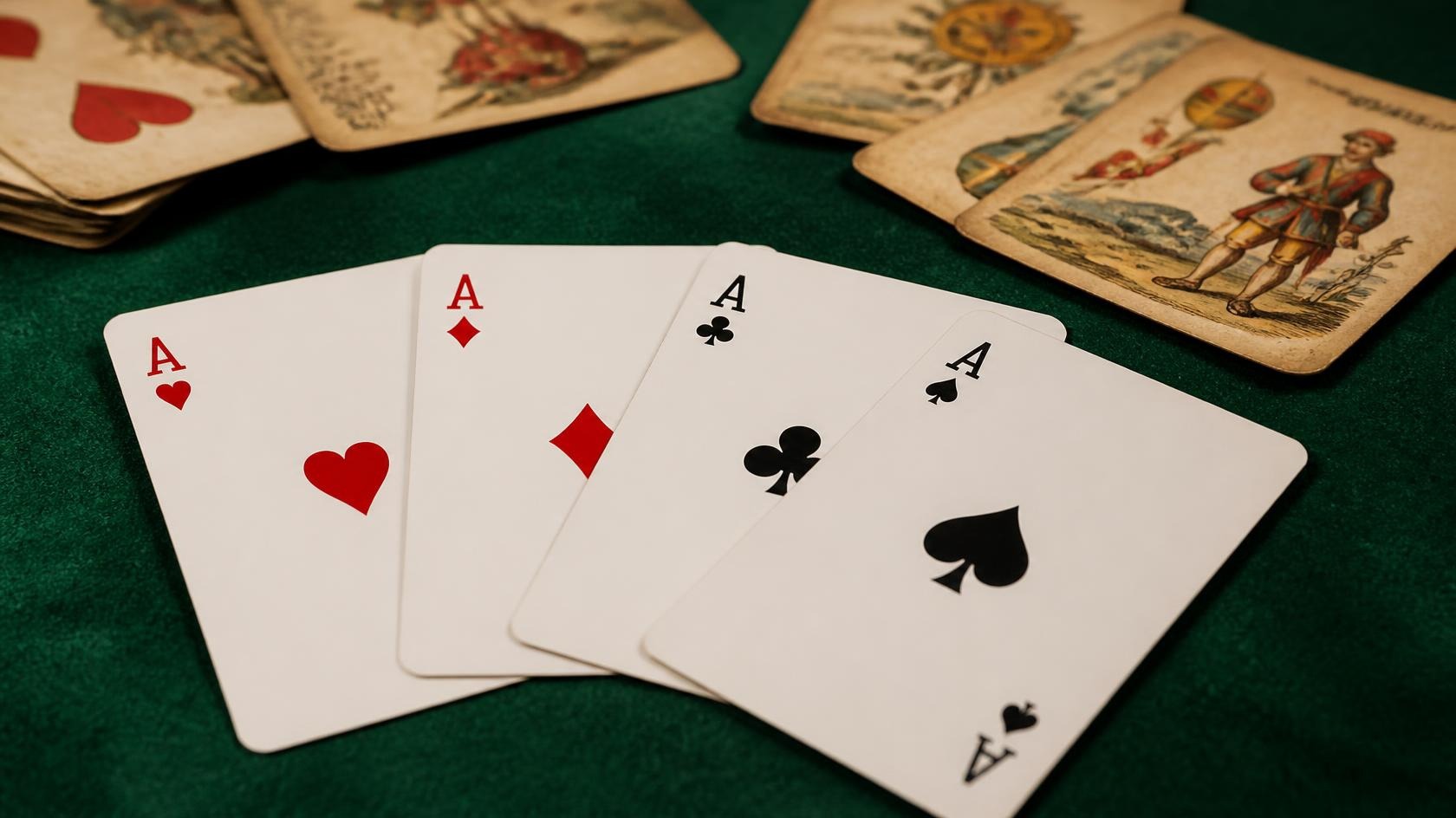
Invention of Suits game
Pick up a standard deck of playing cards and look at the suits. Hearts, diamonds, clubs, spades. You’ve seen them thousands of times. You know which ones are red, which are black, which games assign them rank. But have you ever wondered why those four symbols specifically? Why a heart? Why a shovel-shaped spade rather than an actual spade?
The answer involves a thousand-year journey across China, the Islamic world, medieval Europe, and eventually France — where the design we know today was finalised in the late 1400s and has barely changed since.
Table of Contents
Where Playing Cards Actually Started
The written history of card playing begins in 10th-century Asia, from either China or India, as a gambling game.
The cards that emerged from those early Chinese origins looked nothing like what we use today. They were narrow strips, more like dominoes than the rectangular cards we’re familiar with.
These Mamluk cards — from the Islamic world — reached Europe sometime in the late 14th century. The history of playing cards in Europe begins with these imported decks, and the history of playing cards shows how rapidly each culture reshaped the suits to reflect its own symbols and social structures.
The Italians and Spanish used suits of Cups, Coins, Swords, and Clubs (or Batons). The word “spade” probably represents the Old Spanish “spado,” meaning sword, while “club” is a direct translation of “basto.”
Germans developed their own set: Leaves, Hearts, Acorns, and Bells. These regional variations existed side by side across Europe for decades — and then France standardised everything.
How France Gave Us the Four Suits We Use Today
In the late 1400s, French playing cards standardized on carreaux (diamonds), trèfles (clubs), piques (spades), and cœurs (hearts).
The first three of these were adaptations of the German card suits Leaves, Hearts, and Hawk Bells. Considering that cards were often made for the French upper class, it isn’t difficult to understand why cardmakers chose expensive diamonds over common Acorns.
The French suit insignia was derived from German suits around 1480. The French also did something technically significant: they advanced cardmaking by using flat, single-colour silhouettes for the suits. This made cards cheaper to produce and easier to replicate consistently — which is why the French design spread globally while other regional traditions stayed local.
French cards were exported to England around 1480, and the English carried over their names for clubs and spades from the older Latin suits.
What the Four Suits Were Thought to Represent
Here’s where things get interesting — and contested. People have been attaching meaning to playing card suits for centuries. Some of it is historically documented.
In one interpretation, spades represent nobility, hearts stand for the clergy, diamonds represent the vassals or merchants, and clubs are peasants. This is a French social hierarchy reading — the four estates of medieval society mapped onto four card symbols.
The four Kings were associated with famous historical rulers: King David (Spades), Alexander the Great (Clubs), Charlemagne (Hearts), and Julius Caesar (Diamonds), representing the four empires of Jews, Greeks, Franks, and Romans.
The four suits have attracted all kinds of symbolic interpretations over the centuries. Some say they represent the four elements: hearts as water, spades as air, clubs as fire, diamonds as earth.
And then there’s the claim most people have heard at some point — that the 52 cards represent 52 weeks of the year, the four suits represent the four seasons, and the 13 cards per suit represent the 13 lunar months. It is generally considered an urban myth that the four suits are meant to represent the four seasons, and that the 52 cards represent the 52 weeks of the year.
Each Suit and Where It Really Came From
Hearts
The simplest evolution. The French design was created around 1480 when French suits were invented and was a simplified version of the existing German suit symbol for hearts. Hearts existed in German decks already.
Diamonds
Before the French decided on diamonds, there was a crescent suit instead of diamonds — an intermediate step in the evolution. The German equivalent was bells. The French replaced bells with tiles — carreaux, a geometric diamond shape — presumably because a tile pattern was more printable and cleaner than a bell illustration.
Clubs
Clubs didn’t always have the fancy clover shape. The German suit of Acorns became the French trèfle — a clover or trefoil. The English name “clubs” came from the Latin/Spanish basto — a cudgel or wooden club — even though the symbol on the card looks nothing like one.
Spades
The German suit of Leaves became the French pique — a pike, the weapon. Perhaps attempting to represent a more peaceful image, their spades became beautiful green leaves. In English, the name “spades” came from the Spanish “espadas” meaning swords — another case where the English word has nothing to do with what you’re looking at on the card.
How Card Games Use the Suits
The four suits in cards aren’t just decoration. They’re the structural logic of most card games.
In games like Bridge, suits have a strict hierarchy that changes with each hand based on bidding. The two major suits are spades and hearts. Diamonds and clubs are minor suits. The ranking of suits affects everything — what you bid, how you play, what winning looks like.
In Poker, suits matter for flushes (all five cards have the same suit) but don’t otherwise rank against each other — a king of spades and a king of hearts are equal.
In Hearts (the game), the suit of hearts is the one you try to avoid collecting because each heart card carries a penalty point. The queen of spades is the most dangerous card in the deck.
In Rummy and its variants, suits matter for building runs — sequences of consecutive cards within the same suit.
Why the French Design Won
Other countries had their own suit systems. Germany kept its regional suits for centuries. Spain and Italy maintained their Latin suits. So why did the French system become the global standard?
French cards are the most widespread due to the geopolitical, commercial, and cultural influence of France, the United Kingdom, and the United States in the 19th and 20th centuries.
The British Empire exported English-language playing cards to every territory it touched. The United States industrialised card production in the 19th century and distributed cards globally.
FAQs About Playing Card Suits
What are the four suits in a standard deck of playing cards?
The four suits in cards in a standard 52-card deck are hearts, diamonds, clubs, and spades. Each suit contains cards ranked from Ace (high or low) down to 2, giving 13 cards per suit. Two suits — hearts and diamonds — are printed in red. Two suits — clubs and spades — are printed in black.
Where did the four suits in playing cards originally come from?
The four card suits we know today — Hearts, Diamonds, Spades, and Clubs — are a French design from the 15th century, but the idea of card suits is much older. They evolved from earlier suit systems — the Islamic Mamluk cards used Coins, Cups, Swords, and Polo Sticks. German cards used Leaves, Hearts, Acorns, and Bells. The French adapted the German suits around 1480 and created the design still in use today.
Do the playing card suits have symbolic meanings?
Several symbolic systems have been proposed over the centuries. In one interpretation, spades represent nobility, hearts stand for the clergy, diamonds represent the vassals or merchants, and clubs are peasants — a reading of French feudal society. Others propose the suits represent the four elements, the four seasons, or aspects of human character.
Why do English names for suits not match their symbols?
Because the names come from different historical suit systems than the symbols. The word “spade” probably represents the Old Spanish “spado” meaning sword, while “club” is a direct translation of “basto.” When the English adopted French-designed cards, they kept their existing names from older Latin/Spanish card traditions, even though the French had replaced the sword symbol with a pike (spade shape) and the cudgel symbol with a clover.
Why do most card games use suits as part of their rules?
Suits divide a 52-card deck into four equal, identifiable groups — which creates the possibility of rules around matching, following suit, trump cards, and sequence-building. Without suits, most card games would lose their core strategic mechanic. Bridge, Poker, Hearts, Rummy, and dozens of other card games all build their fundamental rules around what suits a card belongs to, what suits can be played on other suits, and how suits interact with each other during play.