

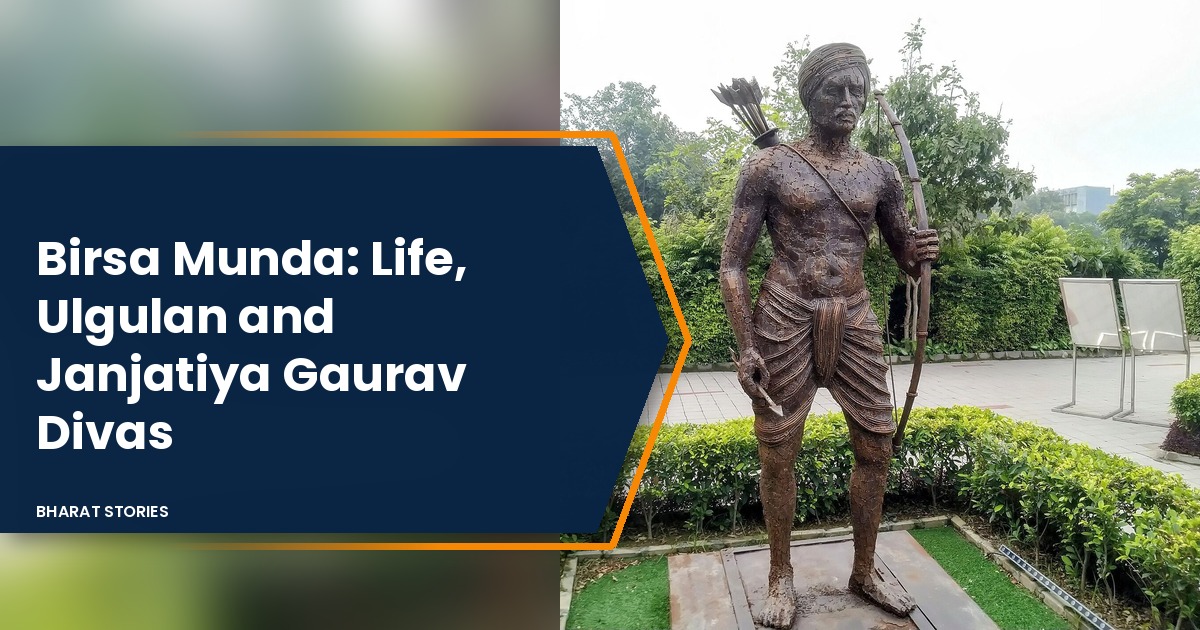
Birsa Munda: Life, Ulgulan and Janjatiya Gaurav Divas
Birsa Munda was a young Munda leader from the Chotanagpur plateau who led the Ulgulan, a tribal uprising against British rule and land grabbing, and died in Ranchi jail in 1900 at about 25. Today he is remembered as Dharti Aaba, and his birthday, 15 November, is observed across India as Janjatiya Gaurav Divas. Here is a clear account of who he was, what he fought for, and why his name still matters in Jharkhand and beyond.
Table of Contents
Who was Birsa Munda?
Birsa Munda was a tribal freedom fighter, religious reformer and folk hero of the Munda community, born on 15 November 1875 in Ulihatu village in present day Jharkhand. His followers called him Bhagwan and Dharti Aaba, which means Father of the Earth.
He grew up in a poor Munda family at a time when the colonial administration was pushing deep into the forests of eastern India. In a short life he went from a village boy who herded animals to the leader of a movement that, in the words of a Ministry of Tribal Affairs explainer published by PIB, drew in Mundas, Oraons and many non tribal people too.
Ulihatu sits in Khunti district, about 66 km from Ranchi, surrounded by forest and low hills, according to DD News. Folk songs sometimes name Chalkad as his birthplace instead, because his family moved between villages looking for work.
Birsa Munda at a glance
| Detail | Fact |
|---|---|
| Born | 15 November 1875, Ulihatu (now Khunti district, Jharkhand) |
| Community | Munda, one of the major Adivasi groups of Chotanagpur |
| Titles | Bhagwan Birsa, Dharti Aaba |
| Movement | Ulgulan, the Great Tumult of 1899 and 1900 |
| Died | 9 June 1900, Ranchi jail |
| Legacy in law | Chhota Nagpur Tenancy Act, 1908 |
| Remembered on | 15 November, Janjatiya Gaurav Divas |
What was life like for the Mundas before the revolt?
The Mundas were losing control of land their own clans had cleared and held for generations. Under British rule a zamindari style system took root in the Chhota Nagpur region and broke up the khuntkatti arrangement, in which the founding lineage of a village held land in common.
Outsiders arrived with the new order. Moneylenders, contractors and landlords, called dikus by the tribal people, gained rights over fields and forests. Families that had farmed a plot for generations found themselves treated as tenants on their own land, paying rent and doing forced labour. Forest rules also tightened in the 1890s, which cut villagers off from wood, grazing and forest produce they had always used.
Earlier Munda leaders had petitioned courts and officials for years with little result. That long, failed legal struggle, known as the Sardar agitation, shaped the young Birsa.
How did Birsa Munda become a leader?
Birsa first won a following as a religious reformer and healer, and that moral authority turned into political leadership. He urged people to shun superstition and witchcraft, to worship one God, and to take pride in their own customs.
As a boy he studied at Salga under a teacher named Jaipal Nag and later at a German mission school in Chaibasa. He left the school around 1890; DD News, quoting a researcher at the Tribal Research Institute in Ranchi, says he was expelled after he began speaking about the loss of tribal rights. His followers came to be known as Birsaits.
His message linked faith with land. The PIB explainer records his call of “Sirmare firun raja jai”, or victory to the ancestral king, which asserted that the land belonged to the tribal people and their ancestors. Mundas, Oraons and Kharias began flocking to Chalkad to see him and to be healed.
Why was Birsa Munda arrested in 1895?
The British saw his growing crowds as a threat and arrested him at Chalkad on 24 August 1895. On 19 November 1895 he was given two years of rigorous imprisonment under Section 505 of the Indian Penal Code, and he came out on 30 November 1897, according to the DD News account. Jail did not quiet him. After his release he began to plan openly for resistance.
What was the Ulgulan movement?
Ulgulan, meaning the Great Tumult, was the armed uprising Birsa Munda declared on 24 December 1899 to end British rule and the power of the dikus in Munda country. Its aim was self rule and the return of khuntkatti land rights.
The slogan recorded by PIB was “Abua raj setar jana, maharani raj tundu jana”: let the rule of the Queen end and let our own rule begin. Around Christmas 1899 his followers targeted mission stations and churches, and in the first week of January 1900 they attacked the Khunti police station. The fighting spread across Khunti, Tamar, Basia and Ranchi, mostly with bows, arrows and axes.
What happened at Dombari Buru?
On 9 January 1900 British troops surrounded thousands of Birsa’s followers gathered on Dombari Buru hill and opened fire. The death toll is still disputed. DD News notes that The Statesman reported on 25 January 1900 that around 400 tribal people were killed, while official figures were far lower. DD News adds that the nearby Tajna river turned red with blood. Birsa himself escaped that day.
How did Birsa Munda die?
Birsa Munda was captured in early February 1900 and died in Ranchi jail on 9 June 1900, aged about 25. The jail authorities said he had cholera, but many in his community never accepted that explanation.
DD News puts his capture on the night of 3 February 1900, in the forests near Chaibasa, where he was found asleep. Many of his followers were tried in Ranchi; one was sentenced to death and dozens were transported for life or jailed for long terms. The old Ranchi jail where he died now houses the Bhagwan Birsa Munda Tribal Freedom Fighter Museum, which the Prime Minister opened on 15 November 2021, as noted in a PIB release on the first Janjatiya Gaurav Divas.
What did the Ulgulan change?
The revolt forced the colonial government to pass the Chhota Nagpur Tenancy Act of 1908, which restricted the transfer of tribal land to non tribal people. PIB calls it a landmark law for the protection of tribal rights, and it still shapes land ownership in Jharkhand.
The uprising also lasted far longer in memory than on the battlefield. It proved that Adivasi communities would organise against colonial power on their own terms, decades before the mass national movement. That is why he sits comfortably in any list of freedom fighters of India next to names like Bhagat Singh and Subhas Chandra Bose.
Why is 15 November celebrated as Janjatiya Gaurav Divas?
15 November is Birsa Munda’s birth anniversary, and the Union Cabinet declared it Janjatiya Gaurav Divas, or Tribal Pride Day, on 10 November 2021. The day honours him and every tribal freedom fighter.
The Cabinet decision mentions movements by the Santhals, Tamars, Kols, Bhils, Khasis and Mizos, and notes that 10 tribal freedom fighter museums had been sanctioned after the 2016 Independence Day speech. A 2025 PIB backgrounder lists 11 such museums now planned or built, from Ranchi to Rajpipla, Wayanad and Tamenglong.
Many people also connect 15 November with Jharkhand itself, since the state was carved out of Bihar on that date in 2000. You can read more about the state in our guide to Jharkhand’s history, geography and places to visit.
What was Janjatiya Gaurav Varsh?
Janjatiya Gaurav Varsh was the year long celebration of Birsa Munda’s 150th birth anniversary, from 15 November 2024 to 15 November 2025. It closed with a Pakhwada, or fortnight, of events from 1 to 15 November 2025, run by Tribal Research Institutes, Eklavya Model Residential Schools, TRIFED and NSTFDC, according to a Ministry of Tribal Affairs release.
One small point confuses students. A 2025 PIB backgrounder prints his birth year as 1874, but the 2022 explainer and DD News give 1875, and the 150th anniversary was marked in November 2025, which matches 1875.
Which other tribal leaders fought British rule?
Birsa was one of many Adivasi leaders who resisted colonial rule, and several rose decades before him. The PIB explainer names Tilka Majhi, Tikendrajit Singh, Veer Surendra Sai, Telanga Kharia, Veer Narayan Singh, Sidhu and Kanu Murmu, Rupchand Konwar and Laxman Naik.
- Tilka Majhi led one of the earliest Paharia revolts in the Rajmahal hills in the 1780s.
- Sidhu and Kanhu Murmu led the Santhal Hul of 1855.
- Veer Narayan Singh of Sonakhan in Chhattisgarh broke open grain stores during an 1856 famine and was executed on 10 December 1857, as the 2025 PIB backgrounder records.
- Alluri Sitarama Raju led the Rampa rebellion in the Andhra hills in the 1920s; read our profile of Alluri Sitarama Raju.
How is Birsa Munda remembered today?
His name is everywhere in eastern India, on an airport, a stadium, a university and countless statues and chowks. Ranchi’s airport is Birsa Munda Airport, and the international hockey stadium in Rourkela, Odisha, carries his name.
His portrait hangs in the Parliament Museum in New Delhi, and India Post released a stamp in his honour in 1988. In Munda villages his story survives mostly in song, in Mundari, a language you can read about in our page about the Munda language. Every 15 November, visitors and ministers travel to Ulihatu to garland the statue at his birthplace, as Union ministers did on the first Janjatiya Gaurav Divas in 2021.
Frequently asked questions about Birsa Munda
Why is Birsa Munda called Dharti Aaba?
Dharti Aaba means Father of the Earth. His followers gave him the title because he fought to return land and forests to the people who lived on them.
Was Birsa Munda a Hindu or a Christian?
He attended a German mission school as a boy, but he left the mission around 1890 and later started his own reformed tribal faith, whose followers were called Birsaits.
Where was Birsa Munda born?
Most accounts name Ulihatu village in Khunti district, Jharkhand, though some folk songs mention Chalkad, where he spent much of his childhood.
How old was Birsa Munda when he died?
He was about 25 when he died in Ranchi jail on 9 June 1900.