

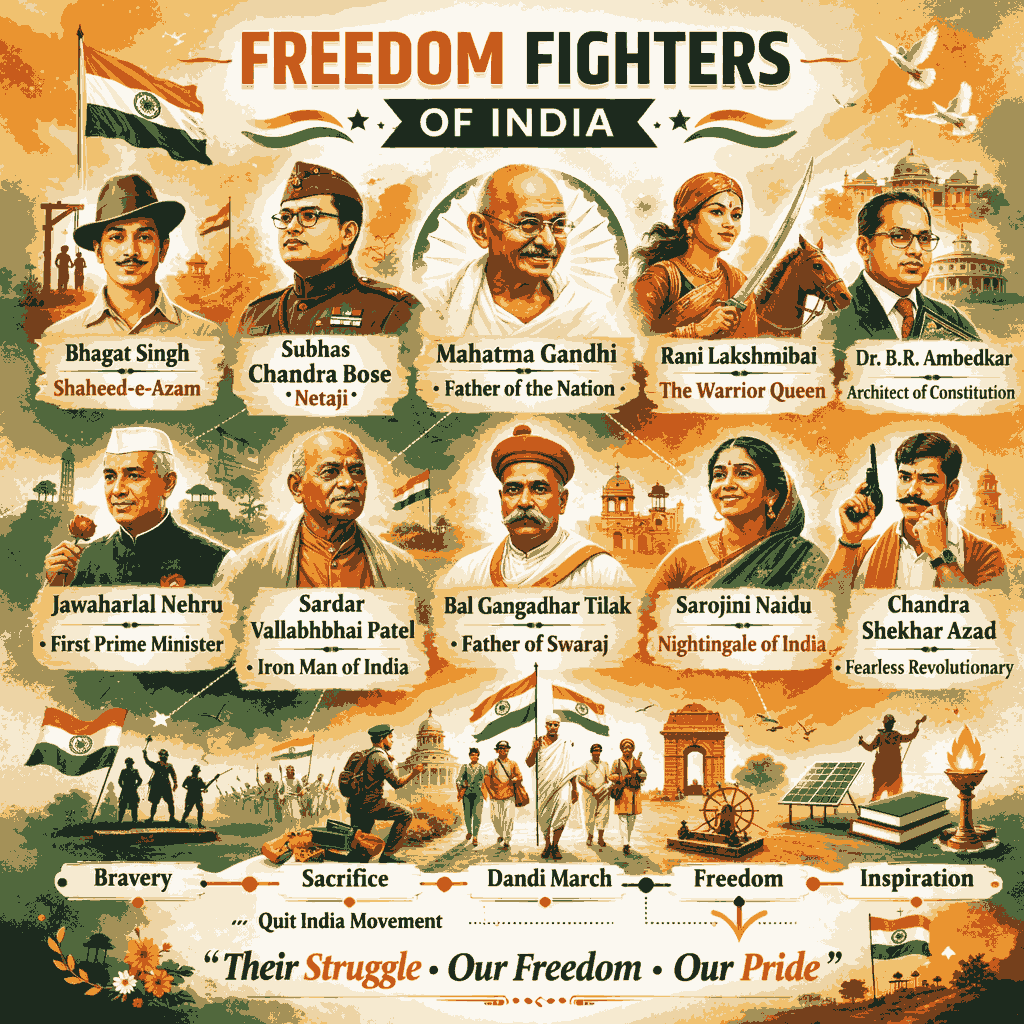
List of Freedom Fighters of India
The Freedom Fighters of India were contributing factors to the role of forming the identity of the nation together with values and spirit of democracy. They did not just work on a single territory, a single faith, and a single way of resistance. The freedom movement was an all-inclusive movement that was expanded through decades of time, which was motivated by fear of sacrifice and bravery, and a feeling of responsibility to the nation.
The List of Freedom Fighters of India is not concentrated on names. Rather it describes the concepts, deeds and input that transformed the Indian freedom struggle into a movement orchestrated by the people. This option aids the reader to comprehend the soul of the struggle to gain independence and not talk about individuals.
Table of Contents
Comprehending the Freedom Movement in India.
The Indian fight to gain independence was not a one time affair. It lasted almost two hundred years and touched the lives of various individuals in society. Resistance to colonial rule was carried out by farmers, students, workers, teachers, writers, and spiritual leaders.
The Famous Indian Freedom Fighters belonged to various backgrounds but they had one common aim that was self-rule and dignity of the people of India. Others believed in the idea of peaceful resistance, whereas others found that an armed struggle was the only alternative. Both strategies had an impact on history.
The involvement of people was what made the movement strong. It was an average citizen who protested, boycotts and marches and even underground activities, usually at a lot of personal risk.
Resistance to Colonialism in the Early Years.
The initial stage of resistance was aimed at creating awareness in regard to unfair policies and injustice. There were numerous protests against the economic exploitation, taxes, and the loss of domestic industries.
The grounds of national unity were established during this time period. Citizens started thinking beyond the regionality and regarded themselves as citizens of a greater country. This was highly spread by newspapers, social reform movements and public meetings.
These pioneering activities might seem to be slow, but they preconditioned the emergence of mass movements in the future.
Mass Movements and Individual Involvement.
Mass involvement was one of the most vital things in the freedom struggle. Citizens were advised to leave their houses and participate in mass action.
Resistance came to be through peaceful demonstrations, non-cooperation and civil disobedience. The boycotting of schools, courts and government offices was done to demonstrate that the foreign rule would rely on the support of people.
The Top Freedom Fighters of India thought that as people removed the cooperation, the system would disintegrate itself. This was a method that demanded discipline, patience and conviction.
Role of Revolutionary Activities Role of Revolutionary Activities
As the non-violent resistance was the subject of the world’s attention, the freedom movement was also influenced by revolutionary activities. These activities were sometimes covert and were marked by direct confrontation of the icons of colonial rule.
Revolutionary groups held the view that something drastic will be required to rouse the nation and break the spook. The high percentage of people involved as young were not afraid to be punished harshly including imprisonment as well as being exiled.
These efforts kept the spirit of resistance alive and demonstrated that the needs of freedom could not be neglected despite different opinions concerning the approaches.
Women Role in the Struggle of Freedom.
Women played a very important role during the Indian freedom movement. They went on to break the roles and took part in protests, marches, and underground actions.
Women held rallies, created awareness and helped to participate in movements through the management of logistics and communication. Their participation was a strong indicator that freedom was a struggle that was to be participated in by all.
The inclusion of women empowered the ethical power of the movement and encouraged the further generations to rise against inequality and injustice.
Impact of Social and Cultural Movements.
The struggle against slavery was not a political one. The idea of independence was supported by social and cultural movements which contributed to education, unity and self-respect.
Indian heritage was exalted through the writing, poetry and art created by writers, poets and artists. Songs, plays and literature with the help of which national feeling was disseminated and people were inspired became means of action.
These attempts assisted in linking emotional identity to the political objective of independence.
Shopping and Student Recruitment.
The youths were very active in the course of the freedom movement. Students held demonstrations, sent pamphlets and participated in protests.
The involvement of the youth added a sense of urgency and vitality into the fight. Schools and colleges were the focus of contention and action.
The contribution of youth citizenship made the message of liberty spread to all corners of the society.
Sacrifices During the Struggle.
The struggle towards independence was a costly affair. Numerous individuals were arrested, their lives were taken away, and they were isolated. Families were affected because their loved ones were either sent to prison or cowered.
The spirit of freedom was not defeated even in the face of adversity. It is due to the sacrifices that were made during this time that independence has such a profound meaning to the nation up to date.
Freedom Fighters of India demonstrated that nobody can be free without struggling and being courageous.
The Heritage of the Freedom Fighters.
The influence of the freedom movement did not stop with independence. India still has the struggle values that have influenced her democracy.
Equality, justice and unity are some of the ideas that drive the social institutions and civic accountability. The movement of freedom equally provided an example of peaceful resistance throughout the entire world.
The List of Freedom Fighters of India as a collective memory aids the realization of the fact that improvement is possible by collectivity.
The Reason Why It is Important to Learn about Freedom Fighters Today.
Knowing the freedom struggle will make you value the rights and the freedoms that are enjoyed today. It also makes society remember the value of participation, awareness and ethical leadership.
The historical experiences teach citizens to be responsible, active and informed. Freedom does not simply mean being independent of foreign rule and it also relates to safeguarding democratic principles.
The Famous Indian Freedom Fighters story will always remind people to strive in an attempt to optimize the society to become a place that is inclusive.
List of Freedom Fighters
Freedom Fighter Name |
Born |
Died |
| Abdul Gafar Khan | February 6, 1890, Utmanzai, Charsadda, Pakistan | January 20, 1988, Peshawar, Pakistan |
| Ashfaqulla Khan | October 22, 1900, Shahjahanpur | December 19, 1927, Faizabad |
| Bal Gangadhar Tilak | July 23, 1856, Chikhli | August 1, 1920, Mumbai |
| Begum Hazrat Mahal | 1820, Faizabad | April 7, 1879, Kathmandu, Nepal |
| Bipin Chandra Pal | November 7, 1858, Habiganj, Bangladesh | May 20, 1932, Kolkata |
| Chandra Shekhar Azad |
July 23, 1906, Bhavra | February 27, 1931, Allahabad |
| Chittaranjan Das | November 5, 1870, Kolkata | June 16, 1925 |
| Dadabhai Naoroji | September 4, 1825, Mumbai | June 30, 1917, Mumbai |
| Khudiram Bose | December 3, 1889, Habibpur | August 11, 1908, Kolkata |
| Lakshmi Sahgal | October 24, 1914, Chennai | July 23, 2012, Kanpur |
| Lala Hardayal | October 14, 1884, Delhi | March 4, 1939, Philadelphia, Pennsylvania, United States |
| Lala Lajpat Rai | January 28, 1865, Dhudike | November 17, 1928, Lahore, Pakistan |
| Mahadev Govind Ranade | January 18, 1842, Niphad | January 16, 1901 |
| Mahatma Gandhi | October 2, 1869, Porbandar | January 30, 1948, New Delhi |
| Mangal Pandey | July 19, 1827, Nagwa | April 8, 1857, Barrackpore |
| Maulana Abul Kalam Azad | November 11, 1888, Mecca, Saudi Arabia | February 22, 1958, Delhi |
| Motilal Nehru | May 6, 1861, Agra | February 6, 1931, Lucknow |
| Ram Manohar Lohia | March 23, 1910, Akbarpur | October 12, 1967, New Delhi |
| Ram Prasad Bismil | June 11, 1897, Shahjahanpur | December 19, 1927, Gorakhpur |
| Ram Singh Kuka | 3 February 1816 (Sri Bhaini Sahib, Punjab) | 18 January 1872 (Dhaka, Bangladesh) |
| Rani Lakshmi Bai | November 19, 1828, Varanasi | June 18, 1858, Gwalior |
| Rash Behari Bose | May 25, 1886, Bardhaman | January 21, 1945, Tokyo, Japan |
| Sardar Vallabh Bhai Patel | October 31, 1875, Nadiad | December 15, 1950, Mumbai |
| Shaheed Bhagat Singh | September 27, 1907, Jaranwala Tehsil | March 23, 1931, Lahore, Pakistan |
| Shivaram Rajguru | August 24, 1908, Rajgurunagar (Khed) | March 23, 1931, Lahore, Pakistan |
| Subhash Chandra Bose | January 23, 1897, Cuttack | August 18, 1945, Taihoku Prefecture |
| Sukhdev | May 15, 1907, Ludhiana | March 23, 1931, Lahore, Pakistan |
| Surendranath Bannerjee | November 10, 1848, Kolkata | August 6, 1925, Barrackpore |
| Sri Alluri Seetarama Raju | July 4, 1897 | 1924 |
| Veer Savarkar | May 28, 1883, Bhagur | February 26, 1966, Mumbai |
| Bhim Sen Sachar | December 1, 1894, Peshawar, Pakistan | January 18, 1978 |
| Acharya Kripalani | November 11, 1888, Hyderabad | March 19, 1982 |
| Aruna Asaf Ali | July 16, 1909, Kalka | July 29, 1996, Kolkata |
| Jatindra Mohan Sengupta | February 22, 1885 | July 23, 1933, Ranchi |
| Madan Mohan Malviya | December 25, 1861, Allahabad | November 12, 1946, Varanasi |
| Nellie Sengupta | 1886 | 1973 |
| Pandit Balakrishna Sharma | December 8, 1897 | |
| Puspa Lata Das | March 27, 1915 | |
| Sagarmal Gopa | 1900 | 1946 |
FAQs
What do we understand by Freedom Fighters of India?
Freedom Fighters of India are defined as the individuals and organizations that strived to put an end to colonial rule and the establishment of independence via political, social, and cultural activities.
What is the significance of the List of Freedom Fighters of India?
The list makes individuals realize the communal work on independence and makes people see the common sacrifices throughout the areas and the communities.
Were political movements constituted of all the freedom fighters?
No, most of them worked with social reform, through education, writing and through culture. The freedom struggle had numerous types of resistance.
What was the role of common citizens in favor of the movement towards freedom?
People opposing the regime stood solidly and contributed to the movement through participating in demonstrations, boycotting imported products, creating awareness, as well as provision of shelter and necessary resources to the activists.
What does the freedom struggle teach to the present day society?
Collective action can teach modern society the importance of unity, non-violent opposition, civic responsibility, and speaking up against injustice.
India gained independence not through a handful of people. It is of a country that preferred boldness to avarice and solidarity to discord. The Top Freedom Fighters of India is the expression of this common way to freedom and self-respect.