

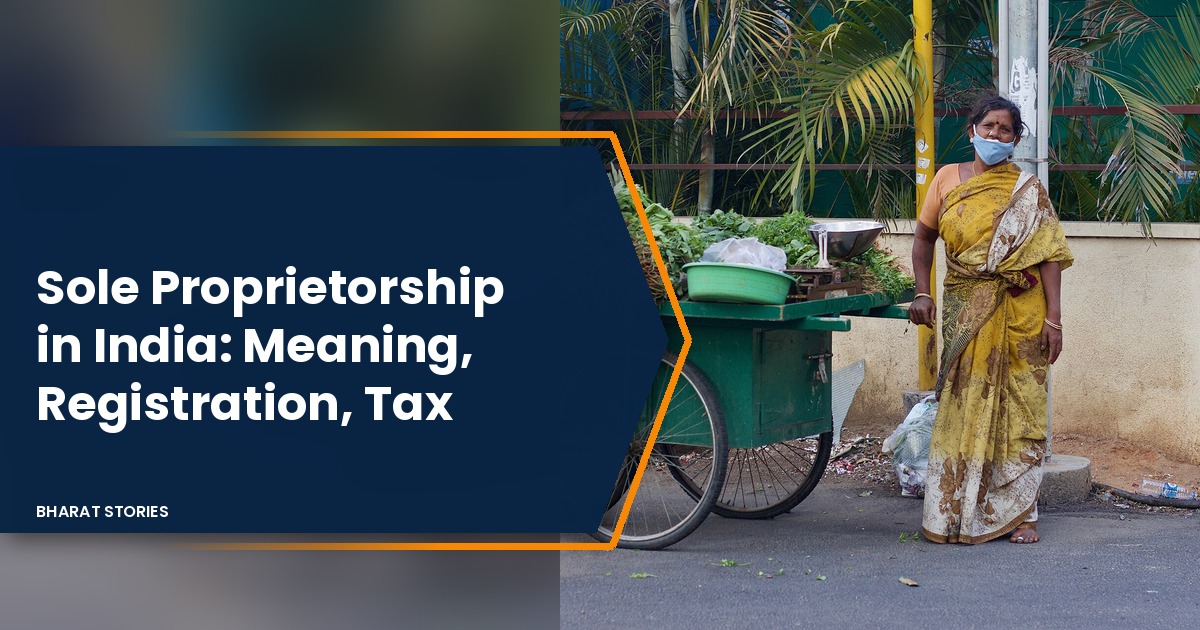
Sole Proprietorship in India: Meaning, Registration, Tax
A sole proprietorship is the simplest way to run a business in India: one person owns it, runs it and keeps all the profit. Most kirana stores, street vendors, tailors, tutors and freelancers work this way, often without realising it has a name. This guide explains what a sole proprietorship means, which registrations you actually need, how it is taxed, and when it makes sense to move to an LLP or a company.
Table of Contents
What is a sole proprietorship?
A sole proprietorship is a business owned and controlled by a single individual, with no legal separation between the owner and the business. In law, the proprietor and the firm are the same person, so the owner holds the assets, signs the contracts and answers for every debt.
The word “firm” in a trade name such as “Sharma Traders” does not create a separate entity. The business uses the owner’s own PAN, and its income appears in the owner’s personal tax return. This is why banks carry out KYC on the proprietor as an individual when a business account is opened.
What are the key features of a sole proprietorship?
The defining features are single ownership, unlimited personal liability, full control, and very light compliance. The main characteristics are:
- One owner: only one person owns the business, although it can employ any number of staff.
- No separate legal identity: the business cannot sue or be sued in its own name apart from the owner.
- Unlimited liability: if the business cannot pay its debts, creditors can recover from the owner’s personal savings and property.
- All profit to the owner: there is no sharing of profit and no dividend process.
- Quick decisions: the owner does not need a board or partners to approve anything.
- No continuity: the business has no existence apart from the owner, so it effectively ends on the owner’s death or exit.
What are examples of sole proprietorship businesses in India?
Any business run by one person in their own name is a sole proprietorship, from a vegetable cart to a busy design studio. Common examples include:
- Kirana and general stores, chemists, mobile repair and stationery shops
- Street food stalls, fruit and vegetable vendors, and small dhabas
- Tailors, beauty parlours, salons and laundry services
- Home tutors, coaching classes and fitness trainers
- Freelance writers, developers, photographers and digital marketers
- Small online sellers listing products on marketplaces or their own website
If you are still choosing what to sell, our list of business ideas with low investment suits this structure well, because most of them start with one owner.
Does a sole proprietorship need to be registered in India?
No single law registers a sole proprietorship, but in practice you need registrations or licences that prove the business exists. There is no “Registrar of Proprietorships”. Instead, the business gets its identity from tax, MSME and local licences that apply to what you do and where you do it.
Which registrations does a proprietor usually need?
The usual set is Udyam registration, GST registration if your turnover or business type requires it, a local shop licence and a current account. Here is how each one works:
- GST registration: according to the GST Council’s registration guide, registration is required once aggregate turnover crosses Rs 20 lakh in a financial year, or Rs 10 lakh in the special category states of Manipur, Mizoram, Nagaland and Tripura. For suppliers dealing only in goods, most states allow a higher limit of Rs 40 lakh, a change the GST Council brought in from 1 April 2019. Some businesses, such as those selling goods to other states, must register regardless of turnover.
- Udyam registration: the official Udyam portal says MSME registration is free, paperless and based on self declaration, with only an Aadhaar number needed. A micro enterprise is one with investment up to Rs 2.5 crore and turnover up to Rs 10 crore. Our guide to Udyam and MSME registration walks through the form.
- Shops and Establishments licence: issued by the state labour department or municipal body for shops, offices and commercial premises. Rules and fees differ by state.
- Trade or sector licences: a municipal trade licence, FSSAI registration or a licence for food businesses, or an Importer Exporter Code from the DGFT if you trade across borders.
How do you open a current account for a proprietorship?
The bank completes KYC on you as the proprietor and asks for any two documents that show the business exists. The RBI Master Direction on KYC lists acceptable proofs, including the Udyam Registration Certificate, a Shop and Establishment certificate, a GST certificate, an IEC, a professional licence, a complete income tax return showing the business income, and utility bills.
If you cannot produce two, the bank may accept one, but only after a contact point verification at your business address. Getting Udyam and GST done first usually makes the account opening smooth.
How do you start a sole proprietorship step by step?
Choose a name, get your PAN and Aadhaar in order, take the registrations your business needs, open a current account, and start keeping proper books. A practical order is:
- Pick a trade name and check that it does not clash with an existing trademark.
- Make sure your PAN and Aadhaar are linked and carry the same name and details.
- Register on the Udyam portal to get an MSME certificate.
- Apply for GST registration if you cross the threshold, sell to other states, or want to claim input tax credit.
- Get the Shops and Establishments licence and any trade licence your city or sector needs.
- Open a current account in the trade name and keep business money separate from personal spending.
- Issue proper invoices, keep records of income and expenses, and file your returns on time.
If you plan to sell online, our guide on starting an ecommerce business in India covers marketplace accounts, payments and logistics.
How is a sole proprietorship taxed in India?
The business income is taxed as the proprietor’s own income at individual slab rates, in the proprietor’s personal return. There is no separate business tax return. Profit is reported under the head “profits and gains of business or profession”.
The Income Tax Department says individuals with business income generally file ITR 3. Small businesses that choose to declare income on a presumptive basis can use the simpler ITR 4 (Sugam), subject to conditions such as total income up to Rs 50 lakh. Under the new regime for assessment year 2026 to 27, the top slab rate of 30% applies above Rs 24 lakh.
Because the rules and forms change from year to year, check the department’s current guidance or speak to a chartered accountant before filing. This guide is general information, not tax or legal advice.
What are the advantages of a sole proprietorship?
It is cheap and quick to start, easy to run, and the owner keeps complete control and every rupee of profit. The main advantages are:
- Minimal setup cost, since Udyam registration itself is free.
- Few compliance filings compared with an LLP or company, and no annual filings with the Registrar of Companies.
- Full privacy, as accounts are not filed publicly.
- Fast decisions and the freedom to change products, prices or location at will.
- Easy to close: you stop trading, cancel registrations and settle dues.
What are the disadvantages of a sole proprietorship?
The biggest drawback is unlimited liability, followed by limited access to capital and no continuity after the owner. Other drawbacks include:
- Personal assets are at risk if the business fails or faces a large claim.
- Investors cannot buy shares, so growth depends on the owner’s savings and loans.
- Some large clients and tenders prefer to deal with registered companies or LLPs.
- All management pressure falls on one person, and illness can stop the business.
- As profit grows, slab rates can push the effective tax higher than in some other structures.
How is it different from a partnership, LLP or one person company?
A proprietorship has one owner and no separate entity, while an LLP and a one person company are separate legal entities that limit the owner’s liability. The table compares the four common options.
| Feature | Sole proprietorship | Partnership firm | LLP | One person company |
|---|---|---|---|---|
| Owners | One | Two or more | At least two partners | One member |
| Governing law | No specific law | Indian Partnership Act, 1932 | LLP Act, 2008 | Companies Act, 2013 |
| Separate legal entity | No | No | Yes | Yes |
| Owner liability | Unlimited | Unlimited | Limited | Limited |
| Registered with | Tax and local authorities only | Registrar of Firms (optional) | Ministry of Corporate Affairs | Ministry of Corporate Affairs |
| Compliance load | Lowest | Low | Moderate | Higher |
When should a proprietor switch to an LLP or company?
Consider switching when your liability risk, team size or funding needs outgrow what one person can safely carry. Typical triggers are signing large contracts, hiring several staff, bringing in a partner, or seeking outside investment. Solo founders who want limited liability without a partner often look at a one person company; read why more professionals are choosing one person companies.
Frequently Asked Questions
Is a sole proprietor the 100% owner of the business?
Yes, the proprietor owns the whole business and is entitled to all its profit. The same person is also fully responsible for its debts and losses.
Can a sole proprietorship hire employees?
Yes, a proprietor can employ as many people as the business needs. Labour laws such as provident fund and ESI apply once the relevant staff thresholds are crossed.
Can one person run two sole proprietorships?
Yes, an individual can run more than one business as a proprietor under the same PAN. GST registration is tied to the PAN and the state, so check how your businesses should be registered before you start billing.
What happens to a sole proprietorship when the owner dies?
The proprietorship ends with the owner, because it has no separate existence. The heirs inherit the assets and liabilities and can restart the business under their own registrations.