

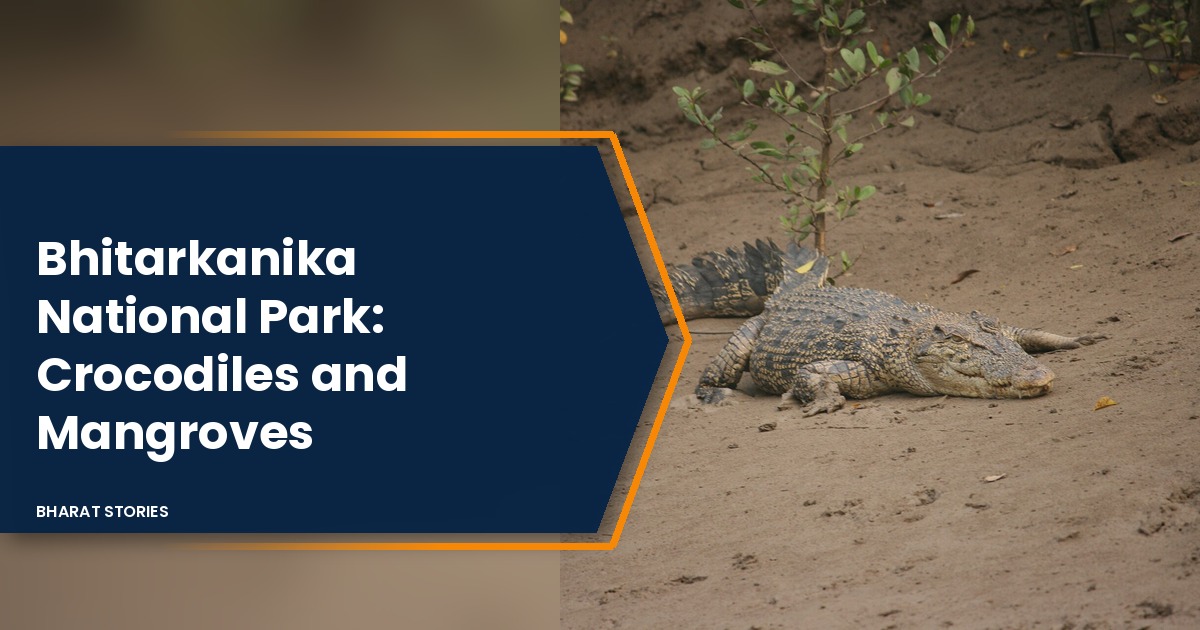
Bhitarkanika National Park: Crocodiles and Mangroves
In the creeks of Bhitarkanika, the first thing you notice is the silence. The boat engine cuts, the tide slaps against mangrove roots, and then, on a mudbank a few metres away, what looked like a log opens its eyes. Odisha’s Bhitarkanika National Park holds one of the largest populations of saltwater crocodiles in India, and a boat trip through its tidal channels is one of the most memorable wildlife experiences on the east coast.
The park lies in Kendrapara district, where the Brahmani, Baitarani and Dhamra rivers meet the Bay of Bengal. This guide explains what makes the place important, which animals and birds you can see, when the park is closed and how to plan a visit.
Table of Contents
Bhitarkanika at a Glance
| Item | Detail |
|---|---|
| State and district | Odisha; Kendrapara district |
| National park | About 145 sq km, notified in 1998 |
| Wildlife sanctuary | About 672 sq km, declared in 1975 |
| International status | Ramsar wetland of international importance since 2002 |
| Flagship species | Saltwater crocodile; 1,858 counted in the January 2026 census |
| Habitat | Mangrove forest, tidal creeks, mudflats and estuaries |
| Closed to tourists | 1 May to 31 July for the crocodile breeding season |
| Main entry points | Khola and Gupti on the Rajnagar side, and Chandbali by boat |
A Crocodile Comeback Story
By the early 1970s, saltwater crocodiles in Odisha had been hunted close to local extinction for their skins. Fewer than a hundred were left in the Bhitarkanika river system. In 1975 the state, with help from the United Nations Development Programme and the Food and Agriculture Organization, started a conservation project at Dangmal. Eggs were collected from the wild, hatched in safety, and young crocodiles were reared until they were large enough to survive before being released into the creeks.
The same year the mangroves were declared a wildlife sanctuary. In 1998 the core, about 145 sq km, became a national park. The results have been remarkable. Annual counts rose steadily, from about 1,192 crocodiles in 2000 to 1,826 in 2025 and 1,858 in January 2026. With numbers this healthy, the artificial breeding programme was ended in 2024, though a small hatchery at Dangmal is kept for education.
The park is also known for its white, or albino, crocodiles. Dangmal’s best known resident, a white crocodile nicknamed Sankhua, became a minor celebrity, and the recent census counted 18 albino animals living in the wild.
Mangroves and Why They Matter
Bhitarkanika protects one of the richest mangrove forests in India, second in size on the east coast only to the Sundarbans. Dozens of mangrove and associated plant species grow here, with tangled stilt roots and breathing roots that poke up through the mud. These forests buffer villages from cyclones and storm surges, trap sediment, and serve as nurseries for fish, crabs and prawns that support local fishing families.
Walking trails at Dangmal and Habalikhati let you see the mangroves up close from raised paths, and boats take you deeper into creeks where the canopy almost closes overhead.
Wildlife Beyond the Crocodiles
The estuarine crocodile is the star, but it is far from alone. Water monitor lizards, king cobras and Indian pythons live in the mangroves. Spotted deer and wild pigs graze in clearings near the forest blocks, and fishing cats, jungle cats, otters and rhesus macaques are present. Dolphins are sometimes seen near the river mouths.
Just offshore, the Gahirmatha coast is one of the most important nesting grounds in the world for olive ridley sea turtles. Mass nesting, known as arribada, usually takes place in February or March, though exact dates vary and access to nesting beaches is tightly controlled to protect the turtles.
Birds
Over 300 bird species have been recorded in and around Bhitarkanika. Eight kingfisher species, including the brown winged and black capped kingfishers, make it a favourite with birders. In winter, migratory ducks, waders and gulls arrive from Central Asia and beyond. During the monsoon months a large heronry at Bagagahana fills with Asian openbills, egrets, cormorants, darters and ibises, though the park is closed to tourists for part of that time.
Planning Your Boat Trip
Almost everything at Bhitarkanika happens on the water, so the boat trip is the heart of any visit. Short trips from Khola or Gupti take you along the main Bhitarkanika river and a few side creeks to Dangmal, where you can step ashore at the crocodile hatchery, the interpretation centre and a mangrove walkway. Longer trips from Chandbali cover more of the Baitarani and Dhamra and give a stronger sense of how vast the delta is.
Boats range from small open craft to larger covered launches. A covered boat is worth paying for between March and October, when the sun on open water is fierce. Carry drinking water, a hat, sunscreen and a light rain jacket, along with binoculars and a camera with a zoom lens, since crocodiles are often watched from a careful distance.
Ask the boatman to cut the engine near basking spots and quiet creeks. Drifting in silence, you are far more likely to see kingfishers hunting, monitor lizards slipping into the water, or a deer stepping out of the mangroves to drink.
Plan to leave the creeks before dusk. Permits are issued for daytime trips, navigation in the narrow creeks is harder once light fades, and the walk back from the jetty is easier in daylight.
When to Visit
The park is closed from 1 May to 31 July each year, when female crocodiles guard their nests and become highly aggressive. Fishing, honey collection and boat traffic are also restricted in this period. The rest of the year divides roughly as follows.
- August to October: hot and humid, with monsoon showers. Few visitors and lush forest.
- November to February: the best months. Cool weather, migratory birds and crocodiles basking on mudbanks in the winter sun.
- March and April: warming up, but still good for crocodile sightings at low tide.
Timing matters within the day too. Crocodiles bask most at low tide on sunny days, when the mudbanks are exposed. Ask your boatman to plan around the tide tables.
How to Reach Bhitarkanika
Bhubaneswar has the nearest major airport, about 130 to 150 km away depending on the entry point. Cuttack and Bhadrak are the nearest large railway stations. From there, roads lead to Rajnagar and on to Khola or Gupti jetties, or north to Chandbali on the Baitarani, from where longer boat trips start.
Entry permits are issued by the forest department at the Rajnagar mangrove forest division offices and at the jetties. Boats are hired locally, and tour lengths range from two hours to a full day. Accommodation includes forest department cottages at Dangmal, Gupti and Habalikhati, and private lodges near Chandbali and Rajnagar. Rooms inside the park are limited, so book ahead in peak months.
Safety and Responsible Travel
Saltwater crocodiles are dangerous. Attacks on people who enter the water to fish or bathe happen in the villages around the park every year. As a visitor, stay inside the boat, keep hands and feet out of the water, and never step down onto a mudbank for a photo.
Keep plastic out of the creeks, and do not ask boatmen to approach animals closely or to chase birds. Choose operators who follow forest department rules on noise and speed. Your fees support protection staff who patrol these channels in all weather.
For other wetland parks, see our guide to the Vikramshila Gangetic Dolphin Sanctuary in Bihar, or browse the full list of national parks of India. Official tourism information on the region is published by Odisha Tourism.
Frequently Asked Questions
How many crocodiles live in Bhitarkanika?
The January 2026 census counted 1,858 saltwater crocodiles, up from 1,826 the year before.
When is Bhitarkanika closed?
The park closes to tourists from 1 May to 31 July during the crocodile breeding and nesting season.
Is a boat safari safe?
Yes, if you stay inside a licensed boat and follow the boatman’s instructions. Never enter the water or stand on mudbanks.
Can I see olive ridley turtles on the same trip?
Sometimes. Mass nesting at Gahirmatha usually happens in February or March, but access is restricted and dates vary each year.
How long should I stay?
Two nights allow one long boat trip, a shorter evening trip and a walk on the mangrove trails without rushing.