

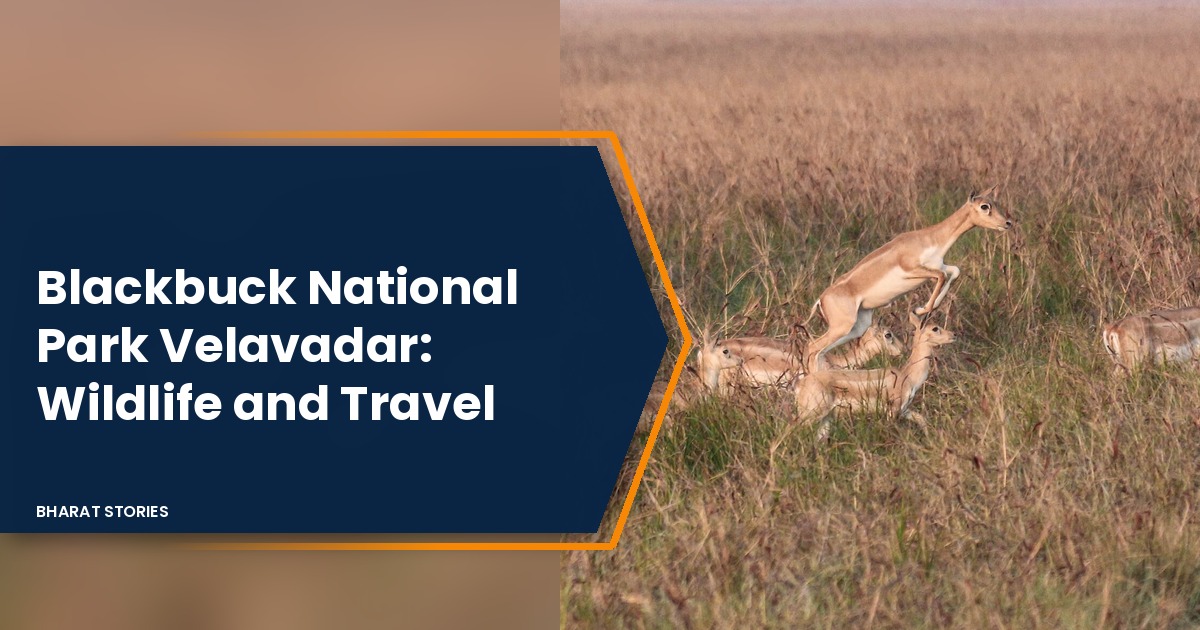
Blackbuck National Park Velavadar: Wildlife and Travel
Most Indian national parks are about forest. Velavadar is about sky. The Blackbuck National Park in Gujarat’s Bhavnagar district is a sweep of flat golden grassland that runs almost to the Gulf of Khambhat, broken only by a few trees and the odd water body. Into that openness step herds of blackbuck, the males jet black above and white below, with spiralling horns that catch the low sun. It is one of the finest places in the world to watch this antelope, and a surprisingly good one for wolves, hyenas and birds of prey.
The park is small, about 34 sq km, but its grassland ecosystem is rare in India and very well protected. Here is what to expect, when to go and how to reach it.
Table of Contents
Blackbuck National Park at a Glance
| Item | Detail |
|---|---|
| Also known as | Velavadar National Park |
| State and district | Gujarat; Bhavnagar district, in the Bhal region of Saurashtra |
| Established | 1976 |
| Area | About 34 sq km (34.08 sq km in most records) |
| Habitat | Flat grassland, saline flats and patches of thorn scrub |
| Key species | Blackbuck, Indian wolf, striped hyena, lesser florican, harriers |
| Closed | 16 June to 15 October every year |
| Distance | Roughly 42 to 55 km from Bhavnagar city, and about 140 km from Ahmedabad |
From Royal Hunting Ground to Protected Grassland
Before independence, the Velavadar grassland was a vidi, or grass reserve, of the Maharaja of Bhavnagar. It was also his hunting ground, where trained cheetahs were once used to chase blackbuck. After the princely states merged with India, the area came under the state forest department, and in 1976 it was declared a national park. The first notification covered about 18 sq km, and later additions brought it to roughly its present size.
The park lies between two seasonal rivers, the Parvalia and the Alang, which drain into the gulf. In the monsoon, low lying parts flood, and the southern edge sits in the high tide zone of the Gulf of Khambhat. This mix of seasonal fresh water, salt and grass creates a habitat that suits a special group of animals.
The Blackbuck
The blackbuck is the only living member of its genus and is found almost entirely in India, with small numbers in Nepal. Adult males are strikingly dark, with long spiral horns; females and young males are a soft brown with white undersides and no horns. Herds can be large, and at Velavadar you may see hundreds in a single drive.
These antelope are among the fastest land animals in the country, and they often bound high into the air when alarmed, a behaviour known as stotting or pronking. During the rut, dominant males defend small territories and chase rivals, sometimes in serious fights. The animals here are used to vehicles and often stay close enough for good photographs.
Blackbuck are protected under Schedule I of the Wildlife (Protection) Act. Across much of their former range they have vanished because of hunting and the loss of grassland to farming. Velavadar is one of the places where they still live in near natural conditions.
Wolves, Hyenas and Other Mammals
Velavadar is one of the most reliable places in India to see the Indian wolf. Packs den in the grassland and scrub, and sightings are most frequent in early morning and late evening in winter. Striped hyenas are seen more often here than in most parks, sometimes in daylight. Golden jackals, jungle cats, Indian foxes and nilgai are also common. In the scrub patches, look for Indian hares.
A Paradise for Birds of Prey
Every winter, thousands of harriers arrive from Central Asia and Europe to roost in the tall grass at Velavadar. The roost is often described as one of the largest harrier roosts in the world. Montagu’s harriers and pallid harriers make up most of the numbers, with marsh harriers near the wetlands. At dusk they come in low over the grass from feeding grounds in the surrounding cotton and millet fields, a spectacle that draws birders from across the globe.
The lesser florican, a small and endangered bustard, breeds here during the monsoon, when males perform leaping displays above the grass. Because the park is closed in those months, sightings by visitors are rare, but the species is a key reason why the grassland is protected. Other birds include sarus cranes, common cranes and demoiselle cranes in winter, short eared owls, eagles, larks, pipits and flamingos and pelicans at the wetlands near the coast.
Tips for Photographers
Velavadar is a photographer’s park because there is so little to block the view. The challenge is distance and heat haze. A long lens helps, but so does patience: sit quietly near a herd for twenty minutes and the animals often drift closer on their own.
Light is best in the first hour after sunrise and the last hour before sunset, when the grass turns gold and the blackbuck coats glow. By late morning, shimmer rising from the flat ground softens every distant shot. Shoot low from the vehicle window to put the horizon behind the animals, and keep a beanbag to steady the lens.
For the harrier roost, arrive well before dusk and stay put. The birds come in fast and low, and the drama lasts only a short while.
Best Time to Visit
The park is closed from 16 June to 15 October for the monsoon and breeding season. When open, it operates every day.
- Mid October to November: the grass is tall and golden after the rains; the first harriers arrive.
- December to February: peak season. Cool mornings, the harrier roost at its height and good chances for wolves and hyenas.
- March to mid June: hot and dry; grass is shorter and animals easier to see, but midday heat is intense.
Morning and late afternoon slots are the best times to be in the park. In winter the gates typically open at about 6:30 am. Weekends and holidays may carry higher fees.
How to Reach Velavadar
Bhavnagar is the nearest city, with an airport and a railway terminus. From Bhavnagar the drive is about an hour, depending on route and road works. Ahmedabad is roughly 140 km away by road, and Rajkot about 160 km. The nearest small town is Vallabhipur. Public transport to the gate is limited, so most visitors hire a car.
Visitors can enter in their own private vehicles or in hired vehicles, paying an entry fee per vehicle plus fees for guides and cameras. A forest department guide is recommended, as they know where wolf dens and hyena burrows are and keep visitors within the rules. Accommodation is available at a forest department guest house near the park and at a few private lodges on the road from Bhavnagar.
Many travellers combine Velavadar with Gir, home of the Asiatic lion, or with the temples of Palitana. For more on the state, see our overview of Gujarat’s history, geography and tourism.
Visiting Responsibly
Stay on the marked tracks. Driving onto the grass damages nesting habitat and can crush the eggs of ground nesting birds. Keep a good distance from wolf dens, and never try to approach or feed animals. Turn off engines when watching wildlife, and keep noise down so others can enjoy the stillness that makes this park special.
Current timings, fees and permit bookings are published on the Gujarat forest department permit site. You can also compare other protected areas in our list of national parks of India.
Frequently Asked Questions
Where is the Blackbuck National Park?
It is at Velavadar in Bhavnagar district, Gujarat, in the Bhal region of Saurashtra near the Gulf of Khambhat.
When is the park closed?
From 16 June to 15 October every year.
Can I drive my own car inside?
Yes, private vehicles are allowed on marked tracks after paying the vehicle entry fee. Hiring a forest guide is advised.
What is the best time to see wolves?
Early mornings and evenings in winter, from December to February, give the best chances.
How many blackbuck live in the park?
Numbers change with each count and season, so treat any single figure with care. What is certain is that Velavadar holds one of the largest concentrations of blackbuck in Gujarat, and herds of a hundred or more are a common sight.