

Jim Corbett National Park
Table of Contents
About Jim Corbett National Park
One of India’s most well-known wildlife parks is Jim Corbett National Park. The park lies in the foothills of the Himalayas in the state of Uttarakhand, and nature lovers, wildlife photographers, and families visiting the park enjoy a serene stay.
It is the oldest national park in India and a significant part of the state’s efforts to preserve tigers. Various species of animals are well at home in thick forests, flat grasslands, streams, and hills.
This destination is a great experience for anyone keen on wildlife tourism, as one can see animals in their natural habitat and learn more about conservation.
Jim Corbett National Park History.
The park was founded in 1936, though it was initially referred to as Hailey National Park. It was renamed after Jim Corbett, a hunter-conservationist who helped preserve wildlife on the land.
Jim Corbett was renowned for hunting man-eating tigers during British rule. In later life, he was a strong advocate for protecting wildlife and wrote a series of books about the forests and animals of India.
The park was also central to one of India’s famous tiger conservation initiatives, Project Tiger, launched in 1973. Nowadays, it is regarded as the most significant component of the Tiger Reserve in India.
Due to the park’s long conservation history, it has become a symbol of wildlife protection in India.
Location and Natural Landscape.
The park is located in Uttarakhand between the Nainital and Pauri Garhwal districts. The park covers over 500 square kilometers and features hills, forests, grasslands, and river valleys.
There is a variety of landscapes across the park. Most locations are covered in sal forests, with only a few spots along riverbanks and in grasslands that allow easy viewing of animals.
The park has the very beautiful Ramganga River, which provides water to wildlife throughout the year.
Due to this combination of land and water supply, animals and plants are well nourished in the park.
Wildlife in Jim Corbett Park
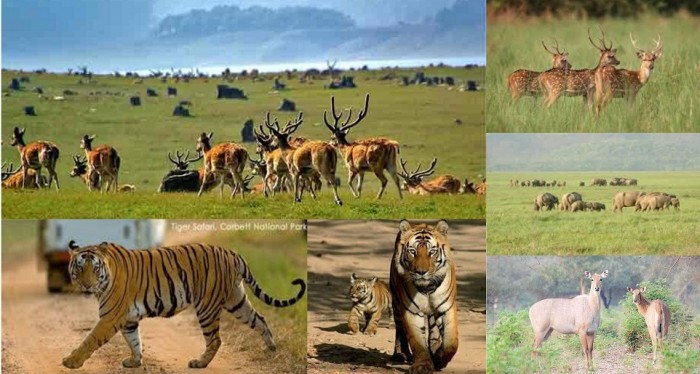
The Bengal tiger is the most famous animal found in Jim Corbett Park. It is among the select locations in India where visitors have a high probability of seeing these mighty beasts in the wild.
There are many other species within the park as well.
Tourists can observe elephants on their journeys along the wooded paths, deer grazing, and wild boars on the riverbanks.
The animals in the park include Bengal tigers, Asian elephants, leopards, sloth bears, barking deer, sambar deer, and wild boars.
The park also supports over 600 bird species, making it a popular destination for birdwatchers. During other seasons, the kingfishers, hornbills, eagles, and numerous migratory birds can be seen.
The park’s wetlands and rivers host reptiles, including crocodiles and snakes.
Due to its abundant biodiversity, Jim Corbett Park ranks among the most important wildlife tourism destinations in India.
Park Safari Tours.
The most popular activity that tourists appreciate in the park is a safari. The forest department oversees the conduct of safaris, protects wildlife, and provides opportunities for people to see the animals safely.
An average Uttarakhand safari would take the visitors deep into the forest with knowledgeable guides who train their drivers well.
The safaris usually take place early in the morning or late in the afternoon, when animals are more active.
During the ride, the visitors are in the animals’ habitats, including forest roads, grasslands, and river areas.
In some cases, the safari can give us a view of a tiger crossing the highway or a herd of elephants at a water source. The forest itself is a peaceful and memorable experience, even when no large animals are visible.
In Jim Corbett National Park, there are Safari Zones.
To control tourism and preserve wildlife habitat, the park is divided into various zones. In different zones, there are different animal sights and landscapes.
Dhikala zone is said to be the most renowned park area. It has vast grasslands in which one can frequently find animals.
Another popular zone is Bijrani, which has a dense forest and offers frequent tiger sightings.
Jhirna is open year-round and is also renowned for birdwatching and deer sightings.
Dhela is a more recent area, consisting of forest interspersed with open areas.
The Durga Devi area offers visiting tourists and birdwatchers a more peaceful forest environment.
The zones are different, and to this extent, visitors usually choose based on availability and whether they are interested in wildlife photography or simply watching birds.
Best Time to Visit
The Jim Corbett is open from November to June, though some areas are open year-round.
The winter season, from November to February, is cool and pleasant for any travel. Birds are also highly active at this time, and many migratory species are present.
The likelihood of tiger sightings is higher in the summer months, between March and June. As the number of water bodies declines, animals often flock to rivers and lakes.
The monsoon rains are very heavy, and parts are closed for safety and forest recovery.
Those visitors who intend to spend time on wildlife photography tend to visit during the summer, whereas families tend to visit during the winter season.
Staying Near the Park
The park is close to many resorts, lodges, and forest rest houses, particularly in Ramnagar.
Commodities range from basic guesthouses to deluxe jungle resorts.
Forest rest, which is within a park, is a more engulfing nature stay, yet the booking requires a lot of prior information through the forest department.
Many hotels also make safari and domestic tour bookings.
When one arrives at the park entrance early in the morning, one can visit the park and take part in the morning safaris.
Visitors’ Acts that Can be done.
- Jim Corbett Park is not only a place to have wildlife safaris.
- The nature walks available in the neighbouring villages give visitors an insight into the local ecosystem and life in the rural environment surrounding the forest.
- Birdwatching is popular because the park shelters hundreds of bird species.
- River places are soothing places to capture a photo.
- There are also interpretation centers and museums around the park where visitors can learn about wildlife conservation.
- Nature, coupled with wildlife and local culture, makes the trip worthwhile for many travellers.
Sustainable Wildlife Tourism.
Wildlife tourism is relevant to the preservation of the national parks. Such visitors, however, are required to adhere to certain rules to protect animals and their habitat.
- During the safaris, one should keep quiet to avoid disturbing the animals.
- Plastic waste must never be disposed of within the trees.
- Tourists are not supposed to leave their cars and must follow the information provided by the guides.
- These rules are important for protecting wildlife and other visitors to the park in the future.
- Responsible travel also helps local communities that have depended on tourism as a source of livelihood.
Reaching the Jim Corbett National Park.
- Ramnagar is the major gateway to the park.
- Ramnagar is well connected by train to major cities, including Delhi.
- Pantnagar is approximately 80 kilometers away, and it is the closest airport.
- Visitors may reach various park gates by road from Ramnagar.
- People visiting Delhi prefer driving because the distance to cover is about six to seven hours.
So why is Jim Corbett Park important in conservation?
- Jim Corbett Park is a tourist site as well as a very important wildlife conservation site.
- The park protects one of the largest populations of Bengal tigers in India.
- It is also a key passage route for animals to and out of forests.
- Here, scholars and conservationists learn about animal behavior and their environments.
- The park has become a model for wildlife conservation in India due to its successful efforts to protect animals.
FAQs
In which area is Jim Corbett National Park situated?
Jim Corbett National Park is located in the state of Uttarakhand in northern India. The closest town is Ramnagar, a major entry point for visitors.
Which types of animals may be observed in the Jim Corbett Park?
Visitors can see tigers, elephants, leopards, deer, wild boars, crocodiles, and several hundred bird species. Nevertheless, locations require chance and the movement of animals in nature.
When is the most appropriate time to go on a visit to Jim Corbett Park?
November to February is a good time in winter, and March to June is a good time in summer. Nature offers a good chance of encountering tigers.
What is the procedure for booking the safari for visitors?
The online reservation website of the Uttarakhand forest department can also be used to book Safaris, or through hotel and tour operators in the park area.
Are tourists safe in Jim Corbett?
Yes, the park can be safe for tourists provided they observe regulations and remain in cars during safaris. All the safari trips have trained guides and drivers.