

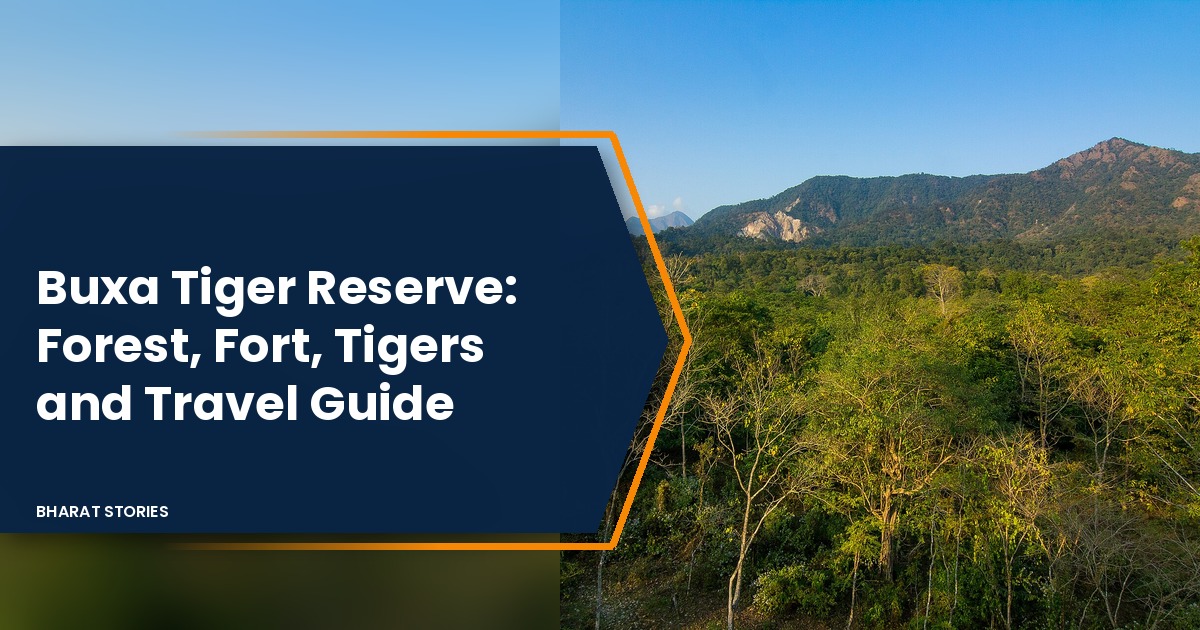
Buxa Tiger Reserve: Forest, Fort, Tigers and Travel Guide
On the northern edge of West Bengal, where the plains of the Dooars run up against the hills of Bhutan, lies a forest that has seen more history than most. Buxa Tiger Reserve covers about 760 sq km of sal forest, river beds and steep hills in Alipurduar district. It holds a colonial era fort where freedom fighters were once imprisoned, a river that is a dry bed of white pebbles for much of the year, and a tiger story that took a new turn in October 2026.
This guide covers Buxa’s geography, history and wildlife, the latest on its tigers, the best time to visit and how to get there from Siliguri or Alipurduar. For more on the state, see our overview of West Bengal’s history, geography and tourism.
Table of Contents
Buxa Tiger Reserve at a Glance
| Item | Detail |
|---|---|
| State and district | West Bengal; Alipurduar district |
| Total area | About 761 sq km: roughly 391 sq km core and 370 sq km buffer |
| Tiger reserve declared | 1983, as India’s 15th tiger reserve |
| National park | About 117 sq km inside the reserve, notified in 1992 |
| Borders | Bhutan to the north, Assam to the east |
| Main entry points | Rajabhatkhawa, Jayanti and Santalabari |
| Closed to tourists | 16 June to 15 September each year |
| Nearest railway | Alipurduar Junction, roughly 15 km from Rajabhatkhawa |
Landscape
Buxa rises from about 60 metres above sea level on the plains to over 1,700 metres on the Sinchula range along the Bhutan border. That climb, over a short distance, creates a remarkable range of habitats: tall moist sal forest in the lowlands, riverine grassland and savannah, and evergreen and semi evergreen forest on the higher slopes. The reserve forms part of an international corridor for elephants that links forests in Bhutan, Assam and North Bengal.
Several rivers flow down from the hills, the best known being the Jayanti. For much of the year it is a wide, dry bed of pebbles and boulders with a thin stream running through, framed by forested hills. In the monsoon it turns into a fast, muddy torrent. The village of Jayanti on its bank is one of the most photographed spots in the region.
Buxa Fort and the Freedom Struggle
High above the plains, at around 850 metres, stand the remains of Buxa Fort. The site was a Bhutanese outpost guarding a trade route into the hills until the British took it after the Anglo Bhutan war of 1864 and 1865, later rebuilding it in stone. In the 1930s the British turned it into a detention camp for political prisoners, and many leaders of the freedom movement, along with revolutionaries from Bengal, were held there. After 1959, the fort housed Tibetan refugees, including monks, for some years.
Today the fort is reached by a trek of about 4 to 5 km uphill from Santalabari. The climb takes most people around an hour and a half each way. Above the fort, the trail continues to the hamlet of Lepchakha, a small village with sweeping views over the Dooars on a clear day.
Wildlife
Buxa has one of the highest numbers of mammal species recorded in any Indian tiger reserve, with around 70 species listed. Asian elephants, gaur, sambar, barking deer, hog deer and wild pigs are the larger animals most likely to be seen. Leopards, clouded leopards, Himalayan black bears, civets, Malayan giant squirrels and pangolins live in the reserve, though most are rarely spotted. In the rivers, look for otters and the occasional mahseer.
Birding is excellent. Hundreds of species have been recorded, and the reserve is known for great hornbills, oriental pied hornbills, kalij pheasants and the ibisbill in the river beds in winter. The black necked crane, a rare winter visitor, has been recorded on the edges of the reserve. Butterflies and orchids add colour to the forest after the rains.
The Tiger Question
For many years Buxa was a tiger reserve without resident tigers. Tigers had once been widespread here, but direct evidence faded through the 1990s and the national estimate of 2018 recorded none. In December 2021, a camera trap in the East Damanpur range photographed an adult male tiger, the first such image in 23 years, and occasional transient tigers have been recorded since then, some apparently moving in from neighbouring Bhutan or Assam.
The big change came on 2 October 2026, when a three year old tigress, tagged T138, was released into the reserve after being translocated from the Valmiki Tiger Reserve in Bihar. Officials described it as the first step in a phased reintroduction, with more tigers planned. She is being tracked through a radio collar, camera traps and field patrols. It is an important conservation move, but one tiger in 760 sq km does not make Buxa a place to go for tiger sightings, at least not yet.
Best Time to Visit
The forest is closed to tourists from 16 June to 15 September each year, as with other protected areas in North Bengal. During this period visitors may still be allowed into some eco tourism centres outside the core.
- Mid September to November: lush after the rains, clear mountain views on good days and comfortable temperatures.
- December to February: cool and dry, with good birding and the best weather for the fort trek. Mornings can be foggy.
- March to mid June: warmer and more humid; good for elephants near water, but rain can start early.
Getting There and Getting Around
Alipurduar Junction is the nearest major railway station, roughly 10 to 17 km from Rajabhatkhawa depending on route. New Jalpaiguri, the main rail hub for North Bengal, is about 160 to 180 km away. Bagdogra airport near Siliguri is the nearest airport, and the drive to Buxa takes about four to five hours.
Rajabhatkhawa, the main gateway, has the forest department office, a nature interpretation centre and the ticket counter. Jeep safaris are arranged through the forest department and authorised operators, with routes through the core and buffer. Permits are needed for entry, and rules on which routes are open can change, so confirm on arrival. Homestays and forest lodges are available at Rajabhatkhawa, Jayanti, Santalabari and nearby villages.
Buxa combines well with Jaldapara, known for its one horned rhinos, and with the hill views of Bhutan’s border towns. If you like quiet forests in eastern India, try Betla National Park in Jharkhand as well. Seasonal notices are published by the West Bengal Forest Department wildlife wing.
Practical Tips
Start the fort trek early in the morning, before the day warms up and the clouds roll in over the ridge. Wear shoes with a good grip, since the stones on the path can be loose and slick after rain. Local porters and guides are available at Santalabari, and hiring one helps the village economy.
Carry cash. ATMs and card payments are unreliable once you leave Alipurduar town. Mobile coverage is patchy in the forest and on the trail, so tell your homestay your plans for the day.
Elephants are common on the roads through the reserve, especially at dawn and dusk. If you meet a herd, stop well back, switch off music and wait for them to cross. Never get out of the vehicle to take photographs. Pack out every plastic bottle and wrapper, and leave the pebbles of the Jayanti riverbed where you found them.
Frequently Asked Questions
Are there tigers in Buxa now?
Yes, though very few. A tigress named T138 was released from Bihar’s Valmiki Tiger Reserve on 2 October 2026, and a handful of transient tigers have been recorded on camera traps in recent years.
When is Buxa closed to tourists?
From 16 June to 15 September every year, during the monsoon.
How hard is the Buxa Fort trek?
Moderate. It is about 4 to 5 km uphill from Santalabari on a rough path. Most reasonably fit visitors manage it in an hour and a half.
Can I see Bhutan from Buxa?
The reserve shares its northern border with Bhutan, and on clear days the hills of Bhutan are visible from higher points such as Lepchakha.
What is Rajabhatkhawa?
It is the main gateway village to Buxa, with the forest office, ticket counter and an interpretation centre.