

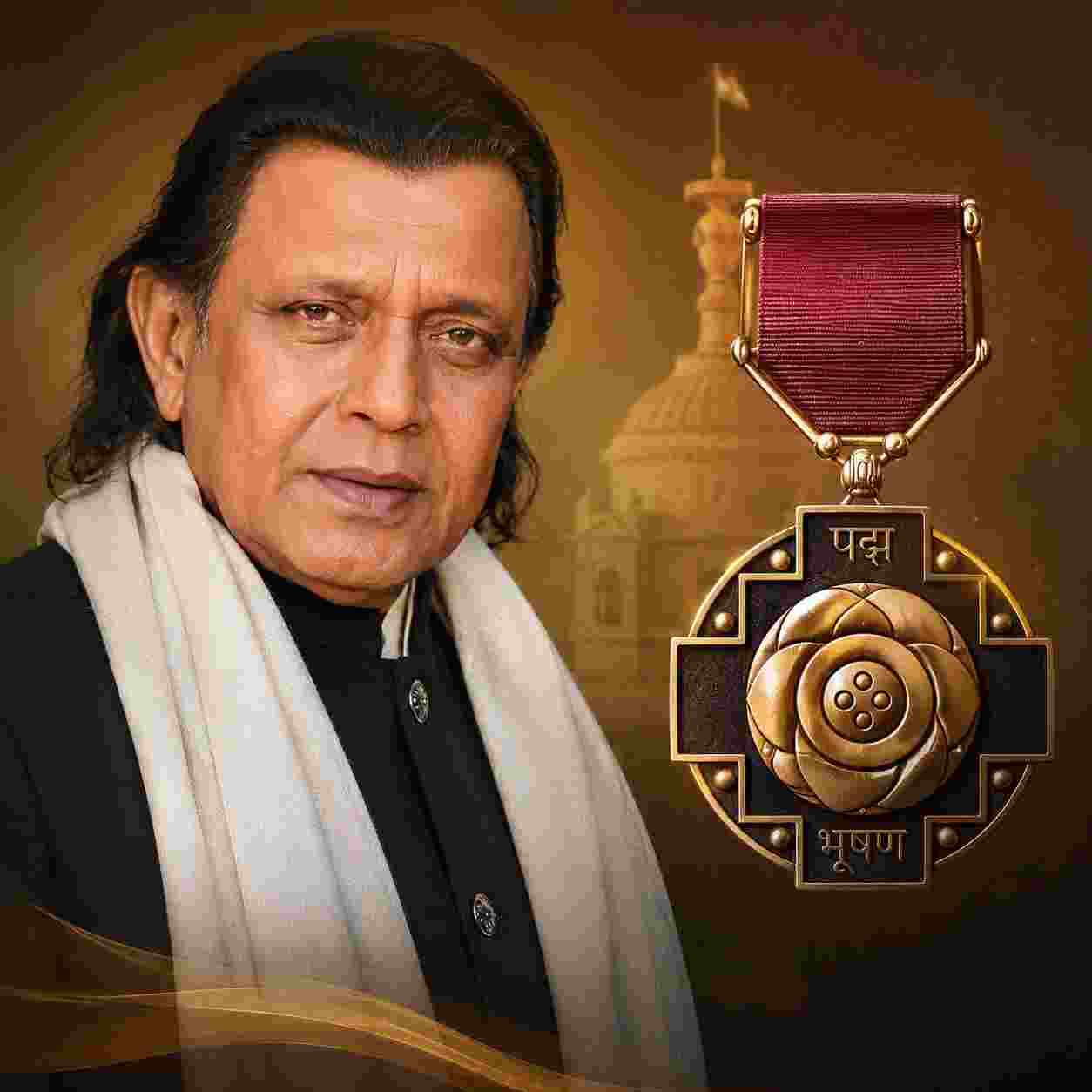
Mithun Chakraborty Padma Bhushan
Awards have a way of arriving either too late or exactly on time. The Mithun Chakraborty Padma Bhushan recognition in 2024 felt like the second kind — not a shock, just the government putting its formal stamp on something the public had understood for forty years.
Mithun Chakraborty is one of those Bollywood actors who refused to fit neatly into one category. Art house début. Disco-era phenomenon. National Award winner. Mass entertainer. Television personality. The career doesn’t follow a simple line, which is part of what makes it worth examining.
Table of Contents
The Mithun Chakraborty Biography: From Calcutta to FTII
The Mithun Chakraborty biography doesn’t begin with privilege. Born Gouranga Chakraborty on June 16, 1950, in Calcutta, what changed his direction was the Film and Television Institute of India in Pune — a serious institution that gave him formal acting training from the start.
His first major film, Mrigayaa in 1976, directed by Mrinal Sen, won him the National Film Award for Best Actor. He was largely unknown to mainstream audiences at that point. The award came before fame — an unusual sequence for any actor, let alone one who would later become one of the biggest draws in Indian popular cinema.
The Mithun Movies That Built a Phenomenon
The shift from art house to mainstream happened sharply, and Disco Dancer in 1982 is where most people mark it. That film didn’t just succeed commercially — it became a cultural reference point. The soundtrack was everywhere. The dance sequences were copied in school playgrounds.
His screen energy connected with audiences in a way that crossed the usual divides of language, region, and class. Among the Mithun movies that followed through the 1980s, several built on the persona he had established:
- Commando — which pushed his action image further with audiences in smaller cities and towns
- Ganga Jamuna Saraswati — another significant entry in his mass-entertainment catalogue
- Tahader Katha — won him his second National Film Award for Best Actor
- Swami Vivekananda — earned his third National Film Award, confirming he could deliver serious performances between commercial projects
This combination is genuinely rare among Bollywood actors. Commercial dominance and National Awards in the same career happens, but not often with the consistency or breadth that Mithun managed across two decades.
What Made Him Different Among Bollywood Actors
When you place Mithun Chakraborty in the wider picture of Bollywood actors of his generation, a few things stand out that didn’t apply to most of his peers.
His audience was different. The fan base he built through the 1980s skewed heavily toward smaller cities, semi-urban areas, and working-class viewers in a way that the top Bollywood actors of that period — who tended to draw more from urban multiplex-going audiences — didn’t match. He found his people, and his people found him, and that connection held for years.
He also moved between Bengali and Hindi cinema with a consistency that few Bollywood actors managed. His work in Bengali films wasn’t secondary to his Hindi career — it was a parallel track that earned him separate critical and popular respect.
The dance factor matters too. His style — physically precise, high-energy, entirely his own — influenced a generation. You can see traces of it in actors and choreographers who came up in the decades after Disco Dancer. That kind of cultural imprint doesn’t get fully captured by any list of box office results.
His later career phases also showed something not all actors can claim: genuine adaptability. Moving into character roles, comedy, and television without losing the public’s affection requires a kind of ongoing self-awareness that is harder than it looks.
The Mithun Family
The Mithun family is a recognisable part of Bollywood in its own right. He married actress Yogeeta Bali, and together they have four children — Mahaakshay (known professionally as Mimoh), Raima, Namashi, and Dishank, who was adopted by the family. Both Mimoh and Namashi have pursued acting careers in their own right, with varying degrees of exposure in the industry.
He has spoken about the Mithun family in interviews with a directness that comes across as genuine rather than performed — the warmth of a man who takes the private side of his life as seriously as the public one.
Politics and the Rajya Sabha
The Mithun Chakraborty biography doesn’t end with cinema. He joined the Bharatiya Janata Party at a public rally in Kolkata, marking a formal entry into politics during the West Bengal assembly election period. His popular standing in Bengal and his roots in the state made this a significant signal at the time.
He was nominated to the Rajya Sabha, giving him a formal role in the upper house of Parliament. For someone who started as a trained actor from a modest background in Calcutta, this range of public life is worth noting — not to blur his identity, but because it reflects the full scope of what the career became.
What the Padma Bhushan Actually Means
The Padma Bhushan is the third-highest civilian honour in India, awarded for distinguished service of a high order to the nation. It sits above the Padma Shri and below the Padma Vibhushan. In the context of cinema, receiving it means the government has looked at a career and found not just popularity or box office success, but a genuine cultural contribution to the country.
The Mithun Chakraborty Padma Bhushan covers three National Film Awards, a commercial reach that arguably no other actor of his era matched in smaller-city and rural India, decades of sustained work across languages and formats, and a career that genuinely left a mark on how Indian popular cinema developed through the 1980s.
None of that is created by the award. The award just names it.
Frequently Asked Questions
-
What is the Mithun Chakraborty Padma Bhushan, and when was it awarded?
The Mithun Chakraborty Padma Bhushan is India’s third-highest civilian honour, awarded to him by the Government of India in 2024 in recognition of his contributions to Indian cinema and public life across several decades as one of the country’s most significant Bollywood actors.
-
What are the most important entries in the Mithun movies catalogue?
Key Mithun movies include his debut Mrigayaa (1976), Disco Dancer (1982), Tahader Katha , and Swami Vivekananda, the latter two winning him National Film Awards. His action entertainers through the 1980s — including Commando and Kasam Paida Karne Wale Ki — were among the biggest commercial hits of that decade.
-
What does the Mithun Chakraborty biography tell us about his early life?
The Mithun Chakraborty biography begins in Calcutta, where he was born in 1950. His path to acting came through the FTII in Pune, which gave him formal training before he entered cinema. His début won a National Film Award — which was an unusual starting point before mainstream commercial fame followed.
-
Who makes up the Mithun family?
The Mithun family includes his wife, actress Yogeeta Bali, and their children Mahaakshay (Mimoh), Raima, Namashi, and Dishank. Mimoh and Namashi have both worked as actors. Dishank was adopted by the family when she was young.
-
How does Mithun stand out compared to other Bollywood actors of his era?
Among Bollywood actors of his generation, Mithun is unusual for holding three National Film Awards for Best Actor while simultaneously building one of the broadest mass-entertainment audiences of the 1980s. His appeal to audiences in smaller cities and rural India, his work across Hindi and Bengali cinema, and his distinctive dance style set him apart from most Bollywood actors of that period.