

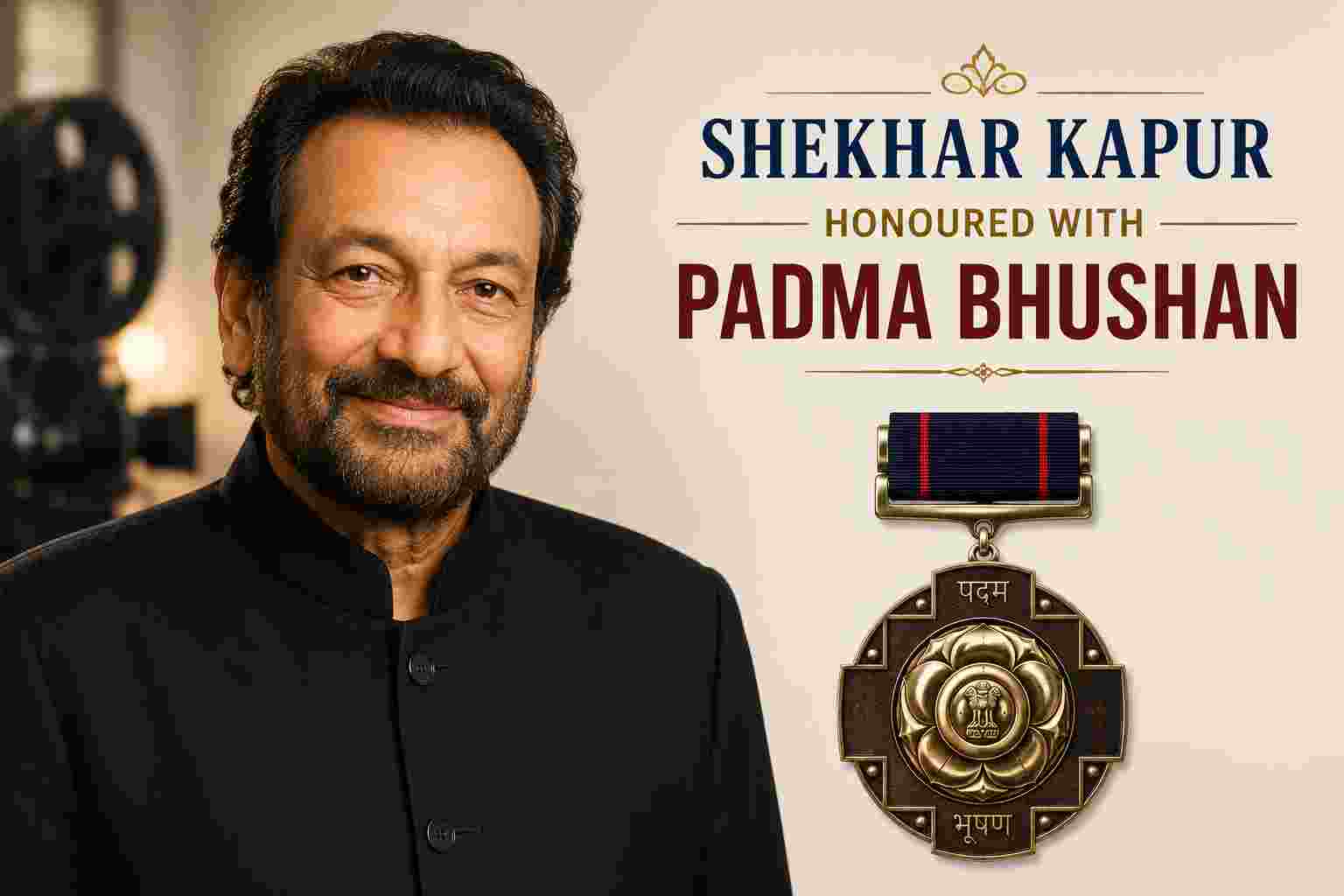
Shekhar Kapur Honoured with Padma Bhushan
There’s something special about watching someone get recognised for work you grew up loving. That’s exactly the feeling many Indians had when veteran film director Shekhar Kapur was honoured with the Padma Bhushan, one of India’s highest civilian awards. President Droupadi Murmu conferred the award on him at Rashtrapati Bhavan, recognising his long and varied contribution to Indian and world cinema.
If you grew up watching Mr. India on a Sunday afternoon or sat through the intensity of Bandit Queen, you already know why this matters. This article talks about who Shekhar Kapur is, what he has done over the years, what the Padma Bhushan actually means, and why this moment deserves attention.
Table of Contents
Who Is Shekhar Kapur?
Shekhar Kapur was born in Lahore, and his family moved to India after partition. He studied at St. Stephen’s College in Delhi, and oddly enough, his first career wasn’t even in films. He trained as a chartered accountant in London. Films were not the obvious path for him, but they were clearly where his heart was.
He started out as an actor in the late 1970s. It didn’t take long for him to realise that he was more interested in what happened behind the camera than in front of it. That shift turned out to be one of the better decisions in the history of Bollywood, because it gave us a film director who wasn’t afraid to take chances with difficult, sometimes uncomfortable stories.
His Career and the Films That Made Him Famous
Ask anyone who has followed Hindi cinema for the last few decades, and they’ll mention at least one Shekhar Kapur film without thinking twice. As a Bollywood director, he built a body of work that mixed entertainment with real substance.
Some of his most memorable films include:
- India (1987) – A film almost every Indian household remembers fondly. The mix of fantasy, comedy, and a genuinely scary villain in Mogambo made it one of the most loved films of its time.
- Bandit Queen (1994) – Based on the life of Phoolan Devi, this film was raw, honest, and uncomfortable in places, but it earned him serious recognition both in India and abroad.
- Elizabeth (1998) – His move into international cinema, starring Cate Blanchett as Queen Elizabeth I. The film picked up several Oscar nominations and introduced Shekhar Kapur to a global audience as a serious filmmaker, not just a Bollywood name.
- Elizabeth: The Golden Age (2007) – The follow-up to Elizabeth, which kept building on his reputation outside India.
What’s interesting about his career is how easily he moved between commercial Hindi films and serious international projects. A lot of directors stick to one lane. He didn’t. He told stories about powerful women, struggle, and survival, and he gave them a visual style that felt different from most films coming out of India at the time.
What exactly is Padma Bhushan?
You might already know the name Padma Bhushan, but it’s worth breaking down what it actually represents. The Padma awards are India’s top civilian honours, given out by the Government of India every year around Republic Day. There are three levels:
- Padma Vibhushan – given for exceptional and distinguished service.
- Padma Bhushan – given for distinguished service of a high order.
- Padma Shri – given for distinguished service in any field.
The Padma Bhushan ranks just below the Padma Vibhushan and the Bharat Ratna, which is India’s highest civilian honour overall. These awards cover a wide range of fields, including art, literature, science, sports, public affairs, and social work. Getting one means you’re now part of a small group of people whose work has genuinely made a difference.
Shekhar Kapur had actually received the Padma Shri earlier in his career, also for his work in the arts. So this Padma Bhushan isn’t his first recognition from the government — it’s the next step in a long relationship between his work and the honours India gives to its artists.
Why This Moment Matters
For a man who has spent close to five decades making films, an award like this isn’t just a medal to put on a shelf. It’s a way of saying that the risks he took, the stories he chose to tell, and the years he spent building his craft actually meant something.
His daughter, Kaveri Kapur, shared an emotional message on social media after the ceremony. She spoke about the values her father had passed on to her over the years, and it was the kind of post that made even strangers feel something. Kapur himself spoke with a lot of humility about the honour, saying he hoped to give back to the people and the country that had supported him throughout his journey.
For young writers, filmmakers, and creators who follow BharatStories, his story has a few lessons worth thinking about:
- You don’t need to follow the obvious path. He trained as an accountant before becoming one of India’s most respected directors.
- Stepping outside your comfort zone, like he did by working in Hollywood after building his name in Bollywood, can open doors you didn’t expect.
- Telling honest stories, even uncomfortable ones, tends to leave a longer mark than chasing easy box office success.
His Legacy in Indian Cinema
When people talk about Indian directors who managed to build a name both at home and internationally, Shekhar Kapur’s name comes up almost immediately. His biography reads like a story of constant reinvention — from accountant, to actor, to one of the most respected film director to ever come out of India.
His films have shaped how a whole generation of filmmakers think about storytelling. Directors who came after him often mention his influence when talking about mixing strong narratives with bold visuals. And even today, years after Mr. India and Bandit Queen first hit the screens, people are still rewatching them, still talking about them, still discovering them for the first time.
This Padma Bhushan adds one more chapter to that legacy. It’s a recognition of someone who never stuck to a single genre, never stopped experimenting, and never stopped representing Indian cinema, even when he was working oceans away from home.
Final Thoughts
Shekhar Kapur’s Padma Bhushan is more than a ceremony or a headline. It’s a recognition of a career that was built on patience, honesty, and a willingness to tell stories that mattered, not just stories that sold tickets. From Mr. India to Bandit Queen to Elizabeth, his work as a film director has touched audiences far beyond Bollywood.
As one of the most respected Bollywood director of his time, his journey is proof that good storytelling has no real boundaries. Recognition might take time, but honest work eventually finds its way to it.
FAQs
-
When was Shekhar Kapur honoured with the Padma Bhushan?
He received the award from President Droupadi Murmu at a ceremony held at Rashtrapati Bhavan, in recognition of his contribution to art and cinema.
-
What is Shekhar Kapur best known for?
He is best known for directing Mr. India, Bandit Queen, and Elizabeth. He has worked across Bollywood and Hollywood throughout his career.
-
Did he receive any Padma award before this one?
Yes, he was earlier given the Padma Shri in the arts category, so the Padma Bhushan is the next honour in that journey.
-
What’s the difference between Padma Vibhushan, Padma Bhushan, and Padma Shri?
Padma Vibhushan is for exceptional service, Padma Bhushan is for distinguished service of a high order, and Padma Shri is for distinguished service in any field. All three are presented by the President of India around Republic Day.
-
Why does this award matter for Indian cinema?
It celebrates a filmmaker who carried Indian cinema onto the world stage while never losing his connection to Bollywood storytelling.