

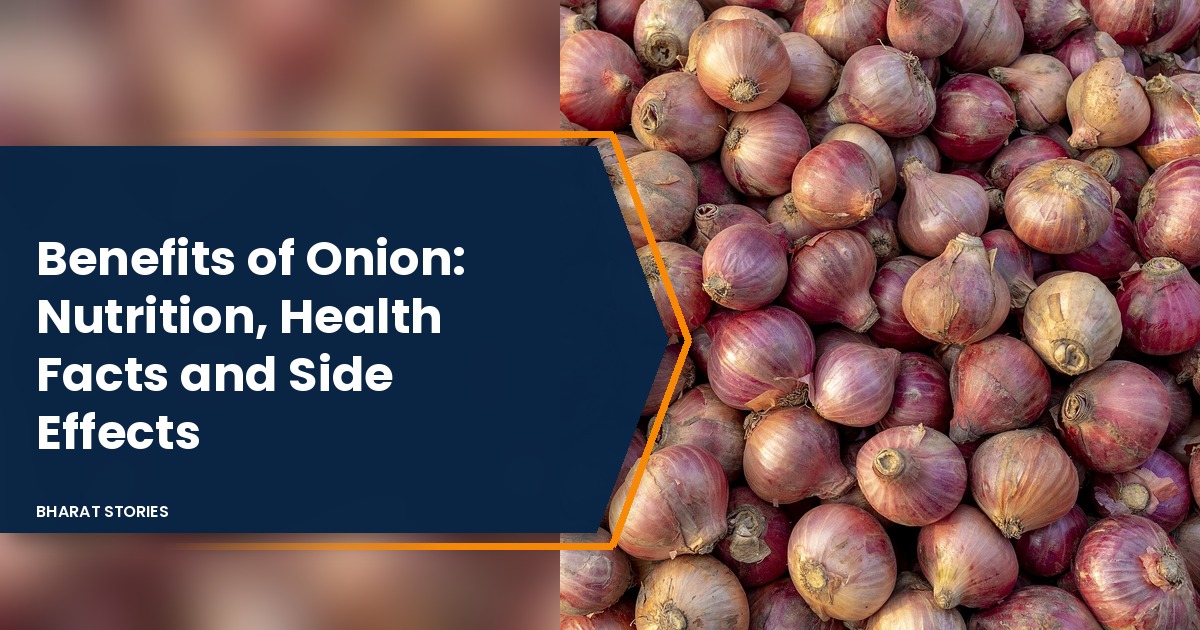
Benefits of Onion: Nutrition, Health Facts and Side Effects
Onions go into almost every Indian kitchen, from tadka and sabzi to raw slices next to a plate of dal chawal. Because they are eaten so often, people like to credit them with big health powers. Some of these claims have real science behind them, some are based only on lab or animal studies, and a few are myths. This guide looks at the benefits of onion in plain terms, what the evidence actually says, and when onions may not suit you.
This article is for general information and is not medical advice. If you have a health condition or take regular medicine, talk to your doctor before making big changes to your diet.
Table of Contents
What nutrients are in an onion?
A raw onion is mostly water and carbohydrate, with about 40 calories per 100 grams, some fibre, a little vitamin C and small amounts of B vitamins and potassium.
The figures below come from the USDA food database, as summarised on Wikipedia’s onion page, for 100 grams of raw onion (roughly one medium onion).
| Nutrient | Amount in 100 g raw onion |
|---|---|
| Energy | 40 kcal |
| Water | About 89 g |
| Carbohydrates | 9.34 g |
| Sugars | 4.24 g |
| Dietary fibre | 1.7 g |
| Protein | 1.1 g |
| Fat | 0.1 g |
| Vitamin C | 7.4 mg |
| Vitamin B6 | 0.12 mg |
| Folate | 19 micrograms |
| Potassium | 146 mg |
So onions are not a nutrient powerhouse on their own. Their value comes from adding flavour with very few calories, and from plant compounds that other foods lack.
What are the main benefits of onion?
The best supported benefits of onion are that it adds flavour with few calories, supplies fibre that feeds gut bacteria, and provides plant compounds such as quercetin and anthocyanins that are being studied for their effects on health.
Do onions contain antioxidants?
Yes. Onions are one of the richest everyday sources of flavonoids, especially quercetin, and red onions also contain anthocyanin pigments.
Levels differ a lot by type. Research summarised on Wikipedia notes that yellow onions have the highest total flavonoid content, about 11 times more than white onions, while shallots have the highest polyphenol levels. Red onions get their colour from anthocyanins, with at least 25 different compounds identified. These compounds act as antioxidants in the lab. Scientists are still studying how much of that effect carries over to the human body after digestion.
Are onions good for gut health?
Onions contain fructans, a type of fibre that acts as a prebiotic, which means it feeds helpful bacteria in the large intestine.
Prebiotic fibre is linked to healthier gut bacteria and regular bowel habits. The same fructans, however, are a known trigger for people with irritable bowel syndrome, as explained in the section on side effects.
Can onions help the heart and blood sugar?
Some small studies and observational research suggest onion compounds may help blood pressure, cholesterol or blood sugar, but the evidence is limited and onions cannot replace medicine.
Most of these findings come from lab work, animal studies, onion extracts or short trials with few people. Diets rich in vegetables, including onions, are linked with better heart health overall, but it is hard to credit any single vegetable. If you have diabetes or high blood pressure, eat onions as part of a balanced meal and keep taking your prescribed treatment.
Do onions lower cancer risk?
Some population studies link a high intake of allium vegetables like onion and garlic with lower risk of certain cancers, but these studies cannot prove cause and effect.
People who eat more vegetables often have other healthy habits too. Treat onions as one part of a good diet, not as a cancer prevention tool.
Is onion juice good for hair?
There is only small, early evidence. A 2002 study of 38 people with patchy hair loss (alopecia areata) found more regrowth with onion juice than with tap water, but it has not been confirmed by larger trials.
The study, by Sharquie and Al Obaidi, was published in the Journal of Dermatology. In the group of 23 patients who used crude onion juice twice daily, regrowth was seen in most of them by six weeks. It was a small study on one type of hair loss, so it does not show that onion juice helps common thinning or baldness. Onion juice can also irritate the scalp. Do a patch test on a small area first, and see a dermatologist if hair loss is sudden or patchy.
Does onion increase sperm count?
There is no good human evidence that onions increase sperm count; the claim comes mainly from animal studies.
If you are worried about fertility, see a doctor for proper tests. A healthy weight, not smoking, limiting alcohol and a balanced diet have much stronger evidence than any single food.
Is raw onion better than cooked onion?
Raw onion keeps more vitamin C and some sulfur compounds, while gentle cooking keeps most flavonoids; both are healthy choices.
Very long frying at high heat in a lot of oil adds calories and can reduce some nutrients. Lightly sautéed, roasted or raw onion in salads, raita and chutneys gives you the most benefit. Quercetin is concentrated in the outer layers, so peel off only the papery skin and not the fleshy outer ring.
What are the side effects of eating onions?
For most people onions are safe, but they can cause bad breath, gas, heartburn and stomach pain in sensitive people, and rarely allergic reactions.
- IBS and bloating: onions are high in FODMAPs (fructans), which ferment in the gut and can cause gas, pain and loose motions in people with irritable bowel syndrome. See FODMAP for background.
- Acid reflux: raw onion can make heartburn worse in people with acid reflux.
- Bad breath and body odour: sulfur compounds stay in the breath for hours.
- Allergy: some people react to handling onions, with itching, skin rash, runny nose or, rarely, breathing trouble. Cooking may reduce reactions.
- Pets: onions are toxic to dogs and cats, so never feed them leftovers with onion in them.
Why do onions make you cry?
Cutting an onion breaks its cells and releases enzymes that produce a gas called syn propanethial S oxide, which irritates nerves in the eyes and makes them water.
To reduce tears, chill the onion before cutting, use a sharp knife, and keep the root end intact for as long as possible, because that part holds more sulfur compounds. Cutting near running water or under a kitchen exhaust also helps.
How much onion should you eat?
There is no official daily target; including onions regularly in cooked dishes and salads, as most Indian meals already do, is a reasonable amount for healthy people.
If raw onion upsets your stomach, cooked onion or the green tops of spring onions are often easier to digest. People on a low FODMAP diet should follow the advice of their dietitian.
How should you store onions?
Keep whole onions in a cool, dry, dark and airy place, away from potatoes, and refrigerate cut onions in a closed box for a few days.
Cooking onions usually last three to four weeks at room temperature in good conditions, while sweet onions last one to two weeks. India is one of the world’s largest onion growers, and prices swing sharply with the season, which you can read about in our report on how onion prices pushed up retail inflation. For more food guides, see our pieces on the health benefits of apples, foods that naturally increase hemoglobin and the best foods for fatty liver recovery.
Frequently Asked Questions
Is it good to eat raw onion every day?
For most healthy people, a small amount of raw onion daily is fine. Skip or cut down if it causes heartburn, gas or stomach pain.
Which onion is the healthiest?
Red and yellow onions have more flavonoids than white onions, and shallots have the most polyphenols. Any onion you enjoy eating regularly is a good choice.
Do onions help in summer heat?
Raw onion is a traditional summer food in many parts of India. It adds water and flavour to meals, but there is no strong scientific proof that it prevents heatstroke. Drinking enough water and avoiding the midday sun matter more.
Can people with diabetes eat onions?
Yes. Onions are low in calories and carbohydrates per serving, so they fit well into a diabetic diet. They are not a treatment, so keep following your doctor’s advice.