

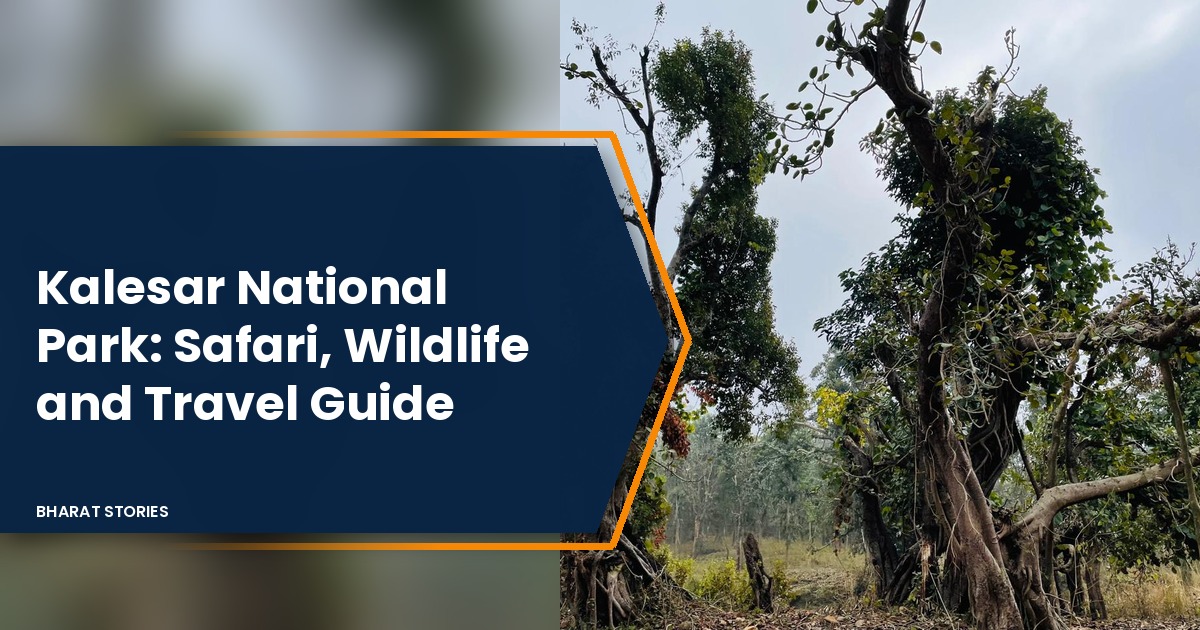
Kalesar National Park: Safari, Wildlife and Travel Guide
Kalesar National Park is Haryana’s only national park in the Shivalik hills, a quiet sal forest on the banks of the Yamuna in Yamunanagar district. It is known for leopards, elephants, red jungle fowl and rich birdlife, and it made headlines in 2023 when a tiger was caught on camera here for the first time in more than a century. This guide covers where Kalesar is, its history, wildlife, safaris, timings and how to reach it.
Table of Contents
Where is Kalesar National Park located?
Kalesar National Park is in Yamunanagar district of Haryana, in the Shivalik foothills, where Haryana meets Himachal Pradesh and Uttarakhand.
The park lies on both sides of the Yamunanagar to Paonta Sahib road (NH 907), about 8 km from the Hathni Kund Barrage. The Yamuna river forms its eastern edge. To the north is Simbalbara National Park in Himachal Pradesh, and to the north east is Rajaji National Park in Uttarakhand, so Kalesar is part of a larger forest corridor. Hills in the park range from roughly 600 m to just over 1,000 m above sea level.
| Fact | Detail |
|---|---|
| State and district | Haryana, Yamunanagar district |
| Hill range | Shivalik foothills of the Himalayas |
| National park notified | 8 December 2003 |
| Area of the national park | About 11,570 acres (around 47 sq km) |
| Kalesar Wildlife Sanctuary | 13,209 acres (about 53 sq km), notified 1996 |
| Main forest | Sal with mixed broadleaf trees |
| Neighbouring parks | Simbalbara (Himachal Pradesh), Rajaji (Uttarakhand) |
When was Kalesar declared a national park?
Kalesar was notified as a national park on 8 December 2003; the adjoining Kalesar Wildlife Sanctuary had been notified earlier, on 13 December 1996.
The two protected areas sit side by side and are managed together by the Haryana Forest Department. The area figure in the table above is the one used by state forest officials in news reports. Some older references give slightly different numbers, so treat these as approximate. Official updates are posted by the Haryana Forest Department.
How did Kalesar get its name?
The park is named after the ancient Kalesar Mahadev temple inside it, a Shiva shrine whose name comes from Kaleshwar, a name of Lord Shiva.
The temple lies close to the highway, a short distance north of a colonial era forest rest house, often called the Kalesar dak bungalow, which is about a century old and overlooks the Yamuna. The forests here have a long history. British officers came to hunt tigers in these hills in the nineteenth century, and by the early twentieth century heavy hunting had sharply reduced big cat numbers, according to the park’s history on Wikipedia.
Which animals are found in Kalesar National Park?
Kalesar is best known for leopards, Asian elephants, sambar, chital, wild boar and the red jungle fowl, the wild ancestor of the domestic chicken.
A camera trap survey by the Wildlife Institute of India in 2016 recorded 19 species of mammals, including 42 leopards. Other animals include barking deer, goral, porcupines, rhesus macaques, langurs, jackals and hares. Elephants move between Kalesar, Simbalbara and Rajaji through the forest corridor, especially in the cooler months.
Has a tiger been seen in Kalesar?
Yes. In April 2023 a camera trap photographed an adult male tiger in Kalesar, the first record of a tiger in Haryana since 1913.
Officials later confirmed that the tiger was a wanderer from Rajaji National Park, as reported by Hindustan Times. The sighting showed that the corridor linking these parks still works and that Kalesar has enough prey and water to attract big cats. It does not mean tigers live here permanently, so visitors should not expect to see one.
Which birds can you see in Kalesar?
Kalesar is a good birding site, with red jungle fowl, crested serpent eagles, red billed blue magpies and many Himalayan foothill species.
- Game birds: red jungle fowl, peafowl and kalij pheasant in the denser forest.
- Raptors: crested serpent eagle and other birds of prey over the river valley.
- Forest birds: red billed blue magpie, grey hooded warbler, bar tailed treecreeper, chestnut bellied nuthatch and grey capped pygmy woodpecker.
- Colourful species: blue bearded bee eater, minivets, barbets and kingfishers along the streams.
Winter brings extra species down from the higher hills, which makes November to March a good time for birdwatchers.
What kind of forest covers Kalesar?
The park is mainly sal forest, mixed with trees such as khair, shisham, semul, amaltas, bahera and axlewood (chhal), along with bamboo and medicinal plants.
The ground is cut by dry, pebbly stream beds that fill with water only during the monsoon. These seasonal streams, known locally as raus, are important water sources for wildlife. Old trees in some parts of the forest are protected as sacred groves by nearby communities.
What is the difference between Kalesar National Park and Kalesar Wildlife Sanctuary?
They are two separate protected areas that share a boundary; a national park has stricter rules than a wildlife sanctuary.
Under the Wild Life (Protection) Act, 1972, human activities such as grazing and collection of forest produce are much more restricted in a national park than in a sanctuary. In practice, visitors experience Kalesar as one forest block, and the safari tracks and rest house are reached from the same highway.
What can you see near Kalesar?
Nearby places include the Kalesar Mahadev temple, the Hathni Kund Barrage on the Yamuna, Paonta Sahib gurdwara and the Adi Badri area in Yamunanagar district.
The barrage is a popular stop for river views and winter waterbirds. Paonta Sahib, across the state border in Himachal Pradesh, is an important Sikh pilgrimage town linked with Guru Gobind Singh. Combining the park with these places makes an easy two day trip from Chandigarh or Dehradun.
What problems does Kalesar face?
The park faces pressure from highway traffic, forest fires in the dry season, grazing and illegal felling along its edges.
The busy road that cuts through the forest is a risk for crossing animals, and fire lines are cleared every year to stop summer fires from spreading. Keeping the corridor to Simbalbara and Rajaji open is the key to the long term future of elephants, leopards and any tigers that wander in.
How do you go on a safari in Kalesar?
Jeep safaris run on three fixed tracks of about 6 km to 7 km each, using only vehicles registered with the wildlife department.
Private cars are not allowed on the safari routes. The park is closed from July to September because of the monsoon. Timings published for the park are 6 am to 10 am and 4 pm to 7 pm in summer, and 7 am to 11 am and 3:30 pm to 6 pm in winter. Fees and booking rules can change, so confirm them with the forest office in Yamunanagar or at the park gate before you go.
What is the best time to visit Kalesar National Park?
October to March is the most pleasant time, with cool weather and good birding; April to June is hot but animals gather near water.
Early morning drives give the best chance of seeing deer, jungle fowl and, with luck, elephants. Carry water, wear neutral colours and keep noise low. Do not leave the vehicle except at permitted points.
How do you reach Kalesar National Park?
Drive from Yamunanagar, about 45 km away, or from Chandigarh, about 120 km away; Dehradun is about 55 km and Paonta Sahib about 15 km.
- By air: Chandigarh and Dehradun have the nearest airports.
- By rail: Yamunanagar Jagadhri is the nearest major railway station.
- By road: follow the road towards Paonta Sahib past Hathni Kund Barrage. Buses run on this route, but a taxi is easier for safaris.
Kalesar pairs well with a trip to Rajaji National Park or Jim Corbett National Park further east. For background on the state, read our guide to Haryana’s history, geography and tourism, and see our full list of national parks of India.
Frequently Asked Questions
In which district is Kalesar National Park located?
It is in Yamunanagar district of Haryana, close to the borders of Himachal Pradesh and Uttarakhand.
Is Kalesar the only national park in Haryana?
Kalesar is one of only two national parks in Haryana. The other is Sultanpur National Park near Gurugram, which is known for wetland birds.
Which river flows near Kalesar National Park?
The Yamuna flows along the eastern edge of the park, near the Hathni Kund Barrage.
Are there tigers in Kalesar?
A tiger from Rajaji was recorded on camera in 2023, but Kalesar does not have a resident tiger population. Leopards are the main big cats here.