

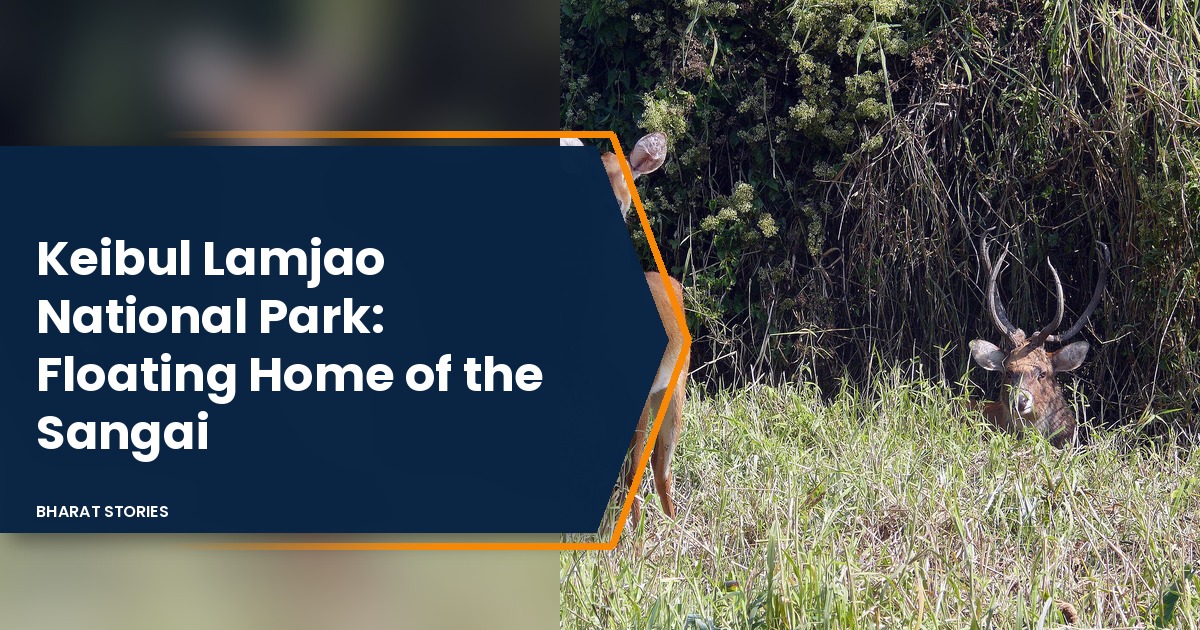
Keibul Lamjao National Park: Floating Home of the Sangai
Keibul Lamjao National Park in Manipur is the only floating national park in the world. It sits on the southern side of Loktak Lake, the largest freshwater lake in Northeast India, and it is the last natural home of the sangai, the dancing deer of Manipur. This guide explains where the park is, how its floating land works, why the sangai matters, the threats the park faces and how to plan a visit.
Table of Contents
Where is Keibul Lamjao National Park located?
Keibul Lamjao National Park is in Bishnupur district of Manipur, on the south eastern side of Loktak Lake, and covers about 40 sq km.
The park is an integral part of Loktak Lake, which lies near Moirang town, south of the state capital Imphal. Most visitors travel by road from Imphal, which is the nearest airport and the main base for the trip. The lake and the park together form a wetland landscape of open water, floating meadows and a few low hills.
| Fact | Detail |
|---|---|
| State and district | Manipur, Bishnupur district |
| Area | About 40 sq km |
| Wildlife sanctuary | 1966 |
| National park | 1977 |
| Flagship animal | Sangai (brow antlered deer) |
| Part of | Loktak Lake, a Ramsar site since 1990 |
| UNESCO status | Tentative list since 2016 |
Why is Keibul Lamjao called a floating national park?
Most of the park is made of phumdis, thick floating mats of soil, plants and decaying organic matter that rest on the surface of Loktak Lake.
Phumdis form two thirds to three fourths of the park area. Over many years, roots, grasses and organic material bind together into a spongy mass strong enough to carry the weight of deer. According to Wikipedia’s summary of field studies, the phumdi layer is roughly 0.3 m to 1.2 m thick, and about a fifth of it floats above the water.
The floating land rises and falls with the seasons. In the dry months, the edges of the mats touch the lake bed and draw nutrients from it. In the monsoon they lift and float again. Three small hills, Pabot, Toya and Chingjao, give the larger animals dry ground when water levels rise. The park is often described as “too deep to be a marsh, too shallow to be a lake”.
What is the sangai and why is it special?
The sangai is a subspecies of Eld’s deer found in the wild only in Keibul Lamjao, and it is the state animal of Manipur.
Its scientific name is Rucervus eldi eldi, and it is also called the brow antlered deer because its antlers curve forward over the brow. Locals call it the dancing deer because of the way it steps delicately across the soft, floating ground. The sangai is listed as endangered.
The deer also holds a special place in Meitei culture. Folk stories link it to the legendary lovers of Moirang, and the state’s biggest tourism event, the Manipur Sangai Festival, is named after it and is usually held in late November.
How many sangai deer are left?
The wild population is small: counts rose from 204 in 2013 to about 260 in the 2016 census, after the deer had nearly vanished in the twentieth century.
The sangai was believed to be almost extinct by 1950. In 1953, a few animals were found again in the Loktak area, and only 14 were recorded in 1975. Protection under the national park, as summarised on the sangai page on Wikipedia, helped the numbers recover. Because all wild sangai live in one small area, a single disaster such as a flood, disease outbreak or habitat collapse could still wipe out much of the population, which is why plans to create a second home for the deer have been discussed.
Which other animals and plants are found in the park?
Apart from the sangai, the park has hog deer, wild boar, otters, civets, jungle cats and many wetland birds and fish.
- Mammals: hog deer, wild boar, large Indian civet, common otter, jungle cat, Asian golden cat, fox, flying fox and sambar.
- Birds: Loktak Lake supports dozens of species of waterbirds, including many migratory ducks that arrive in winter, along with kingfishers, herons and harriers.
- Fish: snakeheads, common carp, wallago and pool barb, which are important for local fishing.
- Plants: wild rice (ishing kambong), reeds, lotus (thambal), water hyacinth and tall grasses that grow on the phumdis.
To compare this list with other parks, see our page on the top wild animals of India.
What is the link between Keibul Lamjao and Loktak Lake?
The park is the southern part of Loktak Lake, so the health of the lake directly decides the health of the park.
Loktak was declared a wetland of international importance under the Ramsar Convention on 23 March 1990. On 16 June 1993 it was placed on the Montreux Record, a list of Ramsar sites where the ecological character is changing or likely to change. Thousands of fishing families depend on the lake, and some live on phumdi huts known as phumshangs. You can read more about the lake and its wider basin on the Loktak Lake page.
What threats does Keibul Lamjao face?
The main threat is a permanently high water level since the Ithai Barrage was built in 1983, which is thinning the phumdis that carry the deer.
The barrage keeps the lake high for most of the year for hydropower and irrigation. As a result, the floating mats rarely touch the lake bed to feed on nutrients, and studies have reported that they are becoming thinner and breaking up. Other pressures include sewage and silt from the catchment, the spread of water hyacinth, fishing enclosures, cutting of phumdis and grazing. In the late 1990s, the protected area was also reduced under local pressure.
Is Keibul Lamjao a UNESCO World Heritage Site?
Not yet. It is on India’s UNESCO tentative list as the Keibul Lamjao Conservation Area, submitted in 2016.
The UNESCO tentative listing describes a core of the national park (40 sq km) with a buffer of Loktak Lake (140 sq km) and Pumlen Pat (43 sq km). A tentative listing is the first step; a full nomination and evaluation are needed before a site is inscribed.
How do you plan a visit to Keibul Lamjao?
Travel from Imphal by road to the Moirang and Loktak area, and visit in the cooler, drier months from about October to April for the best chance of seeing sangai.
- Getting there: Imphal has the nearest airport. Hire a taxi or join a tour to Moirang and the park.
- Best time: the winter months bring migratory birds and comfortable weather. Early morning is best for spotting deer from the watchtower on the hills.
- What to see nearby: Sendra island and its viewpoint over Loktak, boat rides among the phumdis, and the INA Memorial at Moirang.
- Permits and rules: check current entry rules with the Manipur forest department or a registered local guide before you go, and keep to marked paths and boats.
Visit as a responsible guest. Do not walk on phumdis unless a guide says it is safe, keep noise low near the watchtowers, carry back all plastic and never feed or chase the deer. Binoculars, a rain jacket and insect repellent are useful in every season, and a local guide improves your chances of spotting sangai.
For more on the state, read our guide to Manipur’s history, geography and tourism, or browse our list of national parks of India and the best wildlife sanctuaries in India.
Frequently Asked Questions
Keibul Lamjao National Park is located in which state?
It is in Manipur, in Bishnupur district, on the southern side of Loktak Lake.
What is phumdi?
Phumdi is the Manipuri word for the floating mats of soil, vegetation and organic matter on Loktak Lake. Most of Keibul Lamjao is made of phumdis.
Why is the sangai called the dancing deer?
Because it steps lightly and carefully across the soft, floating phumdis, which looks like a dance.
Which is the only floating national park in the world?
Keibul Lamjao, on Loktak Lake in Manipur, holds that title because most of its land is made of floating phumdis rather than solid ground.