

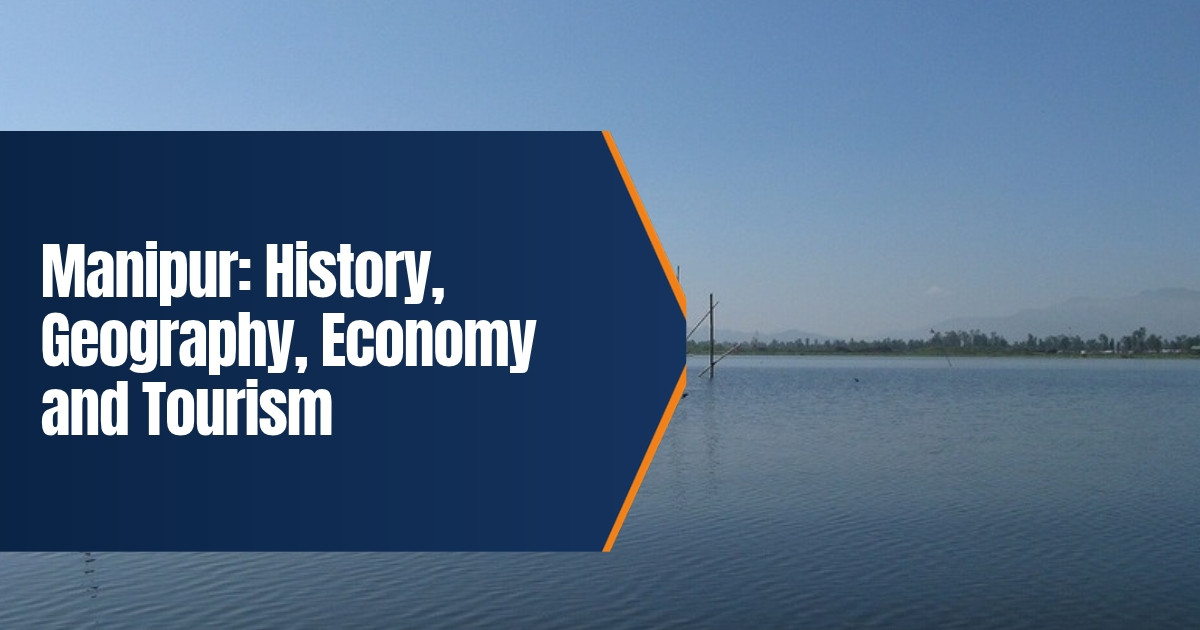
Manipur: History, Geography, Economy and Tourism
Manipur is a small hill state in northeastern India, bordered by Myanmar to the east. Its name is often translated as “land of jewels”. It is known for Loktak Lake, the classical Manipuri dance, the game of polo and a long history as an independent kingdom. This guide explains the history of Manipur, its geography, its people, how the economy works, the current situation in 2026 and what visitors need to know.
Table of Contents
Manipur at a Glance
| Item | Detail |
|---|---|
| Statehood | 21 January 1972 |
| Capital | Imphal |
| Area | 22,330 square kilometres |
| Population | 2,855,794 (Census 2011) |
| Borders | Nagaland, Assam, Mizoram and Myanmar |
| Main language | Meitei (Manipuri), plus many tribal languages |
| Best known lake | Loktak, the largest freshwater lake in the northeast |
| State animal | Sangai, the brow antlered deer |
History of Manipur
The early kingdom
Manipur has one of the longest recorded royal histories in the northeast. The royal chronicle, the Cheitharol Kumbaba, lists rulers from the first century CE, although the early parts mix history with legend. The kingdom was centred on the Kangla, a fortified site in Imphal that served as the seat of power for centuries. Local tradition names Nongda Lairen Pakhangba as the founding king.
Conflicts with Burma
Over the centuries Manipur fought many wars with its eastern neighbour, Burma (now Myanmar). In the eighteenth century King Pamheiba, also called Garib Niwaz, expanded the kingdom and promoted Vaishnavism, which became the main religion of the Meitei. Burmese armies occupied Manipur from 1819 to 1826, a period remembered as the Seven Years Devastation. With British help, Manipur regained its independence after the First Anglo Burmese War.
British rule
Manipur remained a princely state with its own king, but the British had growing influence. In 1891 a succession dispute led to the Anglo Manipur War. The British won, executed several Manipuri leaders, and placed a young prince on the throne under British supervision. The war is remembered every year on 13 August as Patriots’ Day. During the Second World War, the Battle of Imphal in 1944 was one of the turning points of the Burma campaign, and war cemeteries in Imphal still mark it.
Merger and statehood
Manipur became part of India on 15 October 1949. It was made a union territory in 1956 and a full state on 21 January 1972, a date celebrated as Statehood Day. Armed groups demanding independence or autonomy appeared from the 1960s, and the region lived for decades under special security laws in many areas.
Geography and Climate
Manipur is shaped like an oval valley surrounded by hills. The Imphal Valley covers about 1,813 square kilometres in the centre, at around 790 metres above sea level. The rest of the state, roughly nine tenths of its area, is hills and forest.
- Loktak Lake. The largest freshwater lake in northeast India, famous for phumdis, floating mats of soil and plants.
- Keibul Lamjao National Park. Built on phumdis in Loktak, it is described as the only floating national park in the world and is the last natural home of the sangai deer.
- Rivers. The Barak is the largest river, while the Imphal and Iril rivers drain the valley.
- Forests. Teak, pine, oak, bamboo and cane cover much of the hills, and the state is rich in orchids.
- Shirui Hills. In Ukhrul district, home of the rare Shirui lily, the state flower.
The climate is mild. Imphal has warm summers and cool winters, with average annual rain of about 930 millimetres in the valley and much more in the hills. The monsoon lasts from about May to September.
People and Culture
Manipur has three main groups. The Meitei, who make up about 53 percent of the population, live mostly in the valley. Naga tribes, around 20 percent, and Kuki Zo tribes, around 16 percent, live mainly in the hills. There are also Meitei Pangal (Manipuri Muslims) and many smaller communities. Hinduism and Christianity are the main religions, and the traditional Meitei faith of Sanamahism is also practised.
Culture is a source of pride across communities:
- Manipuri dance. One of India’s classical dances, known for the gentle Ras Lila.
- Polo. The modern game grew from Sagol Kangjei, played in Manipur for centuries. The Mapal Kangjeibung in Imphal is often called one of the oldest polo grounds in the world.
- Martial arts. Thang Ta, a sword and spear art, is still taught.
- Festivals. Lai Haraoba, Yaoshang, Ningol Chakouba, Christmas and tribal harvest festivals such as Lui Ngai Ni and Chavang Kut.
- Ima Keithel. The mothers’ market in Imphal, run entirely by women, is one of the largest such markets in Asia.
Manipur has also produced many sports stars, including boxer Mary Kom and weightlifters Mirabai Chanu and Kunjarani Devi.
Economy of Manipur
Manipur’s economy is small and mostly rural. The main sources of income are:
- Agriculture. Rice is the main crop in the valley, with terrace and shifting farming in the hills. Pineapple, oranges, ginger and black rice (chak hao) are well known.
- Handloom. Manipur has one of the largest numbers of handloom weavers in the country, most of them women. Phanek and innaphi are traditional garments.
- Fishing. Loktak and other wetlands supply fish to the valley.
- Bamboo and forest products. Used for crafts, building and food.
- Border trade. Moreh, on the Myanmar border, is a gateway for trade under India’s Act East policy.
- Government jobs and services. A large share of formal employment.
The main limits on growth are remote location, poor road links during the monsoon, and long periods of unrest. A new railway line from Jiribam towards Imphal and better highways are meant to improve connectivity.
Manipur in 2026
Since 3 May 2023 Manipur has been affected by ethnic violence, mainly between Meitei and Kuki Zo communities. Many people were killed, homes and places of worship were destroyed, and tens of thousands were displaced into relief camps. President’s Rule was imposed on 13 February 2025. It was revoked on 4 February 2026, and Yumnam Khemchand Singh was sworn in as Chief Minister. In October 2026 some Kuki Zo groups called for President’s Rule to be brought back, while others have asked for peace talks to continue. Relief, rehabilitation and the safe return of displaced families remain major issues. We describe these events neutrally and will update this section as the situation changes.
Tourism in Manipur
- Loktak Lake and Sendra Island. Views of the floating phumdis and fishing huts.
- Keibul Lamjao National Park. The place to see the sangai deer.
- Kangla Fort, Imphal. The old royal seat, now a heritage park.
- Ima Keithel. The women’s market in central Imphal.
- Imphal War Cemetery and INA Memorial at Moirang. History of 1944.
- Ukhrul and Shirui Hills. The Shirui lily blooms around May.
- Dzukou Valley. A trekking area on the border with Nagaland.
Permits and safety
Indian visitors from outside the state need an Inner Line Permit, which has been required since January 2020 and can be applied for online. Foreign visitors need a Protected Area Permit. Because of the security situation, check the latest state government and police advisories before travelling, stay in well known areas, and follow local guidance. October to April is usually the most pleasant season.
For more reading, see our article on the Meitei (Manipuri) language, our profile of Assam, and our guide to Nagaland’s history and tourism.
Mobile internet has been suspended at times during unrest, so keep offline maps and printed bookings.
Many shops in Imphal close early in the evening, so plan meals and shopping in daylight.
Black rice kheer, called chak hao kheer, is a local dessert worth trying.
Boats on Loktak are run by local fishing families, and hiring them supports the lake community.
The Sangai Festival, when held, is the state’s main tourism event in late November.
Respect local customs in villages and ask before photographing people.
Imphal Airport is the main entry point, with flights from Delhi, Kolkata, Guwahati and other cities.
Roads into the state, such as National Highway 2 through Nagaland and the Jiribam route, can be blocked at short notice, so build spare days into any plan.
Manipuri handloom shawls and phaneks make good gifts and are best bought from cooperatives or weavers directly.
Frequently Asked Questions
When did Manipur become a state?
On 21 January 1972. It had joined India on 15 October 1949.
What is Manipur famous for?
Loktak Lake, the sangai deer, Manipuri dance, polo, handloom and the women’s market in Imphal.
Do tourists need a permit for Manipur?
Yes. Indians from outside the state need an Inner Line Permit, and foreigners need a Protected Area Permit.
Is it safe to visit Manipur?
Conditions vary by area. Check current official advisories before travelling.
What is the capital of Manipur?
Imphal.