

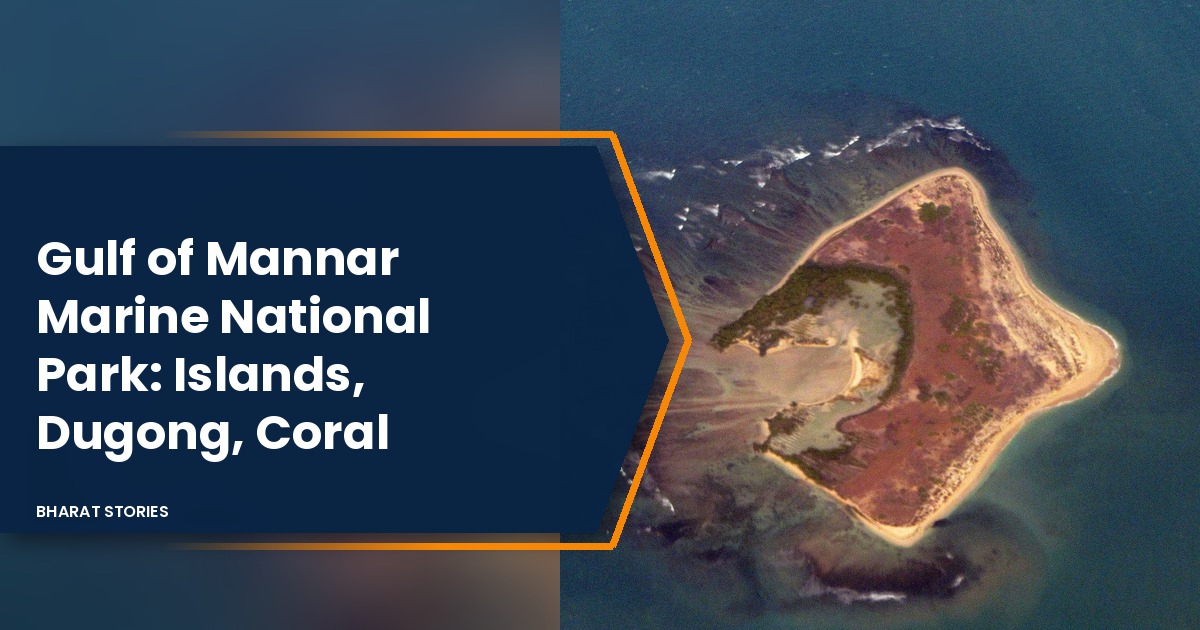
Gulf of Mannar Marine National Park: Islands, Dugong, Coral
Between the southern tip of India and the west coast of Sri Lanka lies a shallow, warm sea that marine biologists rank among the richest in Asia. The Gulf of Mannar Marine National Park protects 21 small islands and the reefs, seagrass meadows and mangroves around them, stretching along the Tamil Nadu coast from Thoothukudi to Dhanushkodi near Rameswaram. It is home to the dugong, more than a hundred kinds of coral and hundreds of fish species.
Here is what the park is, why it matters, what lives there and how ordinary visitors can see a little of it.
Table of Contents
Where is the Gulf of Mannar?
The Gulf of Mannar is a large, shallow bay of the Indian Ocean between southeastern India and western Sri Lanka, with an average depth of only about 5.8 metres. To the north, a chain of shoals and islands called Adam’s Bridge or Rama Setu separates it from Palk Bay.
Several rivers drain into the gulf, including the Thamirabarani and Vaippar on the Indian side. The Indian coast along the gulf runs through Thoothukudi and Ramanathapuram districts, with towns such as Thoothukudi, Vembar, Kilakarai, Mandapam and Rameswaram. Fishing villages have depended on these waters for pearls, chank shells and fish for centuries.
What is the Gulf of Mannar Marine National Park?
It is a marine national park made up of 21 islets and their surrounding coral reefs, lying 1 to 10 km off the Tamil Nadu coast over a stretch of about 160 km, with a total protected area of about 560 sq km.
The islands themselves are tiny. Together they cover only about 6.23 sq km, ranging from less than a hectare to around 130 hectares, according to Wikipedia’s page on the park. The real treasure is underwater: fringing reefs 150 to 300 metres from the islands and patch reefs rising from 2 to 9 metres deep.
| Fact | Details |
|---|---|
| State | Tamil Nadu |
| Declared national park | 1986 (some records cite 1980 for the first notification) |
| Biosphere reserve | 1989, park plus a 10 km buffer zone |
| Area of park | About 560 sq km |
| Islands | 21, in four groups |
| Flagship animal | Dugong (sea cow) |
What are the four island groups?
From southwest to northeast they are the Thoothukudi group, the Vembar group, the Kilakarai group and the Mandapam group.
- Thoothukudi group: Vaan, Koswari, Vilanguchalli and Kariyachalli. Vilanguchalli is now below low tide level because of past coral mining.
- Vembar group: Uppu Thanni, Puluvini Challi and Nalla Thanni.
- Kilakarai group: Anaipar, Vali Munai, Poovarasan Patti, Appa, Talairi, Valai and Mulli.
- Mandapam group: Musal, Manoli, Manoli Putti, Poomarichan, Pullivasal, Kurusadai and Shingle.
What is the Gulf of Mannar Biosphere Reserve?
The biosphere reserve is a much larger zone of about 10,500 sq km that includes the national park as its core, plus the sea and coastline around it, declared in 1989. It was among India’s first marine biosphere reserves and is also part of UNESCO’s World Network of Biosphere Reserves.
The idea behind a biosphere reserve is to protect a strict core while letting people continue to live and fish in the buffer. About 125 villages with roughly 100,000 people, many from the Marakeyar fishing community, live along this coast. UNESCO’s Man and the Biosphere page describes the reserve’s mix of coral reefs, seagrass beds, mangroves and coastal villages.
Which animals is the Gulf of Mannar famous for?
The dugong is the flagship species, and the gulf also holds about 117 species of hard coral, around 510 species of fish, sea turtles, dolphins and an unusual living fossil called Balanoglossus.
Dugongs and seagrass
The dugong, or sea cow, is a slow, gentle mammal that feeds almost entirely on seagrass. The gulf has 12 recorded species of seagrass and 147 species of seaweed, making it one of the last strongholds of the dugong in Indian waters. Numbers are small and the animal is legally protected; nets, boat strikes and loss of seagrass are the biggest risks.
Corals and reef life
Reef building corals from the Poritidae and Faviidae families dominate. Butterflyfish, parrotfish, clownfish, snappers and sergeant majors move among them. Invertebrates are just as varied: 106 species of crab, 17 of sea cucumber, hundreds of molluscs including pearl oysters and chank, sponges, starfish and sea urchins.
Turtles, dolphins and whales
Green turtles and olive ridleys feed on the seagrass and reefs. Bottlenose, spinner and common dolphins are recorded, and larger whales occasionally pass through deeper water. Kurusadai island is known for a rare acorn worm, Ptychodera flava, which biologists see as a link between invertebrates and vertebrates.
Can tourists visit the Gulf of Mannar islands?
The islands are a protected core and are generally closed to tourists; public access is limited to glass bottom boat rides run by the forest department from points along the coast.
Most visitors combine the gulf with a trip to Rameswaram. From the Pamban and Mandapam side you can see the clear, shallow water from the shore, and glass bottom boat trips, when running, give a short look at the seagrass and corals without anyone stepping on them. Services, timings and fares change with weather and season, so confirm them locally with the Gulf of Mannar wildlife division or your hotel before you plan around them.
- Do not buy coral, chank or sea shell souvenirs. Many are taken illegally from protected reefs.
- Choose boat operators approved by the forest department.
- Avoid sunscreen with harsh chemicals if you enter the water at public beaches; use shade and clothing instead.
- Never chase or feed dolphins or turtles if you see them.
Why are the reefs under threat?
Decades of coral mining, destructive fishing, pollution and warming seas have damaged parts of the reef; two islands have already sunk and others are shrinking.
Coral was once quarried for lime kilns, cement and building work. Even after mining was banned in 2005, the damage remained. Vaan island, the southernmost of the 21, shrank from about 16 hectares to under 6 hectares in less than three decades and has split in two. Two more islets near Thoothukudi, Pandayan and Punnaiyadi, were lost to port construction. Live coral cover on many reefs is modest, and bleaching during marine heatwaves adds stress.
The good news is that restoration has started. Researchers in Thoothukudi have tried artificial reefs and coral transplantation, and fishing communities are increasingly involved in protecting the islands they depend on.
When is the best time to visit?
October to March is usually best, with pleasant weather; avoid the peak of the northeast monsoon in November and December if seas are rough. Water clarity is often good between February and May, though afternoons become hot.
How do you reach the Gulf of Mannar?
Madurai airport, about 170 km from Rameswaram, is the nearest major airport; Thoothukudi also has a smaller airport, and both Rameswaram and Thoothukudi are on the rail network.
- Fly to Madurai or Thoothukudi, or take a train to Rameswaram, Ramanathapuram or Thoothukudi.
- Stay in Rameswaram or Mandapam to explore the northern part of the gulf.
- Ask the forest department office in Mandapam or Ramanathapuram about glass bottom boat rides.
- Visit Dhanushkodi at the tip of the island for views across the sea towards Adam’s Bridge.
Pair your trip with our guides to Rameswaram, India’s first marine park in the Gulf of Kutch, Guindy National Park in Chennai, and our list of national parks of India.
Frequently Asked Questions
Where are the Palk Strait and the Gulf of Mannar?
Both lie between India and Sri Lanka. Palk Bay and the Palk Strait are to the north of Adam’s Bridge; the Gulf of Mannar is to the south.
Which animal is the Gulf of Mannar Biosphere Reserve famous for?
The dugong, or sea cow. It is the reserve’s flagship species and depends on the gulf’s seagrass meadows.
How many islands are in the Gulf of Mannar Marine National Park?
There are 21 islands in four groups, though a few have been badly eroded and Vilanguchalli now lies below low tide level.
Is Gulf of Mannar the first marine national park in India?
No. The Marine National Park in the Gulf of Kutch, Gujarat, came first. Gulf of Mannar was one of the earliest marine parks and India’s first marine biosphere reserve.