

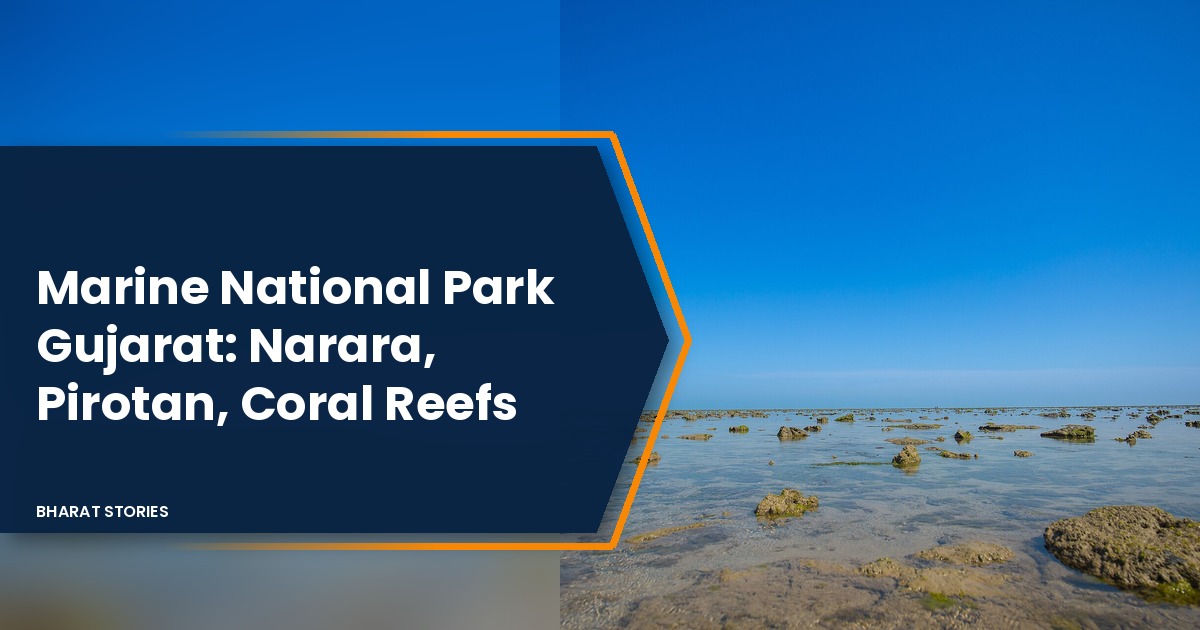
Marine National Park Gujarat: Narara, Pirotan, Coral Reefs
Most people picture coral reefs in Lakshadweep or the Andamans. Few expect them off the dry Saurashtra coast of Gujarat, yet the Marine National Park in the Gulf of Kutch protects living reefs, mangrove creeks and dozens of small islands just a short drive from Jamnagar. At low tide the sea pulls back so far that you can walk across the reef flat and look down at corals, sea anemones and octopuses in ankle deep water.
This guide covers where the park is, how it began, what lives there, how to visit Narara and Pirotan, and the rules that keep this fragile place alive.
Table of Contents
What is the Marine National Park in the Gulf of Kutch?
It is India’s first marine national park, a protected stretch of reefs, islands, mangroves and mudflats along the southern shore of the Gulf of Kutch in Jamnagar and Devbhumi Dwarka districts of Gujarat. The wider protected area is officially the Marine National Park and Marine Sanctuary.
The Gulf of Kutch is a long inlet of the Arabian Sea that separates the Kutch peninsula from Saurashtra. Its northern side is lined with ports such as Kandla and Mundra. The southern side, where the park lies, is fringed by shallow reefs and low islands built partly on old coral. According to Wikipedia’s page on the park, there are 42 islands on the Jamnagar coast within the protected area, most of them ringed by reefs.
When was the marine national park declared, and how big is it?
The marine sanctuary was declared in August 1980 and the marine national park in July 1982, under the Wild Life (Protection) Act, 1972. The first notification covered the coast from Okha to Jodiya.
Area figures vary between sources because the sanctuary and the park are counted separately and boundaries have been revised. The table below shows the commonly quoted numbers.
| Fact | Details |
|---|---|
| Marine sanctuary declared | August 1980, about 270 sq km initially |
| Marine national park declared | July 1982, core of about 110 sq km in the first notification |
| Islands in the protected area | 42 |
| Main ecosystems | Coral reefs, mangroves, mudflats, creeks and sandy beaches |
| Nearest city | Jamnagar, Gujarat |
| Best known sites | Narara reef and Pirotan island |
The Jamnagar district administration confirms the 1980 and 1982 dates and describes the habitats as mangroves, coral reefs, intertidal mudflats, creeks, estuaries, saline grassland and rocky islands.
Why is this park unusual?
Its reefs sit in a very shallow, high tide range gulf, so large areas are exposed at low tide and can be explored on foot rather than by diving.
Spring tides in the gulf can rise more than six metres, which is very high for Indian waters. When the water drains away, pools form across the reef flat and trap small animals until the sea returns. This is what makes Narara famous with school groups, naturalists and photographers. You are not snorkelling over a reef; you are walking among it, usually with a forest department guide pointing out what to look at and where not to step.
The conditions are also tough for corals. The water carries a lot of silt, summer temperatures are high and salinity changes through the year. Scientists consider these reefs some of the hardiest in India because they survive at the edge of what corals can tolerate.
Which animals live in the Marine National Park?
The park holds more than 40 species of sponges, about 40 species of hard coral and 10 of soft coral, along with crabs, prawns, octopus, sea cucumbers, sea turtles, dolphins and the rare dugong.
Life on the reef flat
- Corals and anemones: brain like boulder corals, soft corals, colourful sea anemones and the carpet anemone.
- Molluscs: pearl oysters, sea slugs, cowries and octopuses that change colour as they move.
- Echinoderms: starfish, brittle stars, sea urchins and sea cucumbers.
- Crustaceans: around 30 species of crab and 27 species of prawn, plus lobsters and shrimps.
- Fish: pufferfish, seahorses, stingrays and mudskippers on the mud banks.
Larger marine animals
Green sea turtles and olive ridleys use the area, and leatherbacks have been recorded. Dolphins, finless porpoises and the dugong, a plant eating sea mammal that grazes on seagrass, live in the gulf, though dugongs are now very rarely seen. Whale sharks are sometimes found in deeper water nearby.
Birds
The mudflats draw huge numbers of waders in winter. Look for crab plovers, western reef egrets, Eurasian oystercatchers, curlews, sandpipers, gulls, terns, pelicans and flamingos. Even if the tide is wrong for reef walking, the birdlife alone justifies a morning at the coast.
What is Narara and how do you visit it?
Narara is a reef flat about 55 km from Jamnagar where visitors walk on the exposed reef at low tide with a guide; it is the easiest way for most people to see the park.
Timing is everything. You need to arrive an hour or two before the lowest tide, so check the local tide table and the forest department’s schedule before you leave Jamnagar. Groups usually walk for one to two hours and turn back as the water starts rising. Entry tickets and guide charges are collected at the site; amounts change, so confirm them on arrival rather than relying on old figures.
- Wear old sports shoes or reef sandals that can get wet. Bare feet are risky on sharp coral and shells.
- Walk only where the guide walks. Corals break easily and take years to grow back.
- Do not lift rocks, pick up animals or collect shells. All of it is protected.
- Carry water, a hat and sunscreen. There is almost no shade on the reef.
- Leave before the tide turns. Water comes back faster than you expect.
Can you visit Pirotan island?
Yes, but only with permits from the forest department, customs and port authorities, and only by hiring a boat from Bedi port near Jamnagar. Pirotan is the best known island in the park and one of only two where visitors are normally allowed.
The island covers about 3 sq km of mangroves and sandy beach and has a lighthouse and the shrine of Khwaja Khizer. There is no regular ferry. Boats take roughly an hour and a half and can only land and leave at high tide, which means a full day trip. Foreign nationals need extra police permission. October to March is the usual visiting season.
What threatens the reefs of the Gulf of Kutch?
Coral mining in the past, industrial growth along the coast, oil terminals, siltation, warming seas and mechanised fishing all put pressure on the park.
Satellite studies found that reef cover in the gulf shrank sharply between the mid 1970s and mid 1980s, largely because of coral and sand extraction for the cement industry. Bans on coral mining helped some reefs recover. Since then, bleaching events linked to marine heatwaves have been recorded at Pirotan, and the gulf now hosts refineries, ports and power plants. Scientists have reported around 31 coral species from recent surveys, fewer than older counts, which shows how fragile the system is.
Visitors can help by keeping groups small, staying with guides, refusing to buy shells or coral souvenirs and leaving no plastic behind.
When is the best time to visit?
October to March is best: the sea is calm, the weather is cool and migratory birds are present. Within that window, plan around low spring tides, which usually fall near new moon and full moon.
| Season | What to expect |
|---|---|
| October to March | Pleasant weather, calm water, peak bird season, best for reef walks |
| April to June | Very hot by mid morning; early low tides only |
| July to September | Monsoon swell, rough sea; reef walks and boat trips usually stop |
How do you reach the Marine National Park?
Jamnagar is the gateway: it has an airport, a railway station and good road links, and Narara and Bedi port are both a short drive away.
- Fly or take a train to Jamnagar. Rajkot and Ahmedabad are other options for onward road travel.
- For Narara, hire a taxi from Jamnagar towards Khambhalia and follow signs to the reef site.
- For Pirotan, arrange permits in advance, then hire a boat from Bedi port.
- Combine the trip with Dwarka and Beyt Dwarka, which lie further west along the same coast.
Gujarat has much more wildlife to explore. Read our guide to Gir National Park, our overview of Gujarat’s history and places to visit, India’s other marine parks such as Gulf of Mannar National Park, and our list of national parks of India.
Frequently Asked Questions
Which is the first marine national park in India?
The Marine National Park in the Gulf of Kutch, Gujarat, declared in 1982 after the marine sanctuary of 1980, is generally described as India’s first marine national park.
Is the Marine National Park in Jamnagar or Dwarka?
Both. The protected coast runs from near Jodiya past Jamnagar to Okha, so it falls in Jamnagar and Devbhumi Dwarka districts. Most visitors start from Jamnagar.
Can you swim or snorkel at Narara?
No. Narara is a reef walk at low tide, not a swimming beach. Swimming, snorkelling and collecting are not permitted on the reef.
Can you see dugongs here?
Dugongs are recorded in the Gulf of Kutch but are very rare. Visitors should not expect to see one; corals, crabs, octopus and birds are the usual highlights.