

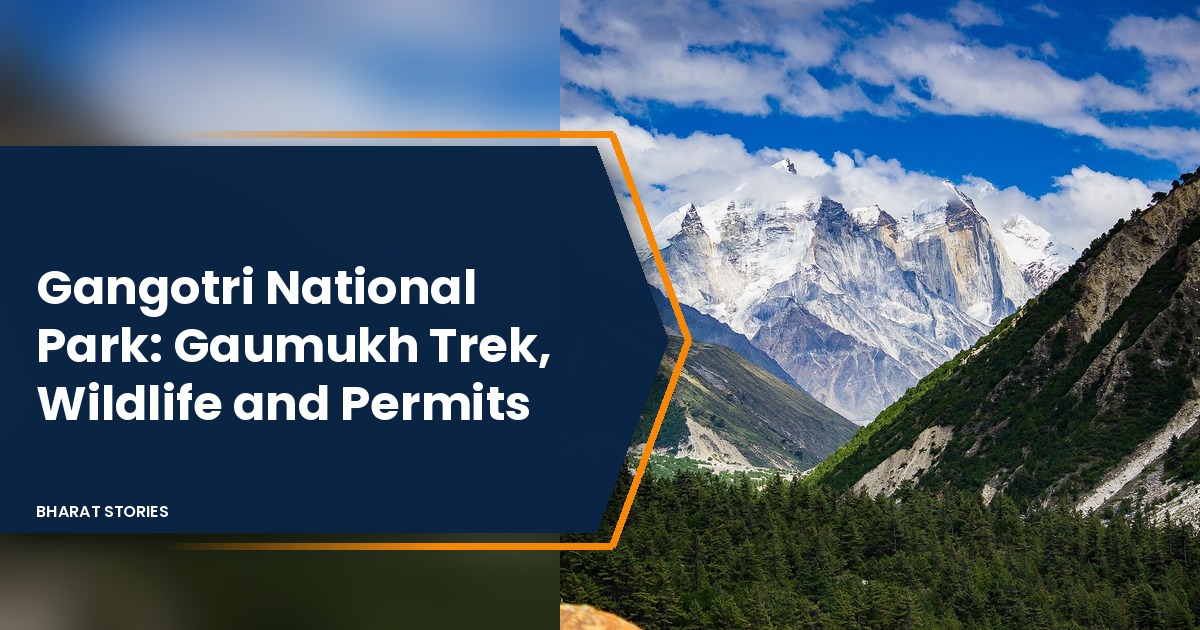
Gangotri National Park: Gaumukh Trek, Wildlife and Permits
Gangotri National Park protects the high Himalayan valleys where the Bhagirathi, the main source stream of the Ganga, begins at the Gaumukh snout of the Gangotri Glacier. It is a landscape of glaciers, alpine meadows, birch forests and snow peaks, home to the snow leopard and the blue sheep, and visited by trekkers and pilgrims from spring to autumn.
Table of Contents
Where is Gangotri National Park?
Gangotri National Park is in Uttarkashi district of Uttarakhand, covering the upper catchment of the Bhagirathi River up to the international border with Tibet. The pilgrim town of Gangotri, with its famous temple, sits at the park’s edge and serves as the starting point for most treks.
To the west the park adjoins Govind National Park, together forming one of the largest continuous protected landscapes in the western Himalaya. The Gangotri temple is one of the four shrines of the Char Dham Yatra, along with Yamunotri, Kedarnath and Badrinath.
How big is Gangotri National Park and when was it established?
The park was established in 1989 and covers about 2,390 sq km, making it one of the largest national parks in India. Some older descriptions give a smaller figure of around 1,533 sq km, but 2,390 sq km is the area used in current official and park records.
| Fact | Detail |
|---|---|
| State and district | Uttarakhand, Uttarkashi district |
| Established | 1989 |
| Area | About 2,390 sq km |
| Key features | Gangotri Glacier, Gaumukh, Tapovan, Nelong Valley, Gartang Gali |
| Signature wildlife | Snow leopard, bharal, Himalayan tahr, musk deer, Himalayan monal |
| Usual season | 1 April to 30 November, subject to weather |
What is the Gangotri Glacier and Gaumukh?
The Gangotri Glacier is one of the largest glaciers in the Indian Himalaya, roughly 30 km long, and Gaumukh is its snout, where the Bhagirathi emerges. The name Gaumukh means “cow’s mouth”, from the shape the ice face was once said to resemble.
Gaumukh is about 18 km from Gangotri town by trail. Beyond it lies Tapovan, a high meadow at the foot of Shivling peak, and further routes lead to Nandanvan and Vasuki Tal. Like most Himalayan glaciers, the Gangotri Glacier has been retreating, and its snout has changed shape over the decades.
In 2012 the stretch of the Bhagirathi valley from Gaumukh down to Uttarkashi was notified as an eco sensitive zone, restricting large construction and some projects in this fragile river corridor.
What wildlife lives in Gangotri National Park?
The park supports high altitude Himalayan wildlife, led by the snow leopard and its main prey, the bharal or blue sheep. Other mammals include the Himalayan tahr, Himalayan musk deer, Asiatic black bear, brown bear and the red fox.
Uttarakhand’s snow leopard population was estimated at 124 in India’s first Snow Leopard Population Assessment, which counted 718 across the country, as explained by the Indian Express. Gangotri and the Nelong Valley are among the state’s key snow leopard areas.
Birds include the Himalayan monal, Uttarakhand’s state bird, along with the Himalayan snowcock, snow partridge, lammergeier and golden eagle. Older descriptions that list tigers here are not accurate for these altitudes.
What plants grow in the park?
Lower valleys have forests of deodar, blue pine and oak, rising to Himalayan birch (bhojpatra), rhododendron and juniper near the treeline. Above that, alpine meadows called bugyals bloom with wildflowers in summer before giving way to rock and ice.
What are the best treks in Gangotri National Park?
The most popular trek is Gangotri to Gaumukh and Tapovan, followed by Kedartal and, for experienced mountaineers, Kalindi Khal.
- Gangotri to Gaumukh: about 18 km each way via Chirbasa and Bhojbasa, with camping or basic stays at Bhojbasa.
- Gaumukh to Tapovan: a steep climb over moraine to the meadow below Shivling, for fit trekkers with a guide.
- Kedartal: a demanding route from Gangotri to a glacial lake below Thalay Sagar peak.
- Kalindi Khal: a high pass crossing towards Badrinath, suitable only for experienced, well equipped teams.
Do you need a permit to enter Gangotri National Park?
Yes. Entry and trekking inside the park need a permit from the Gangotri National Park administration, with fees for Indian and foreign visitors. The forest department limits the number of daily permits on the Gaumukh route to reduce pressure on the fragile trail. Treks are usually arranged through registered operators with local guides.
Is the Gaumukh Tapovan trek open now?
No. As of November 2026 the Gaumukh Tapovan trail is closed for the season. The Times of India reported on 3 November 2026 that authorities stopped issuing permits for routes above 4,000 metres in Uttarkashi, including Gaumukh and Tapovan, after heavy snowfall on 29 October. Park officials said the Nelong Valley and Gartang Gali remained open.
The park normally opens on 1 April and closes for winter on 30 November. A Dainik Bhaskar report of 10 November 2026 says winter tourism from Bhaironghati to Nelong and Naga will be allowed from 30 November under set conditions, while the Jadung valley stays closed this winter. Always check the latest status before travelling.
What are Nelong Valley and Gartang Gali?
Nelong Valley is a high, dry valley near the Tibet border that resembles Ladakh, and Gartang Gali is a historic wooden walkway built along a sheer cliff above the Jadh Ganga gorge. Both lie inside the park and are reached from Bhaironghati near Gangotri.
Nelong was closed to civilians for decades after the 1962 war and was reopened to tourists in 2015 with permits. Gartang Gali, once part of a trade route between India and Tibet, was restored and reopened to visitors in 2021. Visitors need permits, and foreign nationals face additional restrictions in this border area.
How can you trek responsibly in Gangotri?
Travel light on the land: carry out all waste, stay on marked trails and respect the rules set by the park. The upper Bhagirathi valley receives large numbers of visitors in a short season, and litter or careless camping lasts a long time at this altitude.
- Carry reusable bottles and bring every wrapper and battery back down.
- Use designated campsites and toilets at Bhojbasa and other stops.
- Do not disturb wildlife, pick plants or collect stones from the glacier area.
- Keep a safe distance from the Gaumukh ice face, where blocks of ice and rock can fall without warning.
- Check weather forecasts and turn back if snow, rain or rockfall makes the trail unsafe.
When is the best time to visit?
May to June and September to October offer the most reliable trekking weather. July and August bring monsoon rain, landslides and road closures on the route to Gangotri. From November, snow closes the higher trails, and the Gangotri temple shuts for winter around Diwali, when the deity is taken to Mukhba village.
How do you reach Gangotri National Park?
- By air: Jolly Grant Airport near Dehradun is the nearest major airport.
- By rail: Rishikesh and Dehradun are the closest railheads.
- By road: drive or take a bus to Uttarkashi, then continue to Gangotri, about 100 km further up the valley.
Spend at least a night in Uttarkashi or Harsil to acclimatise before going higher. Altitude sickness is a real risk on the Gaumukh trail, so ascend slowly, drink enough water and turn back if symptoms worsen.
Frequently Asked Questions
Which is the most famous national park in Uttarakhand?
Jim Corbett National Park is the most visited, but Gangotri is one of the largest and the most important for high Himalayan wildlife.
Can you see a snow leopard in Gangotri?
Snow leopards live in the park, but they are shy and rarely seen. Camera traps record them far more often than visitors do.
Is Gangotri beautiful to visit?
Yes. Deodar forests, the Bhagirathi gorge, glacier views and peaks like Shivling make it one of the most scenic parts of the Indian Himalaya.
Visit with care
Gangotri National Park is sacred to millions and fragile at every step. Follow permit rules, carry your waste back and respect closures. For more protected areas across the country, see our list of national parks of India.