

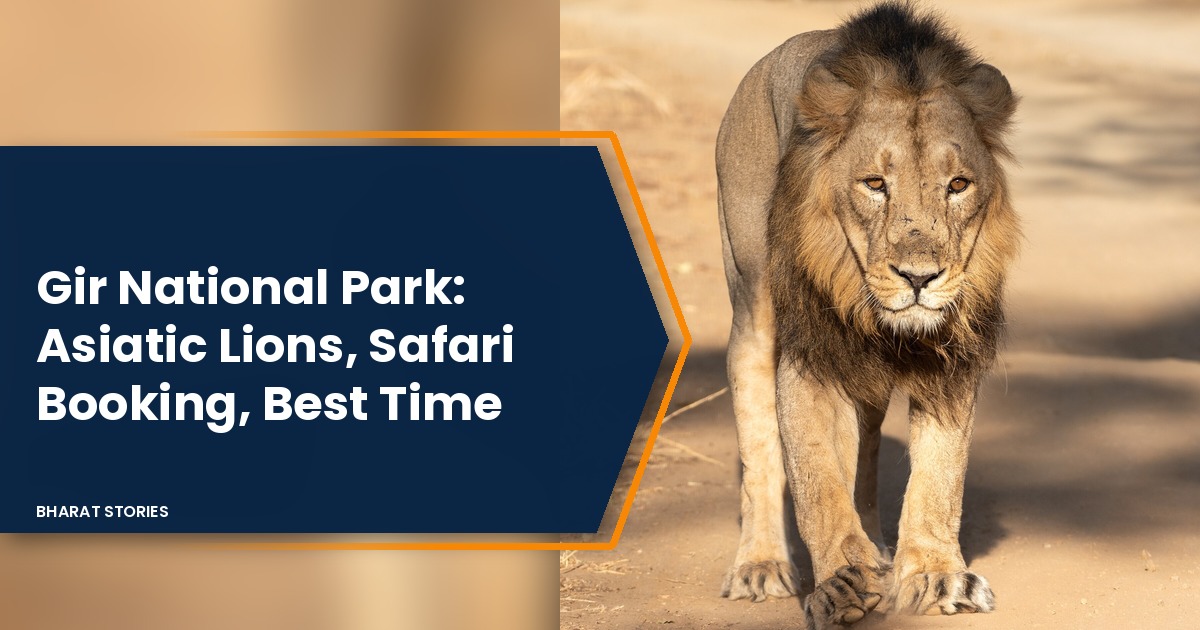
Gir National Park: Asiatic Lions, Safari Booking, Best Time
Gir National Park in Gujarat is the only place in the world where the Asiatic lion still lives in the wild. Spread across the dry teak forests and rocky hills of the Saurashtra peninsula, Gir and the lions around it are one of India’s most successful conservation stories, and a jungle safari here is the one realistic way to see a wild lion outside Africa.
This guide explains where the park is, how many lions live in and around it, what other wildlife you can see, how safari permits work and when to go.
Table of Contents
Where is Gir National Park located?
Gir National Park is in the Saurashtra region of Gujarat, roughly halfway between Junagadh and Veraval, with Sasan Gir village serving as the main gateway. The protected forest spreads mainly across Gir Somnath and Junagadh districts and parts of Amreli.
Most visitors base themselves at Sasan Gir, where the forest department’s reception centre at Sinh Sadan handles safari entry. Junagadh is the nearest large town, and Rajkot, Diu and Ahmedabad have the closest airports. You can read more about the state’s history and other attractions in our guide to Gujarat.
How big is Gir and when was it protected?
Gir was notified as a wildlife sanctuary on 18 September 1965, and the protected area today covers about 1,412 sq km, of which about 258.7 sq km is the core national park. The remaining area of roughly 1,153 sq km is wildlife sanctuary, according to the Gujarat Forest Department’s Gir booklet.
| Fact | Detail |
|---|---|
| State | Gujarat (Saurashtra region) |
| Sanctuary notified | 18 September 1965 |
| Total protected area | About 1,412 sq km |
| National park core | About 258.7 sq km |
| Main gateway | Sasan Gir |
| Signature species | Asiatic lion |
| Jungle safari season | 16 October to 15 June |
The forest was once the private hunting ground of the Nawabs of Junagadh. By the early twentieth century only a small number of lions survived, and protection by the Nawab, followed by the Gujarat government and the forest department, helped the population recover. Gir sits in the national list of protected areas covered in our list of national parks of India.
How many lions are there in Gir?
The 16th Asiatic Lion Population Estimation in May 2025 counted 891 lions in Gujarat, up from 674 in 2020, a rise of about 32 percent. The count included 196 adult males, 330 adult females, 140 sub adults and 225 cubs.
The exercise was carried out between 10 and 13 May 2025 using the Direct Beat Verification method, and it covered about 35,000 sq km across 11 districts of Saurashtra, as the official 2025 estimation report explains. Coverage by The Indian Express notes that about 56 percent of the lions were found in forest areas and the rest in wasteland, farmland, riverine belts and near villages.
So the answer to a common question, “how many lions are left in Gir”, is that the Gir forest remains the source population, while many lions now live in satellite areas outside the park. The 2025 report also recorded a newly established population in Barda Wildlife Sanctuary near Porbandar, often described as a second home for the species within Gujarat.
How is the Asiatic lion different from the African lion?
The Asiatic lion is slightly smaller than its African cousin, males usually have a shorter, sparser mane that leaves the ears visible, and both sexes often show a fold of skin along the belly. Prides in Gir also tend to be small, and adult males often live apart from females except when mating.
Can you spot lions on a Gir safari?
Yes, lion sightings are common on Gir jungle safaris, especially in the drier months from March to May, though no sighting is ever guaranteed. Lions rest in the shade for much of the day, so early morning and late afternoon drives give the best chances.
Sighting luck depends on the route you are allotted, the season and the animals themselves. Experienced guides read alarm calls from deer and langurs, and they look for fresh pugmarks on the forest tracks. Patience matters more than speed, and staying quiet in the vehicle improves your odds.
What other wildlife lives in Gir?
The forest department records about 39 species of mammals, around 300 species of birds, 37 species of reptiles and more than 2,000 species of insects in the Gir protected area. After the lion, the leopard is the most important large predator.
- Mammals: leopard, striped hyena, jungle cat, golden jackal, chital (spotted deer), sambar, nilgai, chinkara, four horned antelope and wild boar.
- Reptiles: the marsh crocodile (mugger) is found in Kamleshwar dam and the rivers, along with monitor lizards and many snakes.
- Birds: six species of vultures, the crested serpent eagle, Indian peafowl, the Indian pitta in season, and many owls and woodpeckers.
Seven rivers, including the Hiran, Shingoda, Saraswati, Datardi, Macchundri, Ghodavadi and Raval, rise in or flow through Gir, and the reservoirs built on them provide water through the dry season. The forest is also home to the Maldharis, traditional pastoral communities who have lived alongside lions for generations.
How do you book a Gir jungle safari?
Safari permits for Gir are sold only on the Gujarat Forest Department’s official booking site, which lists itself as the only official booking website for Gir permits. Book early for weekends, holidays and the Diwali and Christmas periods, when slots sell out.
- Visit the official Gir permit booking website and register with your mobile number and email.
- Choose the experience: Gir Jungle Safari inside the sanctuary, or the Devalia Safari Park (Gir Interpretation Zone).
- Select the date and time slot, enter the ID details of every visitor and pay online.
- Carry the same original photo ID to the Sinh Sadan reception centre at Sasan, where the vehicle and guide are assigned.
Fees differ for Indian and foreign visitors, for weekdays and weekends, and for the vehicle type, and they are revised from time to time, so check the current charges on the booking site rather than relying on third party lists. Be careful of unofficial websites that charge extra or promise guaranteed sightings.
What is Devalia Safari Park?
Devalia Safari Park, about 13 km from Sasan, is a fenced area within Gir where lions, leopards and herbivores live in a large natural enclosure. It runs both bus and gypsy safaris, gives better sighting chances in a short time, and is open in the monsoon when the main sanctuary closes. The forest department notes that Devalia remains closed every Wednesday.
Which month is best to visit Gir?
The best months for most visitors are December to April, when the weather is pleasant to warm and the thinning forest makes wildlife easier to see. The jungle safari season runs from 16 October to 15 June, and the main sanctuary is closed for safaris from 16 June to 15 October during the monsoon breeding season.
| Period | What to expect |
|---|---|
| Mid October to November | Green forest after the rains, fewer sightings, pleasant weather |
| December to February | Cool mornings, comfortable days, popular and busy |
| March to mid June | Hot, dry forest, animals gather near water, good sighting chances |
| Mid June to mid October | Jungle safari closed; Devalia Safari Park usually open |
How do you reach Gir National Park?
Sasan Gir is about 60 km from Junagadh and is easiest to reach by road, with Rajkot airport about 160 km away. Diu and Porbandar also have airports, and Ahmedabad is the main international gateway.
- By rail: Sasan Gir has a small railway station on a slow metre gauge line; Junagadh and Veraval are the better connected railheads.
- By road: state buses and taxis run from Junagadh, Veraval, Somnath and Rajkot. A trip to Gir pairs well with the Somnath temple, about 45 km away, and the coastal town of Diu.
- Stay: Sasan has forest department accommodation at Sinh Sadan as well as private resorts and homestays along the Talala road.
If you enjoy Gujarat’s wild places, the state also protects coral reefs and mangroves in the Gulf of Kachchh Marine National Park.
What rules should visitors follow in Gir?
Visitors must stay inside their allotted vehicle, follow the guide’s instructions and keep to the assigned route at all times. Getting off the vehicle, feeding animals, playing music and littering are not allowed.
- Do not try to bait or attract lions; illegal “lion shows” outside the park are punishable and harm the animals.
- Wear muted clothing, carry water and avoid perfumes and loud colours.
- Keep the photo ID used for booking with you, as checks are made at entry.
- Drones are not permitted without official permission.
What challenges do Gir’s lions face?
The biggest long term risk is that almost all wild Asiatic lions live in a single landscape, so a disease outbreak or natural disaster could hit the whole population. Lions dying after falling into open farm wells, accidents on railway lines and roads, and conflict with livestock owners are other recurring problems.
Gujarat has responded by covering open wells, building ramps and barriers, running veterinary care and rescue teams, and monitoring lions that disperse into new areas such as Barda. The question of relocating some lions to another state has been debated for years, and India’s cheetah reintroduction at Kuno in Madhya Pradesh has kept that debate in the news.
Frequently Asked Questions
What is Gir National Park famous for?
Gir is famous as the last natural home of the Asiatic lion. It is also known for leopards, large herds of chital and its dry teak forest landscape.
Which day is Gir safari closed?
Devalia Safari Park is closed every Wednesday. The Gir Jungle Safari inside the sanctuary follows the official booking calendar, so check available dates on the forest department’s site before you travel.
Can you visit Gir during the monsoon?
The main jungle safari is closed from 16 June to 15 October. Devalia Safari Park usually remains open during this period.
Is Gir National Park the same as Sasan Gir?
Yes. Sasan Gir is the village and headquarters at the edge of the forest, and the name is often used for the whole national park and sanctuary.