

Harike Wetland: Punjab Ramsar Site, Birds and Best Time
Every winter, tens of thousands of ducks, geese, gulls and waders fly over the Himalayas and settle on a broad sheet of water where two of Punjab’s great rivers meet. This is Harike Wetland, also called Harike Lake or Hari ke Pattan, the largest wetland in northern India and one of the country’s oldest Ramsar sites. It is not a national park in the legal sense, but a bird sanctuary and protected wetland, and for birdwatchers in north India it is one of the best days out of the year.
Below you will find how the wetland formed, what birds and animals live there, the best season, practical visiting tips and how to get there from Amritsar or Ferozepur.
Table of Contents
Where is Harike Wetland?
Harike Wetland lies on the border of Tarn Taran and Ferozepur districts in Punjab, just below the point where the Beas river joins the Sutlej, and it also spreads into Kapurthala district. The nearest town is Makhu, and Harike village sits beside the barrage.
The wetland is roughly 60 km south of Amritsar. National highways connect it to Tarn Taran, Ferozepur, Kapurthala and Moga, so it is easy to reach by road. The lake is triangular, bounded on one side by the Dhussi bund, on another by a canal and on the third by a main road.
How was Harike Lake formed?
The wetland is man made: it formed after the Harike headworks, a barrage built across the river in 1953, held back water at the Beas and Sutlej confluence.
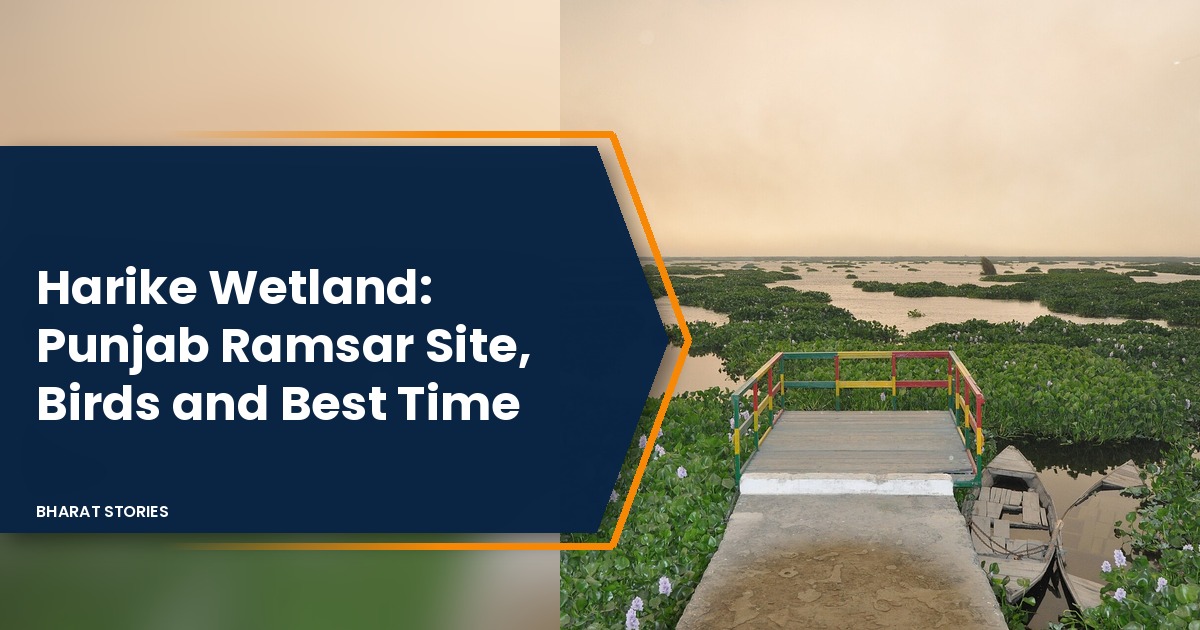
The barrage was built to feed irrigation and drinking water canals, including the Ferozepur feeder, the Indira Gandhi Canal that carries water to Rajasthan, and the Makhu canal. Silt, shallow water and floating plants slowly turned the reservoir into a rich marsh. Today the open lake in the deepest part is surrounded by reed beds, lotus, water hyacinth and grassy islands that birds use for feeding and roosting.
| Fact | Details |
|---|---|
| Rivers | Beas and Sutlej confluence |
| Barrage built | 1953 |
| Wetland area | About 4,100 hectares (41 sq km) |
| Bird sanctuary | Declared 1982, about 8,600 hectares |
| Ramsar site | Since 1990 |
| Districts | Tarn Taran, Ferozepur, Kapurthala |
Is Harike a Ramsar site?
Yes. Harike was recognised as a wetland of international importance under the Ramsar Convention in 1990, among India’s earliest Ramsar sites.
The recognition reflects its huge concentration of migratory waterfowl and several globally threatened species, a gathering often described as second only to Keoladeo in Bharatpur in north India. The wetland was declared the Harike Pattan Bird Sanctuary in 1982, and the Bombay Natural History Society ran research and bird ringing here between 1980 and 1985, according to Wikipedia’s Harike Wetland page. India’s national wetland portal, Indian Wetlands, lists Harike among the country’s Ramsar sites.
Which birds can you see at Harike Wetland?
Around 200 bird species visit in winter, including large flocks of ducks and geese, gulls, terns, grebes and waders, plus rare species such as the Indian skimmer and the Sind Jerdon’s babbler.
Winter migrants
- Ducks and geese: greylag and bar headed geese, tufted duck, northern pintail, common teal, gadwall and the small cotton pygmy goose.
- Gulls and terns: Pallas’s gull, brown headed and black headed gulls, white winged tern and river tern.
- Grebes: great crested, black necked and little grebes on the open water.
- Raptors: marsh harrier, hen harrier and Eurasian hobby hunting over the reeds.
Resident and special birds
The reed beds hold birds that serious birders travel specially to see: the Sind Jerdon’s babbler, rufous vented grass babbler, striated grassbird and white crowned penduline tit. Purple swamphens, pheasant tailed jacanas, cormorants, darters and several kingfishers are present for much of the year.
Why do so many birds come to Harike every winter?
Harike offers what migrating waterbirds need most after crossing the mountains: shallow, food rich water, safe roosting islands and dense reed cover, all at a point where two large rivers meet.
Many of the ducks and geese breed in Central Asia, Siberia and Tibet, where lakes freeze in winter. The Indus plains are one of the first large warm wetlands they reach on the way south. Harike’s mix of open water for diving ducks, muddy edges for waders and tall reeds for skulking songbirds lets very different species share the same site. The fish, snails, insects and aquatic plants that thrive in the warm shallows keep them fed until spring.
The same features make Harike important for research. Ringing studies here have helped show which flyways birds use across north India, and counts at Harike are a regular part of the Asian Waterbird Census every January.
What other wildlife lives at Harike?
Apart from birds, the wetland supports turtles, smooth coated otters, 26 recorded fish species and, in the Beas upstream, the endangered Indus river dolphin.
The Indus dolphin was thought to have vanished from India after the 1930s. In December 2007 a forest officer sighted one in the Beas near Harike, and a WWF India team later counted a small group along a 25 km stretch upstream. That discovery helped bring attention to the Beas as a river worth protecting. Fish such as rohu, catla and snakeheads support both the birds and local fishing families.
What problems does the wetland face?
Polluted water from towns and industries, the spread of water hyacinth, silt, and encroachment by farming have shrunk and degraded parts of Harike.
A remote sensing study found that the open wetland area fell by about 30 percent over 13 years. Untreated sewage and industrial effluents flowing down the Sutlej feed weed growth, and water hyacinth covers large parts of the lake. Desilting, weed removal and pollution control along the rivers are ongoing, but progress depends on cleaning water long before it reaches the barrage.
When is the best time to visit Harike Wetland?
November to March is best, with peak bird numbers from December to February. Early mornings are coldest and foggy but often give the best light and activity.
| Months | What to expect |
|---|---|
| November to February | Peak migratory birds, cold mornings, occasional fog |
| March | Birds start leaving; pleasant weather |
| April to June | Very hot; resident birds only |
| July to October | Monsoon and high water; fewer birds |
How do you plan a visit to Harike?
Go early, take binoculars, start at the barrage and the watchtowers near the sanctuary office, and consider a boat ride through the forest department if available. Entry rules and charges are set by the Punjab Department of Forests and Wildlife Preservation and can change, so check locally.
- Carry warm layers in December and January; mornings can be close to freezing with fog.
- A long lens or spotting scope helps, since many ducks keep to the middle of the lake.
- Keep noise low near the water and do not fly drones; they disturb roosting flocks.
- Food stalls are limited near the wetland, so pack water and snacks.
- Hire a local guide or join a birding group if you are new; they know where the rarer species feed.
How do you reach Harike Wetland?
Amritsar has the nearest major airport and railway station, about 60 km away; Ferozepur and Tarn Taran are closer rail and bus options.
- Fly or take a train to Amritsar.
- Drive south through Tarn Taran towards Harike, about one and a half hours.
- From Ferozepur, the drive north to Harike takes around an hour.
- Combine the trip with Tarn Taran Sahib gurdwara on the way.
Plan more birding and Punjab trips with our guides to Keoladeo National Park and Sultanpur Bird Sanctuary, the pilgrim town of Tarn Taran Sahib, and our overview of Punjab’s history and tourism.
Frequently Asked Questions
Which river flows in Hari ke Pattan?
Harike sits at the confluence of the Beas and the Sutlej. Below the barrage the combined river continues as the Sutlej.
Is Harike the largest lake in Punjab?
Harike is usually described as the largest wetland in northern India and is the biggest in Punjab. It is a reservoir wetland created by a barrage rather than a natural lake.
Is Harike a national park?
No. It is a protected wetland, a bird sanctuary declared in 1982 and a Ramsar site since 1990. The name Harike National Park is used informally.
How many Ramsar sites does Punjab have?
Punjab has several Ramsar sites, including Harike, Kanjli and Ropar, with more added in recent years. Check the national Ramsar list for the current count.