

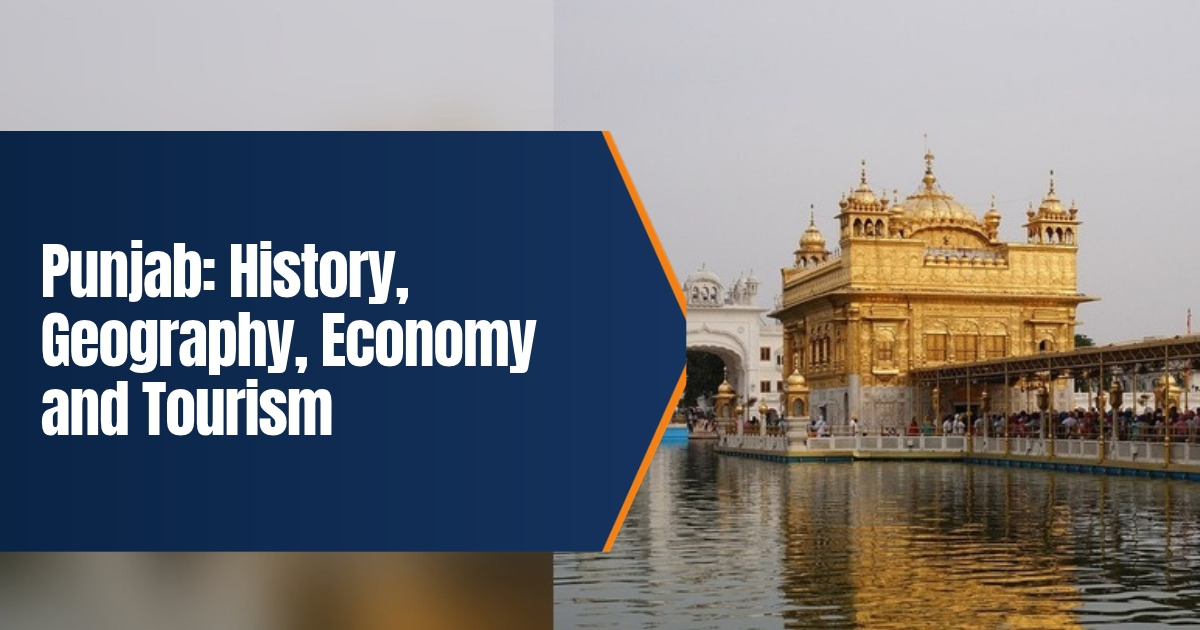
Punjab: History, Geography, Economy and Tourism
Punjab is a state in the northwest of India, on the border with Pakistan. It is known as the homeland of the Sikh faith, as the granary of India, and for its music, food and big hearted hospitality. The name comes from Persian words meaning five waters, a reference to the rivers that cross the wider Punjab region. On 1 November 2026 the present state marked sixty years since it took its current shape.
This guide covers Punjab’s history, geography, people, economy and places to visit, with facts updated to November 2026.
Table of Contents
Punjab at a Glance
| Item | Detail |
|---|---|
| Formed in present shape | 1 November 1966 |
| Capital | Chandigarh, shared with Haryana |
| Largest city | Ludhiana |
| Area | About 50,362 square kilometres |
| Population | 27,743,338 (Census 2011) |
| Districts | Twenty three |
| Official language | Punjabi, written in Gurmukhi |
| Chief Minister | Bhagwant Mann, since March 2022 |
| Governor | Gulab Chand Kataria, since July 2024 |
History of Punjab
Ancient times
The wider Punjab region was part of the Indus Valley civilisation more than four thousand years ago. In present day Indian Punjab, the site at Rupnagar on the Sutlej shows Harappan settlement, and Sanghol near Ludhiana has remains from later Buddhist and Kushan times. Vedic texts describe the land of rivers, and armies from Alexander’s Macedonians to later Central Asian rulers passed through this route into India.
The Sikh Gurus
Guru Nanak, the founder of Sikhism, was born in 1469 at Talwandi, now Nankana Sahib in Pakistan. He taught devotion to one God, honest work and sharing with others, and rejected caste divisions. Nine Gurus followed him. Guru Arjan compiled the Adi Granth and completed the Harmandir Sahib in Amritsar, and Guru Gobind Singh created the Khalsa at Anandpur Sahib in 1699. After him the scripture, the Guru Granth Sahib, became the eternal Guru.
The Sikh Empire and British rule
In 1799 Ranjit Singh took Lahore and built a strong kingdom that stretched from the Khyber Pass to Kashmir. Our article on the Sikh Empire tells that story in full. After his death in 1839 the kingdom weakened, and after two wars with the British East India Company, Punjab was annexed in 1849.
Under British rule, Punjab became a major source of soldiers and, after canal colonies were built, of grain. It was also a centre of the freedom movement. On 13 April 1919 British troops fired on a peaceful crowd at Jallianwala Bagh in Amritsar, killing hundreds, one of the darkest days of colonial rule.
Partition and statehood
In 1947 Punjab was divided between India and Pakistan, with Lahore going west. Millions of people crossed the new border in both directions, and hundreds of thousands died in the violence. Indian Punjab rebuilt with a new capital, Chandigarh, planned by Le Corbusier. On 1 November 1966 the Punjab Reorganisation Act split the state on language lines, creating Haryana and passing hill areas to Himachal Pradesh. The 1980s brought years of militancy and conflict, which ended in the early 1990s.
Geography
Of the five historic rivers, the Jhelum and Chenab now flow in Pakistan. Indian Punjab is crossed by the Ravi, the Beas and the Sutlej, and the Beas joins the Sutlej at Harike, home to a large wetland bird sanctuary. The state is mostly a flat, fertile plain made of river silt, with the Shivalik foothills in the northeast.
Punjab is often described in four regions: Majha, between the Ravi and the Beas, around Amritsar; Doaba, between the Beas and the Sutlej, around Jalandhar; Malwa, south of the Sutlej and the largest region; and Puadh near Chandigarh. Summers are very hot, winters are cold and foggy, and the monsoon brings most of the rain between July and September.
The 2025 floods
In August and September 2025, heavy rain in the hills and swollen rivers caused the worst floods in Punjab in decades. All 23 districts were declared flood affected. Around 1,400 villages were hit, more than three and a half lakh people were affected and dozens of people died, according to state bulletins at the time. Large areas of paddy were damaged, and the floods prompted debate on embankments, dam releases and river management that continues in 2026.
People and Culture
Punjab is the only Indian state with a Sikh majority, about 57.7 percent of people at the 2011 census, with Hindus at about 38.5 percent and small Muslim and Christian communities. Punjabi in the Gurmukhi script is the official language.
Culture here is loud and joyful. Bhangra, once a harvest dance, is now heard at weddings around the world, as our piece on Bhangra dance explains. Giddha is the women’s folk dance. Lohri in January and Baisakhi in April are the great seasonal festivals, and Hola Mohalla at Anandpur Sahib shows martial skills of the Khalsa. The langar, a free community kitchen at every gurdwara, feeds anyone who comes, whatever their faith.
Punjabi food is famous across India: makki di roti with sarson da saag, chole bhature, Amritsari kulcha, lassi and rich dal makhani. Many Punjabi families also have relatives in Canada, the United Kingdom, Australia and the United States, and the diaspora sends money home and shapes music and politics.
Economy
Farming built modern Punjab. During the Green Revolution of the 1960s and 1970s, high yield wheat and rice, canal and tube well irrigation and research from Punjab Agricultural University in Ludhiana turned the state into a grain surplus region. Punjab still supplies a large share of the wheat and rice bought for India’s central food stocks, though it covers only about one and a half percent of the country’s area.
That success has costs. Groundwater is falling in many blocks, and burning paddy stubble after harvest adds to air pollution across north India each October and November. The state and central governments promote crop diversification and machines that handle stubble without burning.
Industry is concentrated in Ludhiana, known for hosiery, bicycles and machine parts, Jalandhar for sports goods and Mandi Gobindgarh for steel. Mohali near Chandigarh has a growing technology sector. The state’s gross domestic product was estimated at about Rs 7.39 lakh crore for 2024 to 2025. Public debt is high, and managing it remains a central issue in state politics.
Government
Punjab has a 117 seat assembly and sends 13 members to the Lok Sabha. The Aam Aadmi Party won the 2022 election, and Bhagwant Mann became Chief Minister in March 2022. The next assembly election is due in early 2027.
Tourism in Punjab
- Golden Temple, Amritsar. The Harmandir Sahib draws more than a lakh visitors on many days and serves langar around the clock. See our guide about the Golden Temple.
- Jallianwala Bagh. The memorial garden in Amritsar keeps the bullet marks of 1919.
- Attari Wagah border. The evening flag ceremony between Indian and Pakistani guards is a popular sight, though access depends on security conditions.
- Anandpur Sahib. Birthplace of the Khalsa, with the Khalsa Heritage Complex museum.
- Patiala. Qila Mubarak and the old royal palaces.
- Harike Wetland. Winter home to thousands of migratory birds.
Getting there and around
Punjab is one of the easiest states to reach in north India. Amritsar and Mohali have international airports, and Ludhiana, Bathinda and Adampur near Jalandhar have smaller domestic ones. Fast trains such as the Shatabdi and Vande Bharat services link Delhi with Chandigarh, Ludhiana and Amritsar in a few hours. The Grand Trunk Road, now part of national highways, runs from Delhi through Ambala, Ludhiana and Jalandhar to Amritsar and the border, and roadside dhabas along it are an attraction of their own. Within cities, autorickshaws and app taxis are common, while state and private buses connect towns and villages. Roads are generally good, though fog in winter calls for slow and careful driving, especially at night and in the early morning.
October to March is the best time to visit, with Lohri and Baisakhi worth planning around.
Amritsar has an international airport with flights to the Gulf and to several Indian cities.
Winter fog can delay trains and flights in December and January, so leave spare time in travel plans.
Visitors to gurdwaras should cover their heads and remove shoes; scarves are usually available at the entrance.
Punjab Day on 1 November marks the formation of the state in 1966.
Phulkari, the bright hand embroidery of Punjab, makes a popular gift and has a GI tag.
Frequently Asked Questions
What is the capital of Punjab?
Chandigarh, which is also the capital of Haryana and a union territory in its own right.
Which rivers flow through Indian Punjab?
The Ravi, the Beas and the Sutlej. The Jhelum and Chenab are in Pakistan.
When was Punjab formed?
The present state was formed on 1 November 1966.
Who is the Chief Minister of Punjab?
Bhagwant Mann of the Aam Aadmi Party, in office since March 2022.